
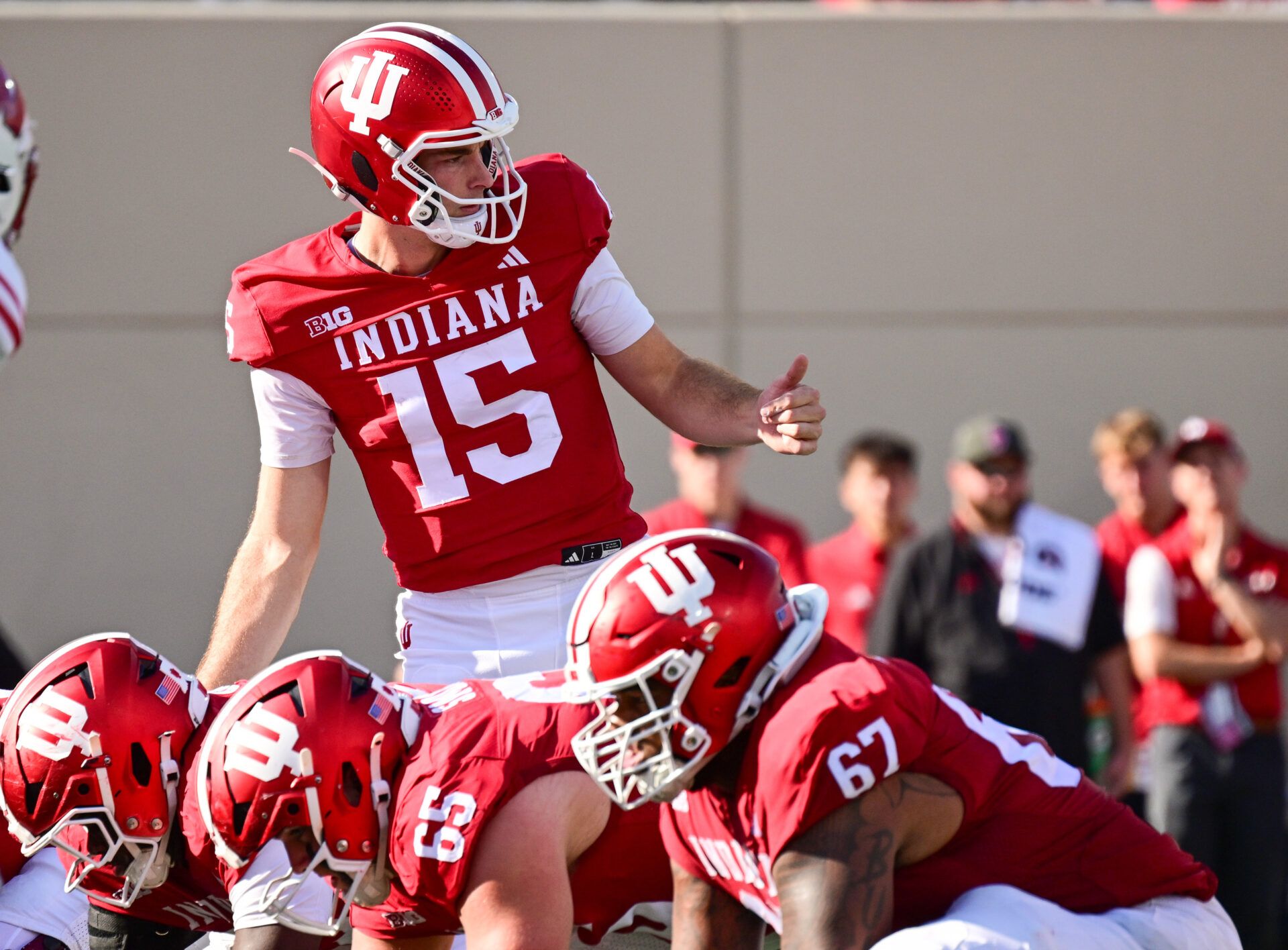
The New York Jets enter the 2026 NFL Draft with something they haven’t had in a long time: hope, direction, and a full arsenal of picks. After an eventful first season under new head coach Aaron Glenn and general manager Darren Mougey, a season defined by tough decisions, major trades, and a full commitment to rebuilding, the Jets hold a few key selections and the draft capital to reshape their roster on both sides of the ball.
Glenn and Mougey inherited a franchise in transition. Star players were moved, young players were elevated, and the organization finally aligned on a long-term plan. This draft represents the first true fingerprint of the new regime, and how they spend this capital will define where the team is headed.
Let’s dive into our mock draft and what it could mean for the future of the Jets.
To create your own mock draft, go to PFSN’s Mock Draft Simulator.
Round 1, Pick 5: Fernando Mendoza, QB, Indiana
This one requires little explanation. After decades of searching for stability at the most critical position in sports, Jets fans finally get a franchise quarterback to build around. With Justin Fields almost certainly on his way out following his mid-season benching, Fernando Mendoza becomes the face of the Glenn–Mougey era.
Mendoza is not the flashy, toolsy, “create out of structure” quarterback archetype dominating the modern NFL, but he checks almost every box that matters. He’s an elite post-snap processor, a rhythm thrower with excellent accuracy, and a polished pocket passer built in the mold of Carson Palmer or Matt Ryan, according to PFSN player comparisons. He has sufficient mobility to extend plays and gain yards when needed, and his football IQ is advanced for his age.
Yes, he struggles rolling left and occasionally trusts his arm too much, but his high floor and still-underrated ceiling make him a perfect top-five selection. He’s exactly the type of stable, cerebral, leadership-driven prospect this franchise desperately needs. The Jets get the Heisman contender to save their franchise.
This is the quarterback Jets fans can finally believe in.
Round 1, Pick 28 (via Colts): Anthony Hill Jr., LB/EDGE, Texas
One of the most versatile defenders in the nation lands in New York. Anthony Hill Jr. brings a do-everything ability to a defense in need of playmaking, range, and identity at the second level. Listed at 6’3″, 238 pounds, Hill has lined up everywhere, inside linebacker, stand-up edge, and even hand-in-the-dirt pass rusher.
Hill exploded in 2024 with 113 tackles, 17 TFLs, and eight sacks, earning All-American recognition before a slight regression this season due to Texas’ overall inconsistency. Even with that dip, he remains a top-20 talent who slips to 28 because teams question his coverage ceiling.
As a run defender, Hill is instinctual, fast downhill, and a sure tackler with a massive tackle radius. His lateral agility allows him to scrape from gap to gap, and his motor is relentless. He may not be polished in coverage, but he’s young, moldable, and athletic enough to improve.
This is a discount version of Arvell Reese, and given how far he fell, it’s tremendous value late in Round 1.
Round 2, Pick 36: AJ Haulcy, S, LSU
The Jets land a tone-setter on the back end. AJ Haulcy transferred to LSU to prove himself against top-tier competition, and he hasn’t disappointed. LSU’s secondary is one of the best in the country, and Haulcy’s physicality and instincts are a major reason why.
Haulcy is a downhill, hard-hitting, strong safety who thrives near the line of scrimmage. He diagnoses the run well, reacts with excellent timing, and brings a physical edge that Glenn will love. His ball production finally picked up this season, showing the growth evaluators needed to see.
In the Jets’ defensive scheme, Haulcy fits perfectly as a low-hole strong safety who can erase tight ends, support the run, and set the tone for the defense. He projects as a day-one contributor.
Round 2, Pick 44 (via Cowboys): Elijah Sarratt, WR, Indiana
Why not pair your new franchise quarterback with his favorite college target?
Elijah Sarratt, who followed Curt Cignetti from James Madison to Indiana, has developed into one of college football’s most productive and reliable receivers. He’s not a burner, but he wins with strong hands, excellent route-running, and a competitive edge that shows up when the game is on the line.
Sarratt thrives on in-breaking routes, crossers, overs, digs, slants, and works the middle of the field with fearlessness and precision. At 6’2″, he also gives Mendoza a big-bodied red-zone weapon and a trustworthy target on back-shoulder throws.
He’s a perfect complement to Garrett Wilson and a stabilizing force for a young quarterback.
Round 4, Pick 106: Dani Dennis-Sutton, EDGE, Penn State
A former first-round projection who slipped due to a quieter 2025 season, Dani Dennis-Sutton represents excellent value early on Day 3. Physically, he looks like he was manufactured for NFL edge play: 6’5″, 265 pounds, long arms, and a powerful base.
Dennis-Sutton wins with power, hand usage, and strength at the point of attack. He sets a firm edge, extends well against blocks, and has enough pass-rush moves to threaten tackles. Where he lacks is in twitch and explosiveness; he isn’t a true speed rusher and can be heavy-footed off the snap.
Still, he’s a high-upside depth piece with starter potential down the road. On a young defense still developing its identity, he’s exactly the kind of investment worth making.
Round 6, Pick 178: Chase Roberts, WR, BYU
The Jets double-dip at receiver, and for good reason. The roster lacks depth, size, and consistency at the position. Chase Roberts, at 6’4″ and 210 pounds, brings all three.
Roberts is a mature, 24-year-old prospect with excellent ball skills, strong hands, and a large catch radius. His X-receiver frame allows the Jets to move Garrett Wilson and Elijah Sarratt around more freely. He’s a natural red-zone threat and excels at contested catches, working back to the quarterback, and outmuscling smaller corners.
Limited short-area burst and separation ability may cap his ceiling, but as a rotational WR3/WR4 and red-zone option, he fits perfectly.
Round 7, Pick 237: Robert Henry, RB, UTSA
Robert Henry brings explosiveness, vision, and surprising contact balance despite being undersized at 5’9″, 205 pounds. He’s decisive, has the juice to break long runs, and adds value as a pass catcher.
With Breece Hall’s return timeline uncertain, Henry adds insurance and a home-run threat to the backfield.
Round 7, Pick 234: John Henry Daley, DL, Utah
One of Utah’s most consistent defenders, John Henry Daley, is a high-effort, power-based edge rusher with leadership qualities and versatility along the line. At 6’4″, 247 pounds, he wins with leverage, strength, and technique more than speed.
He’s a developmental rusher who fits well into the Jets’ rotational defensive line approach. As far as seventh-round picks go, this is a strong value swing.
Round 7, Pick 256: Caden Curry, EDGE, Ohio State
Caden Curry brings burst, violence in his hands, and the motor of a special-teams ace. He’s disruptive, agile, and capable of playing multiple spots across the defensive front. The downside: he needs more strength and mass to hang against NFL run schemes. Still, coming from Ohio State’s defensive line pipeline, Curry is a worthwhile flier with real upside as a hybrid rotational piece.
Round 7, Pick 257: Jaren Kanak, TE, Oklahoma
One of the most fascinating developmental players in this draft. Jaren Kanak is an elite athlete, a former 10.37 100-meter sprinter, who switched from linebacker to tight end this past season. He’s raw but explosive, physical, and fearless.
Kanak’s blocking needs refinement, but his receiving potential is enormous. With depth behind Mason Taylor, he brings the upside the Jets’ offense sorely needs. His linebacker mentality also gives him immediate special-teams value.
This is a true late-round lottery ticket with the tools to become something special if developed properly.
