
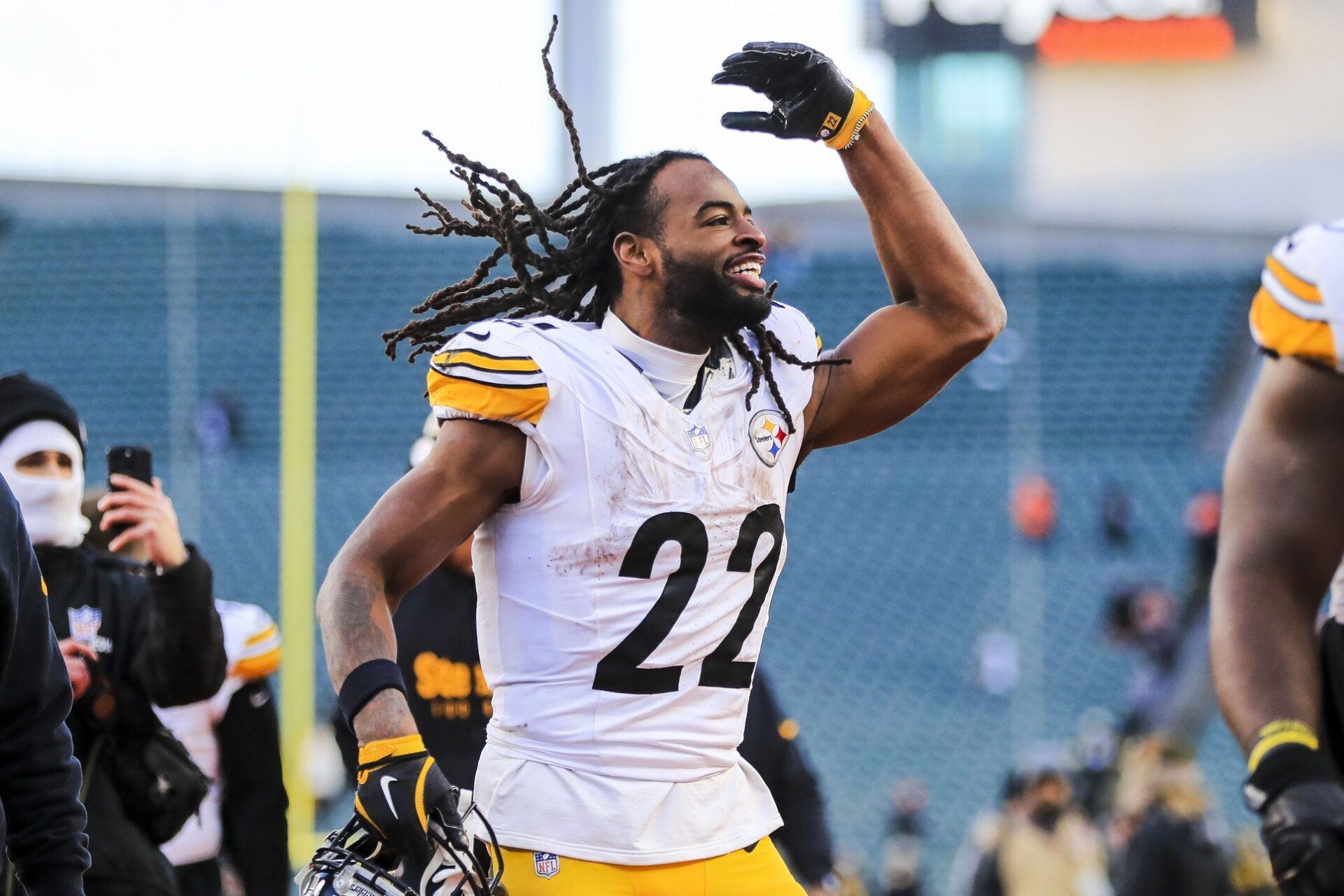
For four straight seasons, Najee Harris gave the Pittsburgh Steelers 1,000 yards and played every Sunday — 71 starts without a miss. But the fifth year never came. The team declined his option in the spring, and by midseason, Harris says he already understood where it was headed.
The separation was all business, a cap‑controlled backfield tilting toward Jaylen Warren and fresh draft capital, with Harris preparing quietly for a move he says he “kind of knew” would be his last in black and gold.
Revisiting Najee Harris’ Move From Steelers
The option decision signaled Pittsburgh’s plan. Harris later explained he saw it coming and that coach Mike Tomlin had framed the “business side” since his rookie year.
“Me and coach T … we’re pretty close in certain ways, so I kind of knew what was coming,” Harris said at his Chargers introduction. “I didn’t plan on doing it … But it’s a business … I just knew that would be my last year … maybe, like, halfway through the end of the season, I kind of knew that.”
He entered free agency and signed a one‑year, $5.25 million contract with the Los Angeles Chargers, drawn by Jim Harbaugh’s system and an offensive line that finishes its blocks. In Pittsburgh, the running game shifted to Warren and other supporting backs. In Los Angeles, Harris expected to play a role in short-yardage situations and have a late-game identity rooted in a trench-first approach.
Harris was also vocal about no longer having the right environment in Pittsburgh to continue his career. In his view, the Steelers had lost their identity.
“It was just a team where we lost Ben, we lost the O-line, we just didn’t know anything on offense really, we didn’t have any identity,” Harris said. “We had a young guy coming in at QB. I was young. The team was young. I really didn’t have nobody to almost learn from on the offensive side.
“I think the veteran guy on that team was a two, three-year vet. And he’s still learning himself. And I’m coming in and I’m just trying to look for people to pick their brain and it was just defensive guys. So I’d go to the defensive guys and talk to them, but there wouldn’t be too much they could tell me about offensive things.”
Najee Harris’ Season So Far With the LA Chargers
The reset started with turbulence. A July 4 fireworks accident caused eye damage, keeping Harris out of training camp. The Chargers eased him in with limited work through Weeks 1-2, then expanded touches in Week 3 — six carries for 28 yards — before a second‑quarter push‑off turned into a non‑contact collapse. Postgame notes listed an ankle issue; next‑day testing confirmed a torn Achilles.
The injury ended his season and wiped out up to $4 million in attainable rushing incentives on the one‑year deal, sending Harris back to the market next March in “reset mode.”
Los Angeles turned to committee approaches and depth in the backfield while adjusting short-yardage plans that initially suited Harris. The sequence — option declined, one-year contract signed, camp lost to an eye injury, and a Week 3 Achilles tear — condensed a full contract arc into summer and early fall. Pittsburgh’s fifth-year decision reflected the modern running back market — a pivot to a cheaper rotation and draft assets after four straight 1,000-yard campaigns.
For Harris, the focus is now on rehab, recovering quickly from the Achilles, proving durability, and regaining value. He summed it up simply: “It’s a business,” a reality evident in cap decisions in Pittsburgh and a one-year opportunity in L.A. cut short by injury, shaping the offseason ahead.
