
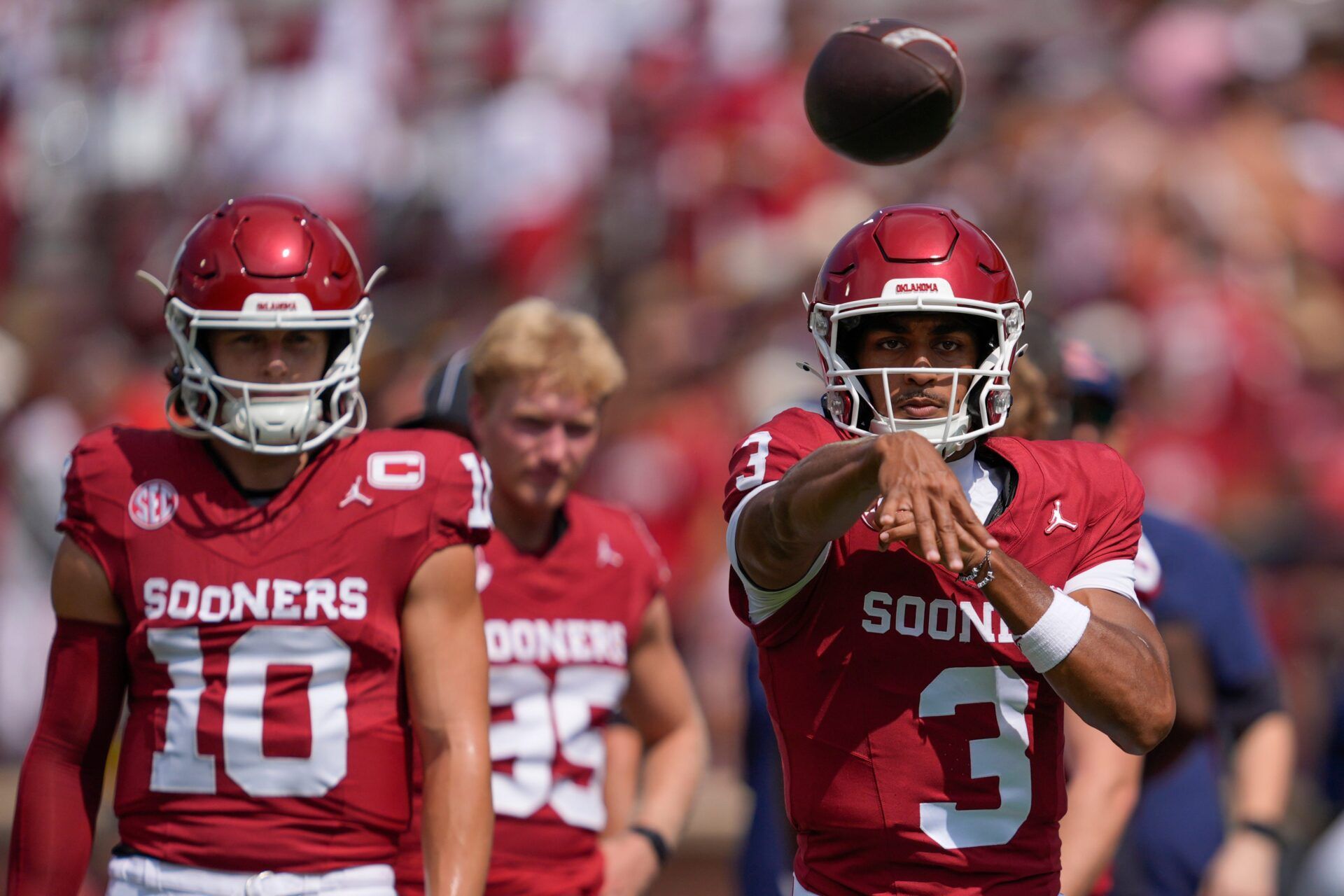
The Oklahoma Sooners face a pivotal moment with John Mateer sidelined due to injury and Michael Hawkins Jr. set to resume the starting job he held last fall. According to PFSN’s exclusive College QBi data, Hawkins steps into the role bringing a unique blend of efficiency, clutch performance, and dynamic athleticism.
With Mateer set for surgery, the team’s quarterback situation has fundamentally shifted. Let’s dive into why Hawkins might be ready to elevate Oklahoma, and what the data tells us about his potential to lead despite some difficulties in the 2024 season.
Can Michael Hawkins Jr. Lead Oklahoma’s Offense Effectively With John Mateer Sidelined?
Mateer leaves big shoes to fill, having posted a stellar 85.0 PFSN College QBi grade through four starts this season. His passing efficiency stands out, with 67.4% completion, over 300 yards per game, and a balanced contribution in rushing with 190 yards and five touchdowns.
Mateer’s value is captured by his 44.2% conversion rate on third and fourth downs and 0.3 Offensive Rush EPA per rush, both metrics that PFSN College QBi weights to reflect reliability in big moments and designed runs.
Now the responsibility of leading the Sooners’ offense falls on Hawkins.
In his seven games last season, Hawkins posted a 68.9 PFSN College QBi score (D+ grade), higher than 2024 teammate Jackson Arnold’s 66.1 and notably boosted by robust clean-pocket efficiency. The metric favored Hawkins with a 0.3 clean EPA per dropback, a sign he’s poised to maximize the offense behind Oklahoma’s talented line.
PFSN numbers behind Hawkins’ most recent play time further illustrate what to expect. Against Navy, Hawkins Jr. played 60 snaps and posted a 78.1 PFSN College QBi grade (C+), supported by positive EPA in clean and pressured settings, a solid clutch score, and smart play in close games.
His performances against Auburn (71.6 PFSN College QBi score) and Tennessee (70.1 PFSN College QBi score) revealed steady improvement in decision-making. While his numbers against Texas dipped (68.4 QBi) due to negative pressured EPA and a limited conversion rate, his unadjusted QB+ averages show Hawkins Jr. remains competitive with other SEC starters.
Transitions matter when analyzing these numbers. Hawkins’ advanced metrics in the 2024 Oklahoma system trail Mateer’s through the Sooners’ starter four games under Ben Arbuckle as the offensive coordinator, notably when it counts on money downs.
MORE: What Caused John Mateer’s Injury That Now Requires Surgery?
However, it could be argued that Hawkins is a more efficient rusher (0.49 EPA per rush vs. 0.32 for Mateer) using his stellar athleticism to give the offense a new dimension. With different offensive philosophies from last year to this, we’re not comparing apples to apples. However, there are reasons to believe that the Sooners’ offense may still contain a little juice moving forward.
His clutch play sum for last season (8.14) is nearly identical to Mateer’s (8.25) so far in 2025, indicating Hawkins can respond under pressure. PFSN College QBi places extra weight on how quarterbacks adapt late in halves and in close games, metrics that Hawkins steadily improved on after his first few starts.
But why does this shift matter so much? First, Hawkins benefits from playing in an offense designed to accentuate his strengths. Oklahoma’s system creates opportunities using varied tempo, heavy motion, and aggressive play calling, an ideal environment for a mobile, clean-pocket quarterback.
PFSN’s data strongly suggests that players who consistently create EPA in clean-pocket situations tend to drive scoring and win probability at higher rates over time. Hawkins trends upward here, notably improving after his Auburn start.
His primary challenge comes from pressured scenarios. Last season, Hawkins’s effectiveness dropped due to a pressured EPA per dropback of -0.57, which is suboptimal when you’re playing in the SEC against some of the most dangerous defenses in the country.
PFSN QBi puts less weight on pressured performance due to its volatility, yet highlights it as an area for development. With more live snaps and game experience, Hawkins’ progression will be visible not just in yardage, where Mateer excelled, but also in the analytically driven metrics Oklahoma values internally.
Moving forward, Hawkins Jr. must maintain consistency in the clean pocket, capitalize on designed runs, and continue to adapt in clutch situations to maximize team performance. The PFSN College QBi uniquely quantifies quarterback value for Oklahoma, putting Hawkins in the spotlight as a well-rounded, ascending option who can deliver beyond standard box score stats.
As the Sooners prepare for their next contest against the Kent State Golden Flashes, Hawkins is not just replacing Mateer; he’s stepping into a role where smart play, dynamic rushing, and EPA-focused passing could define the rest of Oklahoma’s season.