
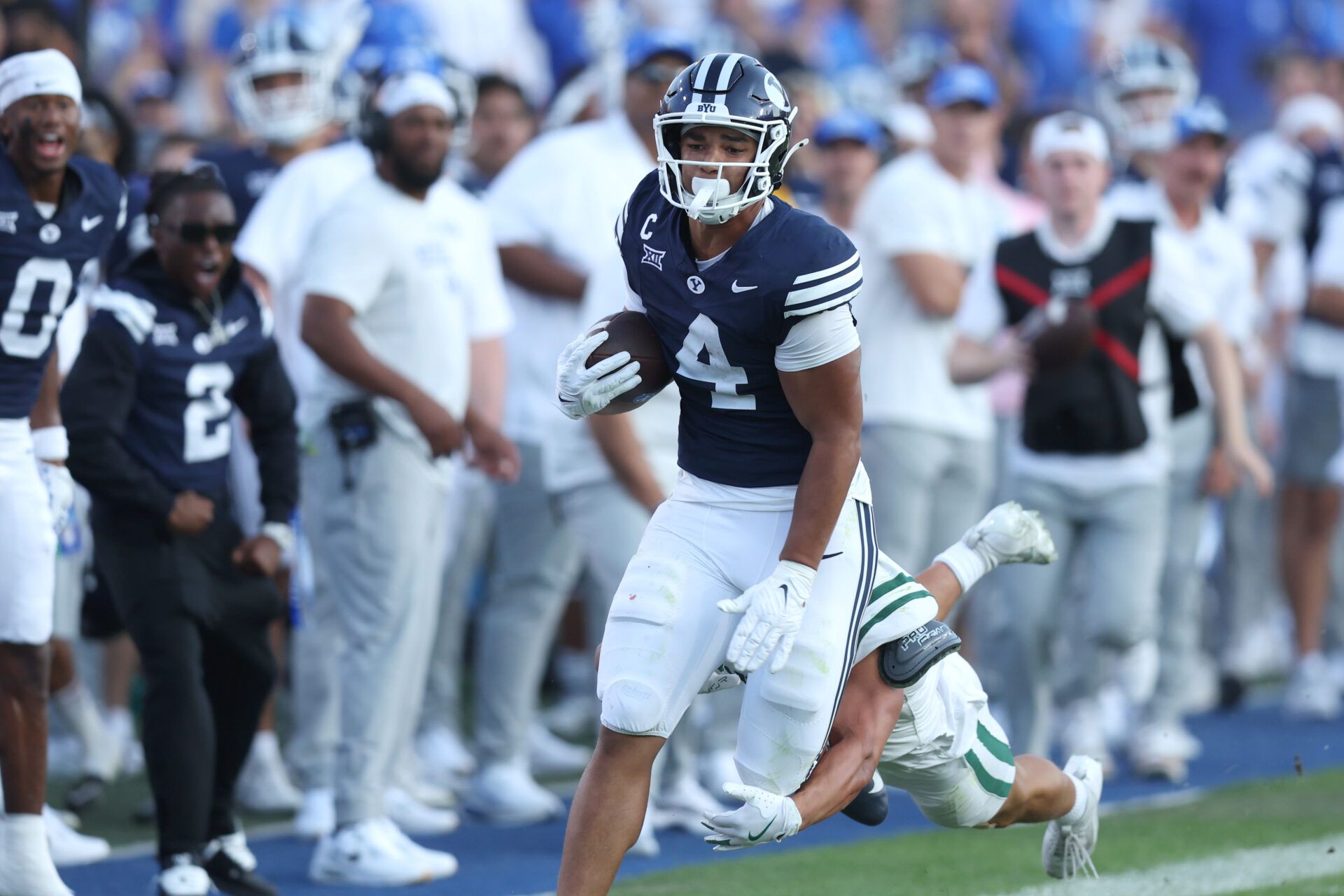
BYU running back LJ Martin has quietly assembled one of the most impressive statistical profiles in college football through two games, establishing himself as a legitimate breakout candidate in the Cougars’ high-powered offense. The 6’2″, 220-pound back leads the nation’s qualifying running backs in yards after contact with an average of 7.5, showcasing the rare combination of power and finesse that makes elite backs special.

What Makes BYU RB LJ Martin So Remarkable?
Martin’s 86.7 PFSN College RBi grade ranks third nationally among all running backs, a figure that becomes even more impressive when considering the comprehensive nature of PFSN’s evaluation system. The metric weighs rushing explosiveness and efficiency alongside receiving and pass blocking performance, adjusted for opponent strength to provide a clear picture.
Through 26 carries, Martin has accumulated 241 yards at a blistering 9.3 yards per rush, numbers that tell only part of his story. His 7.5 yards per carry after contact demonstrates exceptional contact balance and leg drive. Meanwhile, his 46.2% elusive rate shows his ability to make defenders miss before contact even occurs.
PFSN analyst Ian Cummings captures Martin’s unique skill set perfectly: “The 6’2″, 220-pound back no doubt has the powerful leg churn and contact balance you’d expect at his size, but he’s also an amped-up runner with the foot speed and twitch to supplement cuts and gap transitions.”
Martin’s explosiveness shows up clearly in his boom versus bust percentage of 15.4%, indicating he consistently produces positive gains while avoiding negative plays. His 50% offensive rush success rate further underscores his reliability, as he moves the chains at an elite clip when given the ball.
The receiving component adds another dimension to Martin’s profile.
Despite limited targets, he’s caught both passes thrown his way for 20 yards, posting a perfect 100% success rate in the passing game. His 0.95 yards per route run and 56.8% route participation rate show growing involvement in BYU’s aerial attack, suggesting the Cougars view him as more than just a ground specialist.
MORE: PFSN College Running Back Rankings Ahead of Week 4
Perhaps most significantly, Martin commands a 44.8% share of BYU’s running back carries, indicating the coaching staff’s confidence in his abilities. This usage rate, combined with his efficiency metrics, creates the perfect storm for sustained production throughout the season.
His pass-blocking responsibilities remain minimal with just seven snaps per game, but Martin has yet to allow pressure, maintaining a clean slate in protection duties. This reliability in all three phases reinforces his value as a complete back rather than a one-dimensional runner.
Cummings’ projection speaks to Martin’s ceiling: “He’s a fast-rising back who, in my opinion, has Top 5 positional potential and Top 100 upside overall.” This assessment aligns with the statistical evidence, as Martin’s combination of power, elusiveness, and versatility creates a profile typically associated with NFL-caliber talents.
The sustainability question remains the biggest factor in Martin’s continued ascent. His current pace projects to over 2,400 rushing yards, an unrealistic expectation for any back. However, his underlying metrics suggest legitimate star potential, particularly his yards after contact dominance and complete skill set.
Martin’s emergence provides BYU with a foundational piece for its Big 12 championship aspirations. His ability to control games on the ground while contributing in the passing game gives the Cougars’ offensive coordinator, Aaron Roderick, multiple ways to deploy their most dynamic weapon.
Through two games, Martin has established himself as one of college football’s most intriguing breakout stories, backed by PFSN’s comprehensive data analysis that captures his unique blend of power, speed, and football intelligence.