
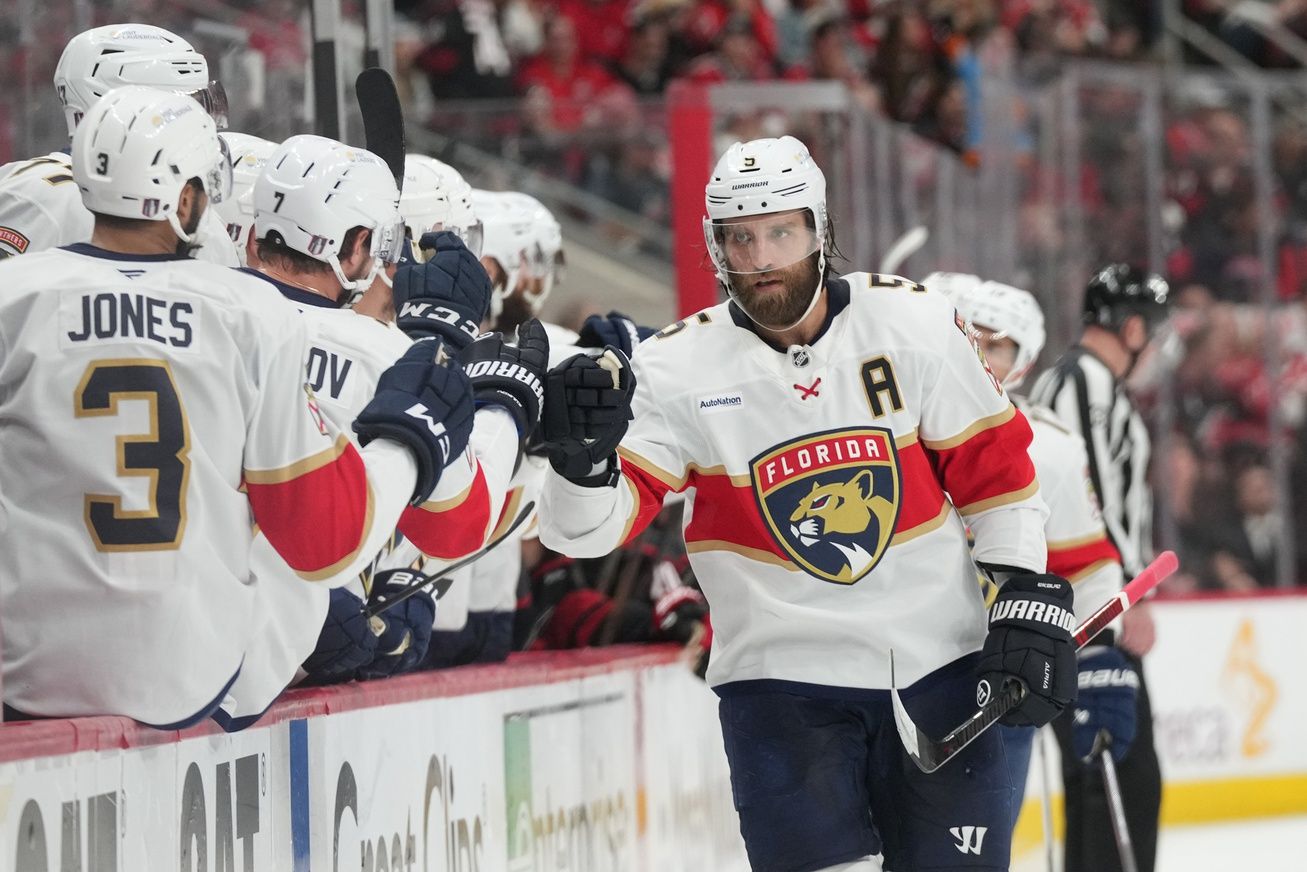
Every offseason in the NHL brings its share of surprises, near-misses, and “what could have been” stories. This summer’s biggest what-if for the Detroit Red Wings? Landing Florida Panthers star Aaron Ekblad.
According to reports, Detroit was prepared to make the defenseman generationally wealthy with an offer that dwarfed Florida’s $6.1 million deal. Instead, Ekblad chose loyalty over dollars, staying with the back-to-back Stanley Cup champions. It’s the kind of story that leaves Red Wings fans wondering just how different their blue line might look today.
How Close Did Detroit Come to Landing Aaron Ekblad?
The Red Wings made their intentions clear from the start of free agency. While they successfully added James van Riemsdyk, Mason Appleton, Ian Mitchell, and Jacob Bernard-Docker, their real targets were much bigger fish. Names like Mitch Marner, Aaron Ekblad, Sam Bennett, and Brad Marchand topped their wish list.
General Manager Steve Yzerman didn’t hide his ambitions when he spoke on July 3, just days into free agency. He acknowledged the challenge of competing for marquee talent in a market where top players move quickly.
By then, the dominoes had already started falling. Marner had been traded from the Toronto Maple Leafs to the Vegas Golden Knights immediately after signing an eight-year, $96 million extension. Florida had moved even faster, locking up Ekblad, Bennett, and Marchand to multi-year deals before they could test the open market.
For Ekblad, the choice came down to more than money. Staying with the Panthers meant continuing his journey with the franchise that selected him first overall in 2014. After a decade in Florida and two consecutive Stanley Cup victories, the pull of championship culture proved stronger than any financial incentive.
James Mirtle: “I know Detroit was pushing for some of the top potential UFAs this summer”; “Aaron Ekblad, in particular, could have signed for a much thicker average annual value in Michigan than the $6.1 million he took with Florida” – The Athletic (8/14)
— NHL Rumour Report (@NHLRumourReport) August 14, 2025
NHL insider James Mirtle of The Athletic revealed the extent of Detroit’s pursuit. “Aaron Ekblad, in particular, could have signed for a much thicker average annual value in Michigan than the $6.1 million he took with Florida,” Mirtle reported.
The phrase “much thicker” suggests Detroit’s offer would have significantly exceeded Florida’s deal, potentially putting Ekblad in rare financial territory for defensemen.
What Financial Flexibility Did the Red Wings Have?
Detroit had the cap space to make such an ambitious offer a reality. The trade of Vladimir Tarasenko and his $4.75 million annual hit to the Minnesota Wild created additional breathing room, leaving the Red Wings with approximately $12 million in available cap space. That kind of flexibility gave Yzerman the ammunition to compete with any team for elite talent.
However, money alone couldn’t overcome what Florida offered beyond dollars. For Ekblad, the opportunity to pursue a third consecutive Stanley Cup with a core group he’s grown up alongside proved impossible to abandon. The relationships built over a decade, combined with the Panthers’ championship momentum, created a compelling case for staying put.
The Red Wings’ pursuit of Ekblad demonstrates their commitment to accelerating their rebuild through high-impact additions.
RELATED: Detroit Red Wings’ 23YO Talent Already Expected To Outplay $56.7 Million Payday
While they couldn’t land the star defenseman, their willingness to make such a substantial financial commitment signals that Detroit is ready to spend when the right opportunity presents itself.
The fact that they were serious contenders for a player of Ekblad’s caliber shows how far the franchise has come in rebuilding its reputation as a destination for elite talent.
For Detroit fans, this near-miss will fuel plenty of speculation about what might have been. But it also serves as proof that the Red Wings are thinking big as they continue climbing back toward NHL relevance. Sometimes the moves that almost happen tell just as much of a story as the ones that do.
