
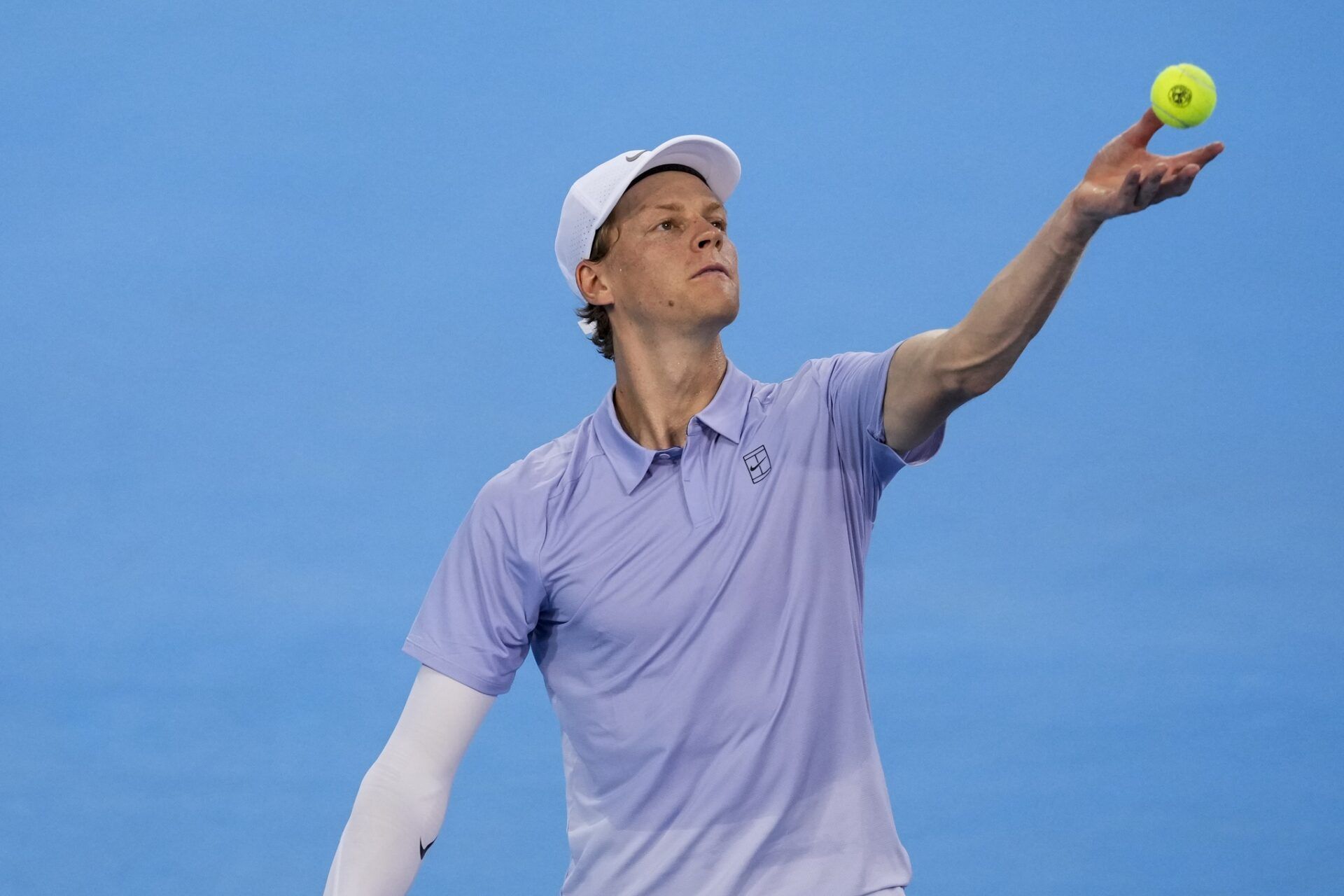
The clock showed 10:18 p.m. at the Cincinnati Open, but Jannik Sinner wasn’t heading to his hotel room. Instead, he grabbed a basket of tennis balls and walked to the practice courts. Most players would be celebrating their third-round victory and preparing for rest. Sinner had other plans.

Why Did Jannik Sinner Hit 100 Serves After His Third Round Victory?
Sinner’s third-round match against Gabriel Diallo had wrapped up with a 6-2, 7-6(6) victory, but the world No. 1 wasn’t satisfied with his serving performance. He saw room for improvement despite winning the match in one hour and 52 minutes. The game had faced several long delays, including a power outage and a fire alarm, but Sinner kept his cool and closed out the victory.
Minutes after the final point, he turned to his team and said, “Let’s go to the court,” urging them to prepare another practice court on the spot. What followed was a dedicated hour-long practice session under the lights.
Jannik Sinner al suo team pochi istanti dopo la vittoria contro Diallo:
“Andiamo al campo” 🫡 pic.twitter.com/efnfyVzJAh
— Giovanni Pelazzo (@giovannipelazzo) August 12, 2025
At 10:18 p.m., he was spotted on Cincinnati court, hitting reportedly 100 serves against the back fence. Frustrated with his inconsistency during the match, he focused on placement and rhythm, repeating the motion until fatigue set in.
10:18 P.M. and straight from center court, Jannik Sinner was not happy with how he was serving tonight and has hit about 100 serves out here at the practice courts under the lights pic.twitter.com/4N2Q0ItOyD
— Tech Takes AI (@TechtakesAI) August 12, 2025
The late session showcased Sinner’s relentless work ethic. By isolating himself on a half-court, he concentrated solely on serve speed and spin, hoping to restore confidence ahead of tougher opponents. His decision to stay late reflects a belief that small margins can decide big matches, particularly with the U.S. Open approaching.
How Did Sinner’s Victory Against Gabriel Diallo Unfold?
The match itself showcased both command and composure from Sinner. He opened strongly, breaking Diallo’s serve in the first game and holding his own delivery games with aggressive serves. Sinner captured the opening set 6-2 in just 30 minutes, using deep groundstrokes to dictate play and keep the Canadian off balance.
However, the second set proved more challenging. Diallo raised his level, trading powerful forehands and forcing Sinner into longer rallies. At 5-6, Sinner faced a set point on his own serve. Diallo’s backhand approached the corner, but Sinner produced a razor-sharp return to set up a forehand winner.
In the tiebreaker, Sinner raced to an early 4-1 lead behind two unreturnable serves. Diallo clawed back to 5-5 with heavy hitting, but Sinner steadied himself, landing a perfect wide serve to earn match point. A final, curving forehand sealed the tiebreaker 8-6 and the match.
That victory pushed his hard-court streak to 23 consecutive wins, a run dating back to last year’s Beijing Open final, where he lost to Carlos Alcaraz 7-6, 4-6, 6-7. In press conferences, Sinner has often spoken about the value of tough practice, especially after matches that expose weaknesses.
