
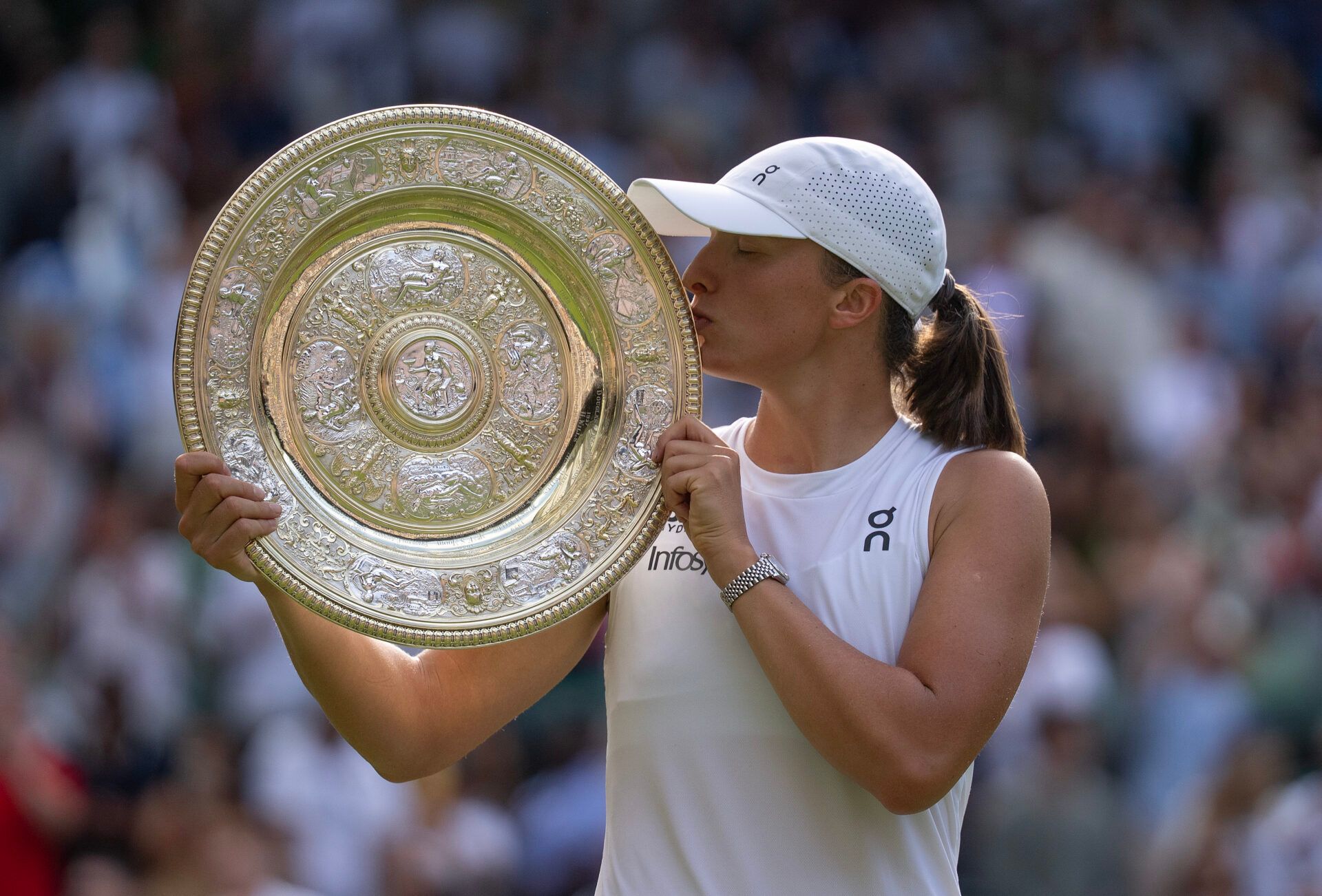
Veteran tennis coach Wim Fissette’s stint with Iga Świątek has been under intense scrutiny as the Pole failed to win a single tournament heading into Wimbledon. However, the 45-year-old Belgian proved his mettle, guiding the Polish player to her first Wimbledon championship.
What Wim Fissette Has Said on Iga Świątek’s First Triumph at Wimbledon
“I’m really, really happy to have won Wimbledon with Iga,” Fissette said in the aftermath of the Pole’s win.
The Belgian continued, “I am really proud of her. How she developed herself in the last weeks, how she adjusted to the grasscourt, how she improved match by match, and how focused she stayed during the tournament.”
— Gosia (@Gosia_CzBradf) July 15, 2025
The Belgian coach also hailed Świątek’s mental strength during his successful campaign at Wimbledon, which he described as “the biggest tournament in the world.”
“[Wimbledon] is the highest you can achieve,” Fissette said. “It is the biggest tournament in the world. It is the most prestigious tournament. And to have a chance to be Wimbledon champion, and to deal with those emotions. This is part of professional sport, part of tennis. And Iga did it really well.”
Fissette is one of the most celebrated coaches in tennis and has worked with former No. 1s Victoria Azarenka, Kim Clijsters, Simona Halep, Angelique Kerber, and Naomi Osaka.
When Iga Swiatek Paid Tribute to Wim Fissette After Lifting Her First Wimbledon Crown
After drubbing Amanda Anisimova 6-0, 6-0 to win her first Wimbledon, Świątek credited her coaching team, with a special shoutout for Fissette.
“I want to thank my team because I feel they believed in me more than I did,” Świątek continued. “And I want to thank my coach, who joined this year. With ups and downs, right now we showed everybody that it’s working.”
The coaching change proved crucial to Świątek’s success. Wim Fissette replaced Tomasz Wiktorowski on her team in October 2024.
Świątek’s partnership with Fissette came under intense scrutiny ahead of her Wimbledon triumph, as she failed to win a single trophy heading into SW19.
Most notably, the Pole’s lack of success on clay led critics to raise the alarm. She routinely fell in the early rounds of clay tournaments leading up to the French Open.
At Roland Garros, where she was the three-time defending champion, the Pole smoothly sailed into the semifinals, where she met a familiar rival in World No. 1 Aryna Sabalenka.
Sabalenka emerged victorious in their semifinal, winning 7-6(1), 4-6, 6-0.
Świątek quickly switched her attention to the grass, entering the Bad Homburg Open in Germany as the No. 4 seed.
She steamrolled her first three opponents, a former World No. 1 in Azarenka, No. 8-seeded Russian Ekaterina Alexandrova, and No. 2 seed Jasmine Paolini, setting up a mouth-watering final showdown with in-form American Jessica Pegula. However, she lost the match 4-6, 5-7.
Nevertheless, the tournament marked a significant turnaround in Świątek’s fortunes and served as a suitable launchpad for her successful Wimbledon campaign.
