
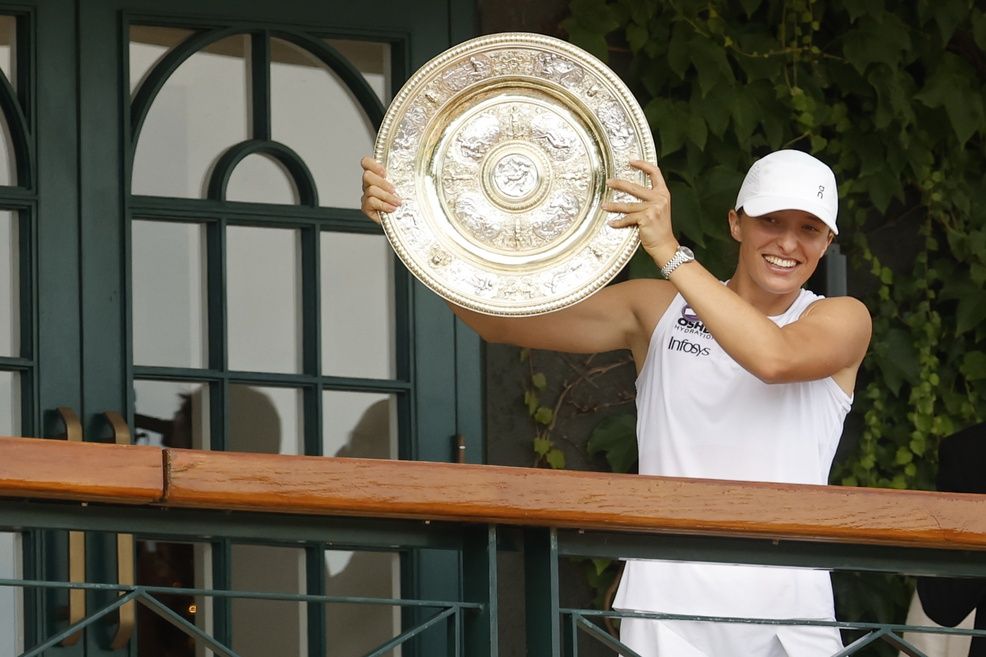
Iga Świątek made history at the 2025 Wimbledon Championships, delivering a flawless performance to defeat Amanda Anisimova 6-0, 6-0 in just 57 minutes. The Polish star’s dominant display marked the first time since 1911 that a women’s Wimbledon final ended in a double bagel.

Iga Świątek’s Dominance In Wimbledon 2025 Final
From the opening point, Świątek demonstrated why she has never lost a Grand Slam final. The 24-year-old eighth seed broke Anisimova’s serve in the very first game and never looked back, controlling every aspect of the match with remarkable precision. Her victory was a masterclass in tactical tennis, showcasing the controlled aggression that has defined her career.
The emotional climax came immediately after match point, when Świątek collapsed to the grass in disbelief before rushing to embrace her team. Among the first to congratulate her was her father Tomasz, a former Olympic rower who has been instrumental in her journey. The heartwarming scene continued as Świątek shared emotional hugs with her sister Agata and the rest of her support team, creating one of the most touching moments of the tournament.
Iga Swiatek hugs her dad and sister after winning her first Wimbledon title.
Beautiful scenes. 🇵🇱🥹 pic.twitter.com/VauGiUryUd
— The Tennis Letter (@TheTennisLetter) July 12, 2025
Świątek’s celebration was particularly meaningful given her father’s influence on her career. Tomasz, who competed in the 1988 Seoul Olympics in rowing, had initially encouraged both his daughters to pursue sports. His presence in the player’s box, along with sister Agata, provided crucial family support during this historic achievement.
Świątek’s Technical Mastery And Her Performance
Świątek’s performance was nothing short of extraordinary from a tactical standpoint. She won 55 of the 79 total points played, demonstrating her superiority across all aspects of the game. Her serving was particularly impressive, winning 72% of first-serve points and 83% of second-serve points. The Polish champion hit only 11 unforced errors compared to Anisimova’s staggering 28.
Throughout the tournament, she had worked extensively on her movement and positioning, focusing on stopping her feet properly before striking the ball. This tactical adjustment proved crucial in her ability to generate power and precision on the faster grass surface.
Świątek’s forehand, which had been problematic on grass in previous years, was perfectly controlled throughout the match. She consistently targeted Anisimova’s backhand, typically the American’s strongest shot, effectively neutralizing her opponent’s primary weapon. By disrupting Anisimova’s rhythm and forcing errors, Świątek demonstrated tactical maturity beyond her years.
The match statistics reveal the extent of Świątek’s dominance. She converted six of nine break point opportunities while never facing a break point herself. Her return game was particularly devastating, winning 90% of return points and keeping 78% of returns in play when facing first serves directed at her forehand.
