
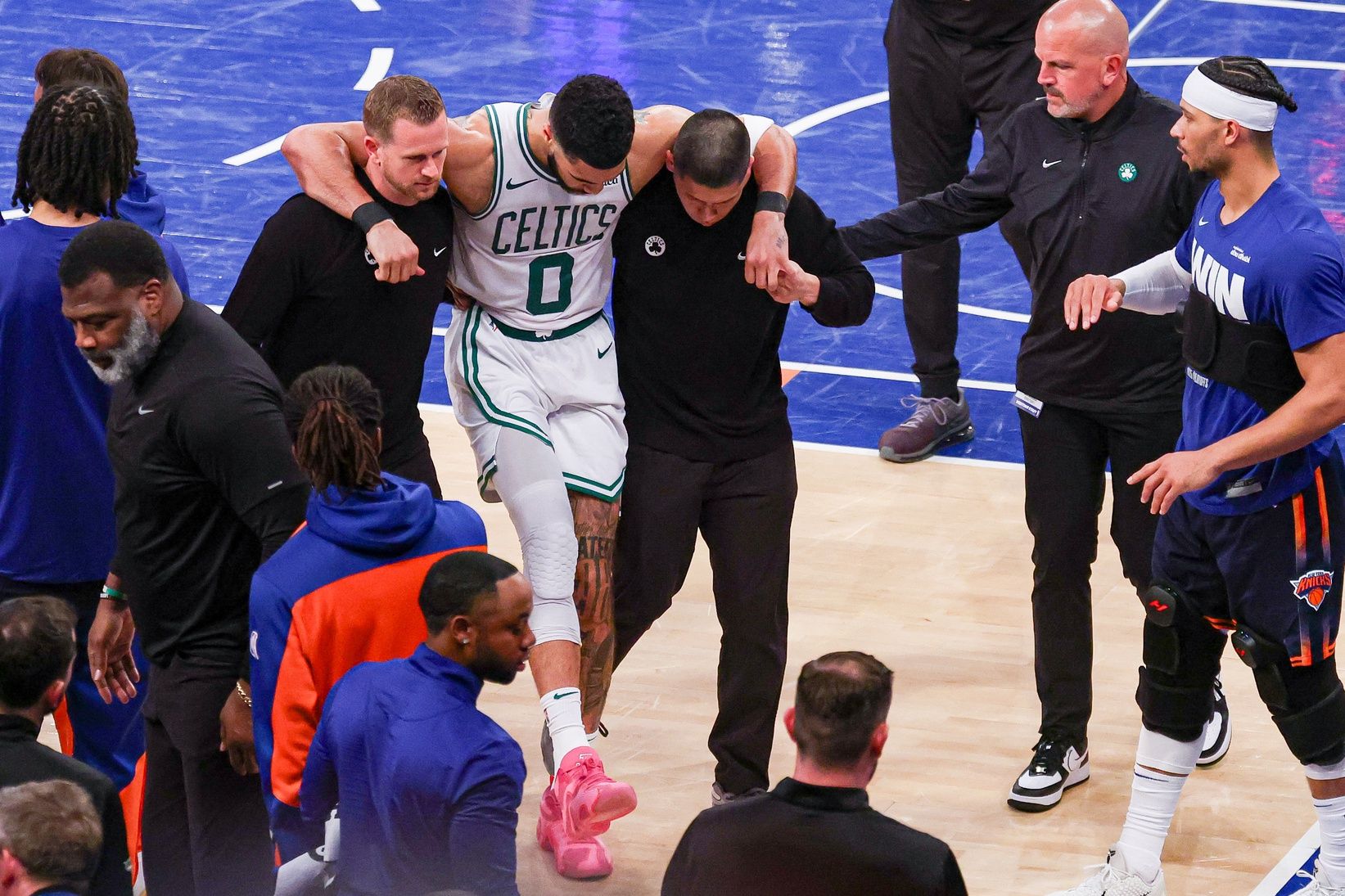
A sudden, heart‑stopping moment late in Game 4 of the Eastern Conference semifinals saw Celtics superstar Jayson Tatum collapse to the hardwood, his right leg betraying him in a split second that changed Boston’s season forever. The Knicks ended up beating the Celtics with a 121-113 victory—a disheartening night for Boston, coupled with their star player’s brutal injury.
The six‑time All‑Star’s absence not only robs Boston of its leading scorer and emotional leader but also shifts the competitive balance in a series now tilted 3‑1 in New York’s favor.
Despite the blow, coach Joe Mazzulla and the Celtics remain determined to “leave it all out there,” leaning on depth pieces like Jaylen Brown and Kristaps Porzingis to mount an unlikely comeback.
Jayson Tatum’s Injury and Recovery Timeline Explored
Tatum has been the linchpin of Boston’s resurgence since being selected third overall in the 2017 NBA Draft. His blend of silky scoring and tenacious defense propelled him to six All‑Star appearances (2019–2024) and three All‑NBA First Team selections.
In 2024, Tatum led the Celtics to their 18th championship. He averaged 22.2 points, 7.8 rebounds, and 7.2 assists per game against the Dallas Mavericks.
That summer, he inked a five‑year, $314 million supermax extension till the 2029-30 season, cementing his status as the franchise cornerstone and one of the NBA’s most coveted stars.
Meanwhile, the injury unfolded with three minutes remaining in Game 4 on May 12 (ET) as Tatum went up to secure a pass and immediately crumpled to the hardwood, clutching his right leg in visible agony.
Despite finishing with 42 points before the injury, an MRI the following day confirmed a full rupture of the right Achilles tendon, prompting the Celtics to announce surgery on Tuesday afternoon in a somber press release.
This effectively ended his 2024‑25 playoff run and casting doubt on the start of next season.
An Achilles rupture is among the most daunting injuries for an elite athlete, historically requiring a minimum of nine months before on‑court activity resumes and up to a full year for conditioning and confidence to return.
Historical comparisons, such as the recoveries of DeMarcus Cousins and John Wall, serve as both cautionary tales and beacons of hope. This highlights that some players regain All‑Star levels post‑surgery while others struggle to recapture prior explosiveness.
Once cleared for limited court work, Tatum will focus on shooting drills and agility training, aiming to rebuild explosiveness without risking re‑injury.
Boston’s championship defense now hinges on a miraculous comeback, with only an 8% historical chance of a comeback when trailing by that margin. With Tatum sidelined, Jaylen Brown must shoulder an expanded offensive load, while Porzingis will see career‑high usage in pivotal moments.
What Lies Ahead for Boston Without Tatum
Even as New York eyes its first Eastern Conference Finals berth since 1999, Boston’s mantra remains clear: honor Tatum’s legacy by playing with relentless effort and unity.
If the Celtics manage to stave off elimination in Game 5, they would attempt an improbable comeback reminiscent of their historic 3–1 rally against the Miami Heat in 2023.
For a franchise steeped in banner legacy, the challenge is to navigate this setback with resilience, preserving the championship window and honoring the standard set by Larry Bird, Paul Pierce, and the Celtics’ storied past.
