
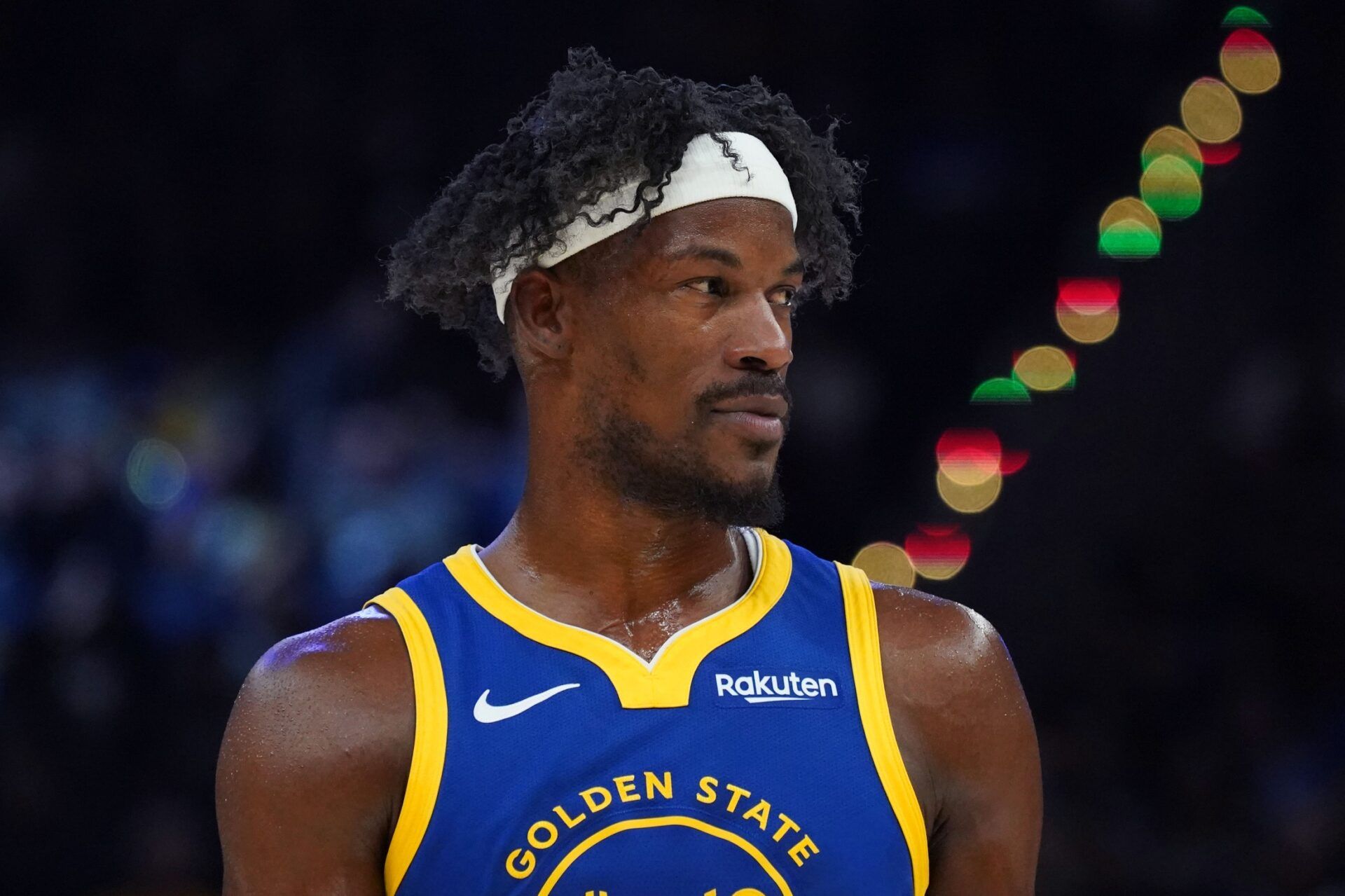
The Golden State Warriors were already grappling with the emotional shock of Jimmy Butler III collapsing on the floor Monday night. As the initial disbelief settled, a quieter but equally damaging reality emerged behind the scenes. It was not just the loss of a star that threatened their season, but the sudden closure of every easy path forward.
Golden State Warriors’ Options Narrow as Injury Fallout Deepens
The severity of Butler’s torn ACL immediately removed him from the Warriors’ postseason plans. Soon after, ESPN’s Bobby Marks delivered another blow, clarifying that the Warriors could not apply for a Disabled Player Exception this season.
As Marks explained on social media, “Deadline to apply for the Disabled Player Exception has passed. The Warriors would have needed a roster spot and room below the 2nd apron.”
Deadline to apply for the Disabled Player Exception has passed.
Golden State would have needed a roster spot and room below the 2nd apron. pic.twitter.com/wRHzmgL45I
— Bobby Marks (@BobbyMarks42) January 20, 2026
The cutoff date was January 15, and the Warriors were already operating too close to the league’s second-apron hard cap to use the exception even if timing had allowed it.
That reality leaves the Warriors without a procedural safety net. The Disabled Player Exception exists to help teams replace players ruled out for the remainder of a season. Still, it must be requested between July 1 and January 15 and approved by an NBA-appointed physician.
Even when granted, the exception comes with strict financial limits tied to either half of the injured player’s salary or the non-taxpayer mid-level exception, whichever is lower. None of those mechanisms is now available to the Warriors.
Before Butler’s injury, the Warriors appeared to be quietly building momentum. The team had won 11 of its previous 15 games and sat at 25–19 after Monday night, climbing the Western Conference standings.
With Jonathan Kuminga eligible to be traded, help seemed imminent. That optimism vanished when Butler crumpled in the third quarter, instantly altering the franchise’s trajectory.
On the court, Butler’s absence creates a void the Warriors cannot replicate internally. He averaged 20.0 points, 5.6 rebounds, and 4.9 assists while shooting efficiently from the field and from three-point range.
More importantly, Butler stabilized minutes when Stephen Curry sat. Lineups with Butler but without Curry were outperforming opponents by 9.6 points per 100 possessions, a critical buffer for a team that historically struggles without its superstar guard.
Jonathan Kuminga is now the most obvious internal option. Steve Kerr acknowledged that the forward could “absolutely” return to the rotation. Kuminga’s scoring flashes, including a 24.3-point average over the final four playoff games last season, offer hope.
Yet those games ended in losses, reinforcing long-standing concerns about consistency, defensive awareness, and overall impact beyond scoring.
With no Disabled Player Exception, no easy roster addition, and a major trade suddenly far riskier, the Warriors face a grim recalibration. Butler’s injury did not just remove a star. It closed doors, compressed timelines, and forced the Warriors to confront how fragile their status as contenders truly was.
