
The 2025 NBA Draft is in the books! After Cooper Flagg was the first overall selection and a surprising and exciting two-night event, some top-ranked players did not hear their name called. Which of the undrafted free agents (UDFAs) should your favorite team covet?
Our tracker below will highlight the players who remain and their original ranking on our 2025 NBA Draft Big Board. To move on to the 2026 NBA Draft, head over to the PFSN’s Free NBA Mock Draft Simulator now!
[EDITOR’S NOTE: The players below will be highlighted with their original ranking on our big board.]
39) Hunter Sallis, SG/SF, Wake Forest
Hunter Sallis, known for his poise, smooth three-level scoring, and defensive energy, is one of the most polished upperclassmen in this year’s class. Sallis has grown into a crafty shot creator with a deceptive handle and advanced change-of-pace moves that allow him to navigate defenders and create quality looks off the dribble.
He’s especially effective in the midrange. Offensively, Sallis thrives as a slasher, showing off his finesse as a finisher. He has elite touch around the basket, using a mix of floaters, off-foot layups, and creative body control to score. Though more scorer than facilitator, he’s shown unselfish instincts as a passer.
Defensively, Sallis brings consistent intensity and discipline. His activity level fighting around screens and sticking with his assignment speaks to his awareness and motor. However, his lean frame remains a concern. He’ll need to get stronger to hold up physically against NBA athletes, especially when switching or guarding more physical wings.
Where Sallis can take a step forward is as a shooter. His three-point shooting hovered around 33.3% over four seasons. If the outside shot becomes more reliable, he has the potential to grow from a secondary scoring option into a legitimate offensive weapon.F
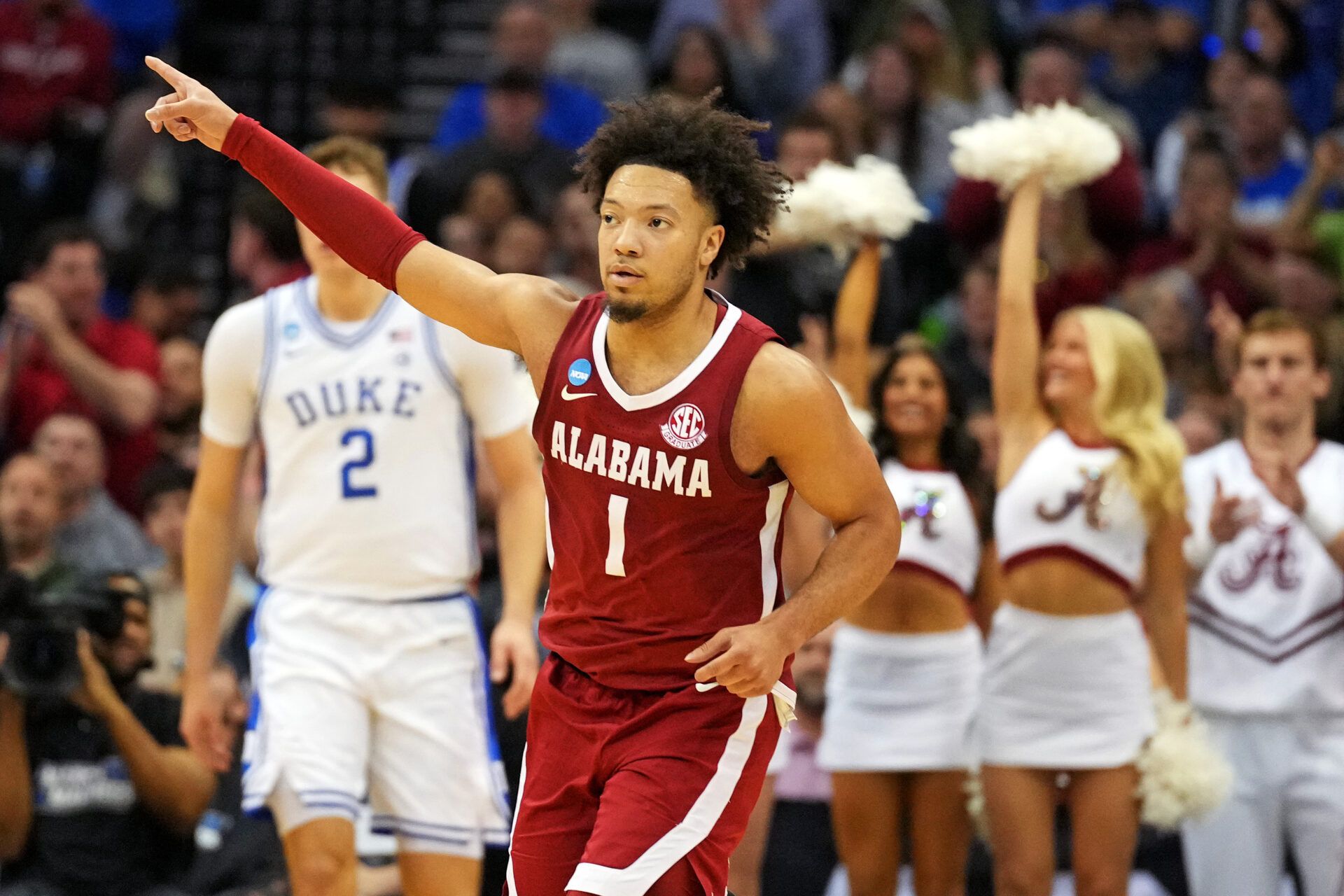
41) Mark Sears, PG, Alabama
Mark Sears was one of college basketball’s most prolific shot-makers. The Alabama star is known for his fearless mentality, advanced handle, and deep shooting range. Though he measured in well under 6’0”, Sears plays more physical than his size suggests.
His sturdy frame helps him absorb contact at the rim, while his creativity and footwork allow him to create space and hit difficult shots from nearly anywhere on the floor. Sears brings a scoring arsenal that few guards in this class can match.
That said, Sears faces a steep path to NBA minutes due to his physical limitations. He lacks elite burst or vertical pop, making it tougher to consistently finish against NBA length.
On the defensive end, his size and short wingspan make him a frequent target, and while he competes, his ability to stay in front of bigger, more athletic guards at the next level remains a question mark.
To stick in the league, Sears will need to continue to work on his decision-making and maintain his shooting efficiency under increased pressure. In the short-term, he has the tools to become an energizing scoring guard off the bench in the NBA.
42) Dink Pate, PG, Capitanes
Dink Pate is one of the youngest and most polarizing prospects in this year’s draft class. A 6’8” wing with impressive fluidity and athleticism, Pate possesses physical tools that fit the mold of a modern NBA perimeter player.
His early exposure to professional basketball through the G League Ignite and Mexico City Capitanes gave him valuable reps against seasoned competition, but also highlighted how raw his game still is.
Offensively, Pate shows the ability to score at all three levels. He’s comfortable with the ball in his hands and has a deep bag of moves. However, his efficiency leaves much to be desired. At the rim, he struggles with touch. His decision-making and shot selection remain works in progress as well.
2024 5 ⭐️ Dink Pate (@IAMTHESHOOTER1) is having an outstanding junior season at Pinkston (TX)
Through 30 games, Pate is averaging 22.6 PPG, 12.4 RPG, 6.0 APG, 2.0 SPG, and 2.0 BPG
6’8 guard that is a true playmaker pic.twitter.com/6bJXmta3Ws
— Alex Karamanos (@KaramanosAlex) February 9, 2023
Defensively, Pate has the physical profile to be versatile. He’s long, mobile, and able to switch, but he lacks the awareness and anticipation to consistently impact plays. That said, his frame and athletic tools give reason for optimism if placed in the right developmental system.
Pate is a long-term bet. He hasn’t produced consistently in two years of pro play, but his age, size, and flashes of skill make him a moldable prospect. He’s best suited for a team with patience and a strong player development program.
43) RJ Luis, SG/SF, St. John’s
After transferring to St. John’s, RJ Luis Jr. showcased his toughness and versatility under Rick Pitino, earning recognition for his ability to guard multiple positions and make winning plays on both ends.
His aggressive, downhill attacking style sets the tone, especially in transition or when cutting into open space. He also brings surprising post-up ability for a wing, using his frame and footwork to bully smaller defenders in the paint.
Defensively, Luis has the lateral quickness to stay in front of guards and the size and tenacity to battle wings, making him a switchable piece who can disrupt passing lanes and compete on the glass. His motor never wavers, and he relishes the challenge of locking in on his man or making help-side plays.
His rebounding and overall activity level consistently impact the game, even when his offense stalls.
That said, Luis’s offensive game is still a work in progress. Despite being a confident midrange scorer, his efficiency remains an issue. To stick at the next level, Luis must simplify his offensive approach and improve his shooting mechanics and ball-handling.
Still, Luis’s mindset, defensive versatility, and physical tools are NBA-caliber. He has a pathway to becoming a reliable two-way role player.
47) Kobe Johnson, SF, UCLA
Johnson projects as primarily a defensive stopper. His 6’6”, 200-pound frame and wingspan allow him to disrupt offensive players, as evidenced by his 1.6 steals per game for the Bruins last year.
A three-year starter for the USC Trojans before finishing his career at UCLA, he never quite grew into a quality offensive player, instead finding success rebounding the ball and in breakaway situations.
He also averaged 2.9 assists per game as a senior, showing off his unselfishness and court vision. A 36.2% three-point shooter, he was often reluctant to shoot and didn’t seem confident with his shooting stroke, but decent efficiency is there.
For him to earn minutes at the next level, he’ll need to improve that aspect of his game. While he’s a good defender, the modern NBA requires shooting, or else Johnson could get played off the court if he’s given a shot in the rotation.
50) Cameron Matthews, SF/PF, Mississippi State
A five-year man who started 120 games in his career for the Bulldogs, Matthews is a physical presence in every sense. At 6’7”, 235 pounds, the power forward has a great core of strength that he used to average 6.7 rebounds per game last season, despite being undersized in many of his positional matchups.
Where he excels is on the defensive end of the floor, where his IQ, matched with excellent hands (2.4 steals per game last season), made him one of the top defenders in the SEC. He’s quick-footed, disallowing the opposition to drive by him.
It’s tough to project Matthews as a high-level offensive player in the NBA, as he shot just 24.0% from three-point range last season on 0.7 attempts per game. He was largely a non-factor offensively outside of put-backs and run-outs, which is an immediate concern as far as how his game will translate.
But if the former Mississippi State forward lands with a team willing to play him to his strengths, he could carve out a spot as a situational defender and fill in as a small-ball center.
51) Eric Dixon, SF/PF, Villanova
Dixon led the country in scoring last season at Villanova, averaging 23.3 points per game while also grabbing 5.1 rebounds. He scored in a variety of ways, getting to the line for 6.1 free throw attempts per game and knocking down 40.7% of his 7.2 three-point attempts.
While he was one of the top players in college basketball, the 6’8”, nearly 260-pound forward doesn’t project as a top scorer in the NBA due to his lack of explosiveness and height as a small-ball center or stretch four.
He’s not particularly strong defensively either. He’ll likely struggle to stay in front of quicker players, while not having the size to out- rebound taller players down low.
His shooting does present hope that he could become a rotational piece in the NBA, as he could contribute in a small role as a backup big man with rim protection behind him.
53) Payton Sandfort, SF, Iowa
Sandfort was the primary creator for the Hawkeyes during his senior season, averaging 16.7 points, 6.0 rebounds, and 2.9 assists while standing 6’8”. At the next level, he’s likely to be put in a floor-spacing wing position, where his true strength can be accentuated most: shooting.
The percentages don’t do it justice, as he knocked down just 34.0% of his triples last season on a bloated 7.5 attempts per game. Make no mistake, Sandfort is a sharp-shooter who isn’t afraid to pull from far behind the line, stretching the defense for teammates and himself to put the ball on the floor.
On defense, he wasn’t bad in the Big Ten, but Iowa often hid him to conserve energy for the other end of the court. NBA teams won’t do that, which means Sandfort will be required to show consistent defensive effort and energy if he wants a shot.
54) Jaxson Robinson, SG/SF, Kentucky
An injury cut Robinson’s senior season with the Wildcats short, but he did enough across his career to reveal himself as one of the top shooters in this draft class. On 6.9 attempts per game in 2024-25, he nailed 37.6% from deep while creating a number of those looks off the dribble.
At 6’6”, the swing player has good positional size and length and would fit right in on an NBA roster. If he is to reach his potential and be a rotational player at the next level, it’ll more than likely be as a 3-and-D player.
While he has the long-range shot down, his defense stands to improve. He has all the tools to be a competent defender and has provided bright flashes on that end, but wasn’t consistent enough to inspire belief that that’s who he’ll be every night.
The 22-year old Robinson is a player that could likely come in and compete from Day 1, but doesn’t have the long-term potential of other prospects at this point in the draft.
55) Grant Nelson, PF/C, Alabama
Nelson is one of the most versatile players in this class. He’s 6’10” with a 7’0” wingspan, and is very comfortable on the perimeter as well as down low.
To sum up the former Crimson Tide forward, he does everything at a proficient level, but doesn’t have one particular calling card skill to rely on – a double-edged sword for a prospect seen as a second-round pick.
If he lands with a team that believes in his ability as a connector on both ends of the floor, he could thrive and be a steal as a key cog for a decade or more in the league. But just as easily, he could be miscast as a small-ball big and resigned to the perimeter, where he isn’t a terrific shooter, and where he wouldn’t be able to use his size in the paint.
But if Nelson can be employed as Alabama used him – with a mix of both inside and outside play – he could surprise many.
56) Izan Almansa, PF/C, Perth
A 6’10”, 230-pound forward who can play center in some lineups, Almansa has put together a solid couple of seasons overseas, showcasing his ability to pass out of the high post, shoot the mid-range jumper, and rebound the ball with tremendous effort and hustle.
Additionally, he has a good feel for finding open spots in the paint, where his deft touch in the paint allows him to finish at a high rate. Where he struggles is shooting from long range, as he doesn’t have the best three-point form, and struggles as a free throw shooter.
Defensively in the paint, he’s not a shot-blocker and is resigned to drop coverage in the pick-and-roll due to his lack of lateral quickness.
Almansa has clear flaws, but he also flashes talent at 19 years old, he’s grown and become a better player over the years, and he’s potentially worth a late pick in this draft.
59) Jalon Moore, SF, Oklahoma
Moore was terrific last season for the Sooners, emerging as their go-to scorer on the wing. He specialized in slashing to the rim and using his 6’7”, 215-pound frame to either finish over or through defenders.
He’s extremely athletic, with a good first step attacking closeouts. Where he made major strides across his collegiate career was from behind the three-point line, as he converted on 38.1% of those shots during his senior season.
That’ll be something he’ll have to continue to hone in on, as he won’t have the ball in his hands nearly as much if he gets a chance in the league. He was a good-not-great defender, and often left something to be desired on that end.
He has a good left hand, which should result in more steals and blocks, but it didn’t always translate in college. For Moore to earn a long-term NBA roster spot, he’ll have to fully commit on that end of the floor.
60) Kadary Richmond, PG/SG, St. John’s
Richmond’s statline in 2024-25 was excellent for the Red Storm, as he averaged 12.4 points, 6.4 rebounds, and 5.3 assists. Standing 6’6”, he operated as the team’s point guard and nearly always had the size advantage over players defending him.
He used that to his advantage, seeing over the defense to find open teammates and finishing at the rim after slashing to the hoop. He was also a good on-ball defender, notching 2.0 steals per game as he showed he has the hands to compete at the next level. Where his ceiling is capped is at the three-point arc.
Though he eclipsed 40% at Seton Hall in 2022, he made an abysmal 17.5% in 2024-25. Add in that he converted just 53.6% of his free throws, and Richmond has a serious problem with his jumper.
Any sort of sustained success at the NBA level will hinge on him becoming a proficient shooter and rediscovering his 2022 form.
61) Caleb Love, PG/SG, Arizona
To casual college basketball fans, Love would likely be considered a lock to be a first-round pick. But the reality is that the five-year North Carolina Tar Heel (three seasons) and Arizona Wildcat (two seasons) was extremely inefficient at the collegiate level and doesn’t have the athletic ability to create shots in the NBA.
Handed the keys to the offense during his time with Arizona, Love rarely played off the ball and faces question marks over how he’ll adapt to playing a role. He can shoot the ball, but will need to clean up his efficiency.
Where he may find his niche is on defense, where he was extremely competitive late in games and showed anticipation in terms of staying in front of his opponent. But the question is if he can sustain that when not given primary volume on offense.
As it stands, Love risks going undrafted and having to work his way through the G League or playing overseas.
62) Zeke Mayo, PG/SG, Kansas
Mayo had a solid senior season with the Jayhawks, scoring 14.6 points per game while hitting 42.2% of his three-pointers. That’s the problem with his game, however; he doesn’t do much else besides shoot the ball, with many coming off of his own creation.
That’s not something that he did at a particularly high-level overall either, as he shot just 44.7% from the field and struggled to finish around the rim. He’s far from a dynamic athlete, leaving questions about how he’ll be able to defend quicker, more athletic players in the NBA.
His 6’4” height doesn’t suggest that he’ll have any advantage in that area either, as he’s strictly a two-guard with limited potential on both ends of the court.
Projected to go undrafted, Mayo will likely spend time in the G League or play overseas before he gets a shot in the NBA, if at all.
66) Brice Williams, SG/SF, Nebraska
Williams’ top skill is his scoring ability, as he averaged 20.4 points per game on 47.1% shooting from the field and 37.0% from three-point range. While that worked in college, he’s a below-average athlete and isn’t projected to be able to get his shots off in the same way at the next level.
In order for Williams to have success at the next level, he’s going to have to adapt into becoming a role player on the wing instead of a primary creator – a transition that many players fail to accomplish.
His size (6’7”, 214 pounds) gives him the frame of a solid team defender, which he revealed himself to be at times for the Cornhuskers last season. If Williams is to be selected in this draft, it’ll be late or he’ll go undrafted.
At 23 years old, he’s not viewed as having a high ceiling, but he could have a terrific career as a scorer overseas if the NBA doesn’t work out.
67) Vladislav Goldin, C, Michigan
Goldin is the prototypical big man who finishes well around the rim, rebounds well, and protects the paint. The problem for him is his dire lack of athleticism.
Adding to that, his 7’1”, 250-pound frame made him bigger than many of his college opponents, which was part of his success. But in the NBA, he won’t be the biggest guy on the court and even if he is, he won’t be the strongest.
He’s also expected to have a tough time guarding the pick-and-roll, as he has relatively slow feet.
On the bright side, there are a number of backup centers in the league who fill in for 10-15 minutes a night who have the same mold as Goldin, who could grow into that role with time.
68) Jaden Akins, SG/PG, Michigan State
Akins led the Spartans in scoring at 12.8 points per game during his senior season but struggled with efficiency, hitting just 39.8% of his shots from the field and just 29.3% from three-point range.
He played well when it mattered the most in the NCAA Tournament, however, averaging 13.8 points across four games. Akins doesn’t project as an NBA player as it stands today. In order for him to turn that sentiment around, he’ll have to find his shooting stroke (he made 42.2% of his threes as a sophomore) and improve his agility.
He was fine athletically in the Big Ten, but there’s a massive step up from that in the NBA. He was a solid team defender as part of Michigan State’s stifling defense, but wasn’t particularly special defending on the ball.
His ceiling is low, as Akins’ best bet is catching onto the bottom of an NBA rotation and carving out a couple years in the league.