
Nobody wants to foul in basketball. It stops the flow, gives the other team free points, and gets your best players in trouble. But here’s the thing about the Oklahoma City Thunder’s NBA Finals matchup with the Indiana Pacers — the Thunder might actually want to send the Pacers to the free throw line more often than you’d think.
This sounds crazy at first. The Pacers are one of the best offensive teams in basketball, and giving them easy points seems like the worst possible strategy. Yet when you dig into the numbers, a strange pattern emerges.
Indiana thrives on chaos and speed. They want to run you off the court. And the one thing that consistently slows them down? Standing at the free-throw line.

The Paradox of Playing Fast
The Pacers have built their entire identity around playing fast. They’ve won seven of their nine fastest games this postseason, and in this series specifically, they’ve taken both games where the pace exceeded their comfort zone.
When Indiana gets rolling, they’re nearly impossible to stop. Their ball movement becomes hypnotic, their shooters find rhythm, and opposing defenses start to crack under the relentless pressure.
But here’s where it gets interesting. After Game 1, Thunder coach Mark Daigneault called fouling the “cost of doing business” when playing their aggressive defensive style. What he didn’t say explicitly, but what the numbers suggest, is that this cost might actually be worth paying.
Look at the free throw rate progression chart from the playoffs. Indiana’s trips to the line actually decreased as they steamrolled through Milwaukee and Cleveland in the first two rounds. Both teams tried to play straight up with them, and both got torched.
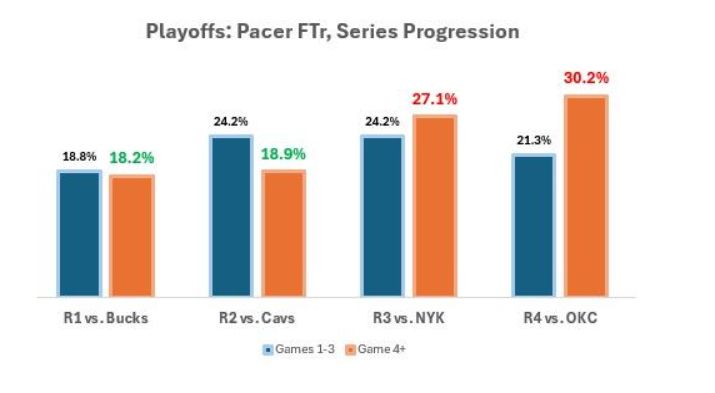
Then came the conference finals against New York, where the free-throw rate suddenly spiked. The Knicks were more physical and willing to foul, and they pushed Indiana to a competitive seven-game series.
Now we’re seeing the same pattern with Oklahoma City. The Thunder are committing about 21 fouls per game, making them one of the most foul-prone teams in the playoffs. Traditional wisdom says this should hurt them. Instead, it might be their best defensive strategy.
Breaking the Rhythm
Think about it from Indiana’s perspective. You’re trying to push the ball up court, get into your offense early, and maintain that breakneck speed that makes you special. But every time you drive to the basket, there’s contact. Every time you start to build momentum, the whistle blows. Suddenly, instead of flowing into your next action, you’re standing at the free-throw line while the Thunder sets their defense.
ESPN’s analysis of the Finals matchup notes that Oklahoma City’s defensive intensity, led by players like Lu Dort and Cason Wallace, naturally leads to more fouls. But what looks like a weakness might actually be strategic genius. Every foul is essentially a timeout that doesn’t cost the Thunder anything except the possibility of two points.
As ESPN’s detailed breakdown of ball pressure explains, the Thunder’s aggressive approach forces opponents to work harder just to get into their offense. When you combine that constant pressure with strategic fouling, you create an environment where Indiana can never quite find their preferred tempo.
The Thunder foul again, not letting Timberwolves to have a 3-point attempt to tie the game. pic.twitter.com/fXKkXmZzes
— MrBuckBuck (@MrBuckBuckNBA) May 27, 2025
The chess match here is fascinating. Indiana wants to turn every game into a track meet. Oklahoma City seems perfectly willing to turn it into a free-throw shooting contest. It’s not pretty basketball, but in a series where every possession matters, controlling tempo might matter more than avoiding fouls.
This strategy won’t work if the Thunder’s stars get in foul trouble, and it certainly won’t work if Indiana starts making an unusually high percentage of their free throws.
But as a tactical wrinkle designed to throw the Pacers off their game? It’s brilliantly counterintuitive. Sometimes the best way to stop a team from running is to make them walk to the free-throw line over and over again.
