
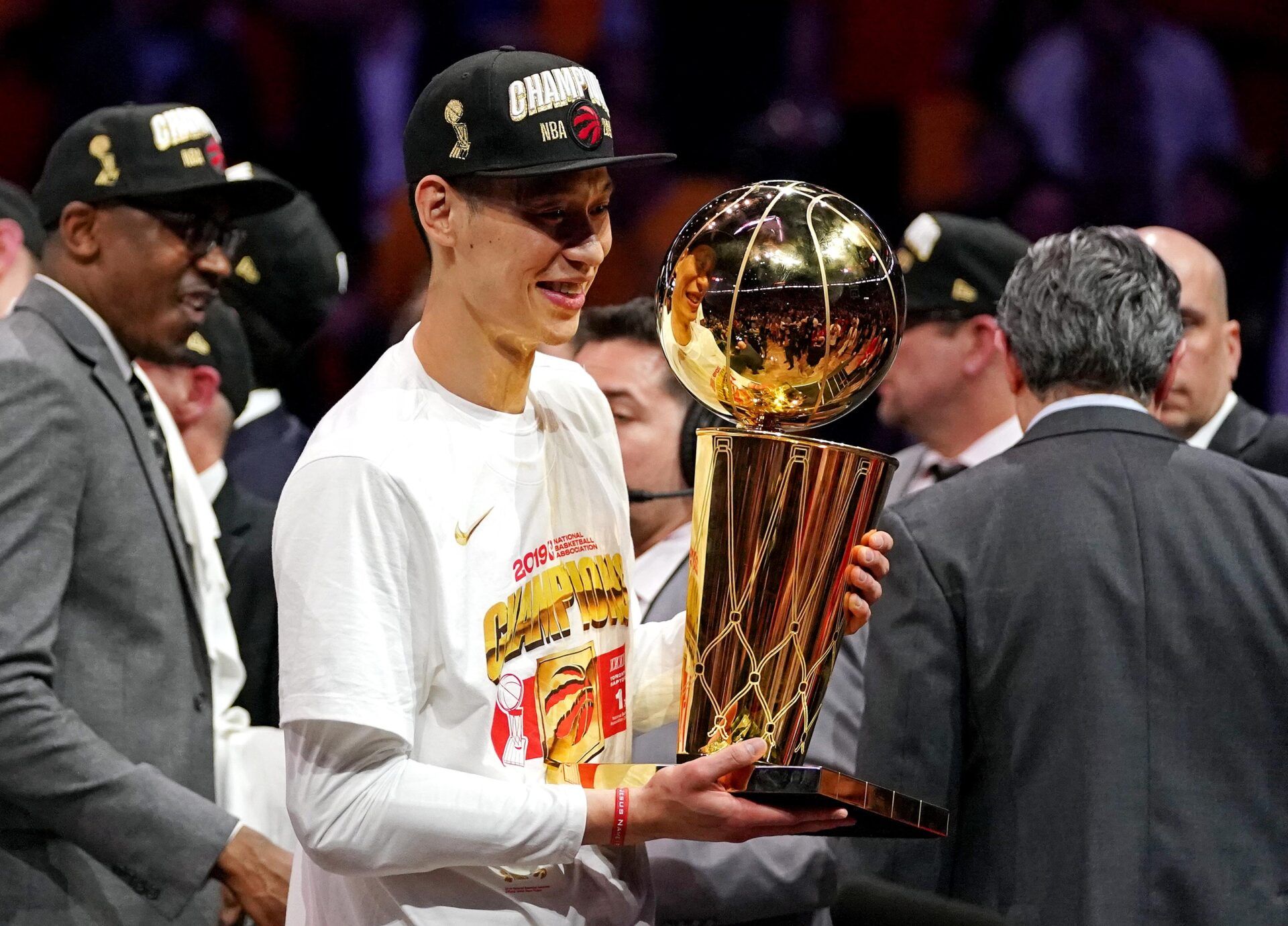
Jeremy Lin has officially closed the book on his 15-year professional career. The 37-year-old announced his retirement with a message that felt like both a thank-you note and a victory lap for a journey that once seemed impossible.
The undrafted Harvard guard, who famously slept on a teammate’s couch before his big break, thanked “the fiercest competitors under the brightest lights.” Lin admitted that saying goodbye was the hardest decision he has ever made and promised fans that their connection would “go beyond just playing.”
With that, the door shut on a career that bent the NBA’s arc, broadened who gets believed in, and gave February 2012 its own proper noun: Linsanity.
How Did a Phenomenon Named Linsanity Ignite the NBA?
In early 2012, New York was wobbling, minutes were scarce, and the margin on Jeremy Lin’s NBA life felt razor-thin. Then, February 4, 2012 happened. Lin erupted for 25 points and seven assists off the bench against the Nets, a feat that turned heads. Just two nights later, in his first start, he delivered again with 28 points and eight assists against the Utah Jazz.
Then, the avalanche came. Lin unleashed a flurry of darts off ball screens, applied fearless pressure at the rim, and gave a city a reason to rediscover its voice. Over a 10-game span, Lin averaged an incredible 24.6 points and 9.2 assists.
That stretch included a 38-point detonation at Madison Square Garden against Kobe Bryant’s Lakers and a Valentine’s Day dagger three-pointer in Toronto that rattled in with the volume of a subway train.
Never forget Jeremy Lin waiving off Kobe and hitting the clutch 3
pic.twitter.com/ncYaDjPXyB
— Overtime (@overtime) August 31, 2025
During that peak 10-game surge, the Knicks went 8–2. “Linsanity” became both a highlight reel and shorthand for unlikely grace under a blinding glare. In 35 total games with the Knicks that season, he posted 14.6 points, 6.2 assists, and 1.6 steals.
What Was the Lasting Impact of Lin’s Career?
Linsanity resonated far beyond the box scores. It rewired the perception of undrafted guards, Ivy League hoopers, and, most importantly, the representation of Asian and Asian-American athletes on an NBA court. Teammates who did not recognize him upon his arrival learned his name quickly, and kids who had never seen themselves in NBA layups suddenly did.
He led by playing instead of preaching, and his visibility mattered then and still does now.
Jeremy Lin retires: “Its been the honor of a lifetime to compete vs the fiercest competitors under the brightest lights…to challenge what the world thought was possible for someone who looks like me.…I’ll forever be the kid who felt fully alive everytime I touched a basketball” pic.twitter.com/Nf2CcBtbIS
— New York Basketball (@NBA_NewYork) August 31, 2025
His unlikely ascent translated into significant financial success, with career earnings of about $65.8 million, including multiyear deals with the Houston Rockets in 2012 and the Nets in 2016.
Across 480 career NBA games with eight different franchises, he averaged 11.6 points, 4.3 assists, 2.8 rebounds, and 1.1 steals.
His journey culminated in a 2019 NBA championship with the Toronto Raptors, making him the first Asian-American player to lift the Larry O’Brien Trophy. Years later, as anti-Asian sentiment spiked, the memory of a packed Madison Square Garden roaring for a Taiwanese-American point guard landed like a counterpunch.
What Challenges Defined Lin’s Post-Knicks Journey?
A torn meniscus abruptly ended his 2011–12 season with New York. That offseason, his tenure as a Knick officially ended due to restricted free agency and a “poison pill” offer sheet from Houston that New York chose not to match. It’s a lingering question for fans: What if he had never gotten hurt that spring, or what if New York had matched the offer?
Despite the Knicks winning 54 games the next year without him, Lin’s star never completely disappeared. He played all 82 games in 2012–13 with Houston before moving on to Los Angeles, Charlotte, Brooklyn, Atlanta, and finally Toronto.
His roles shifted constantly: he was a starter, a sixth man, and a stabilizer. A ruptured patellar tendon on opening night of the 2017–18 season with Brooklyn was another major setback. Through it all, his theme remained the same: he was a true craftsman with conviction and a knack for tilting a game’s temperature.
How Did Lin Continue His Career Beyond the NBA?
After his time in Toronto, Lin kept hooping. His journey took him through stints in the Chinese Basketball Association, a run in the G-League, and a final stop in Taiwan. There were more bumps along the way, including a concussion scare, but he carried himself gracefully, taking the game to new places where it could grow.
He brought his fans along for the ride, managing everything with tempo and toughness. His career was earned, not given. It was brief enough to feel impossible yet long enough to feel undeniable. The film 38 at the Garden captures how close it came to never happening and how many doors swung open when it did.
The sight of a 6-foot-3 guard from Palo Alto, undrafted out of Harvard, cooking drop coverage at the world’s loudest arena still makes your heart race. In the final chapter, Lin leaves behind a legacy that includes eight NBA teams, one championship, and millions of fans who will forever carry his story with them.
