
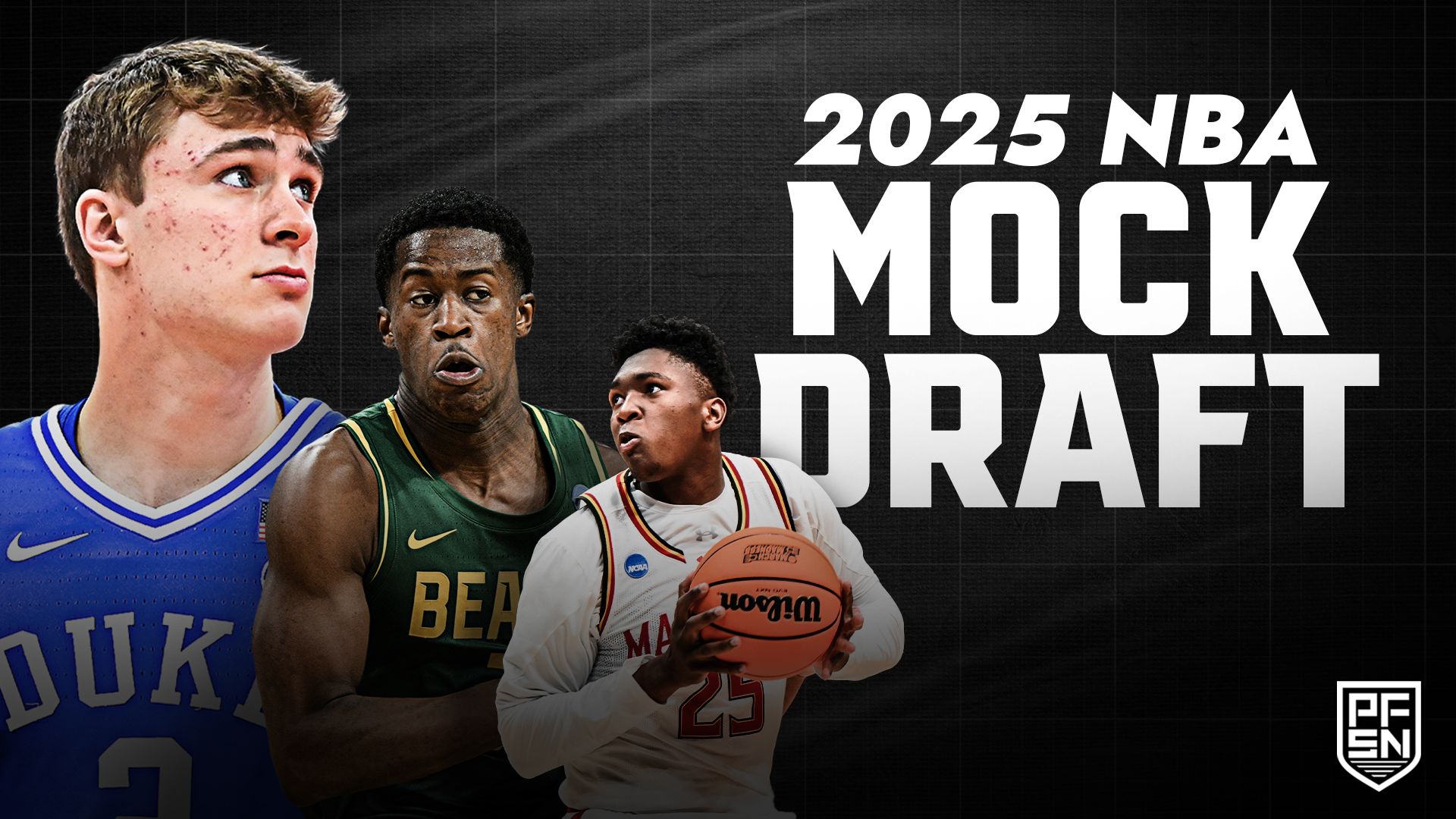
Who will your favorite team add on June 25? The grades for these prospects are incredibly close, and while I believe the top option is a cut above the rest, there are no shortage of large tiers, thus giving draft day the potential to be wild.
How do I think it’ll play out? As we sit here today, here’s what we are looking at.
This 2025 NBA Mock order will be determined by the NBA Draft Lottery on May 12.
1) Washington Wizards
Cooper Flagg, Duke
The Wizards are 109-230 over their past 339 regular season games, the exact mark that the Cavaliers held ahead of winning the 2003 lottery.
They took LeBron James. They increased their win total by 18 games in his first season and averaged a tick under 50 wins during the King’s first stint (seven seasons).
The “Wizards” have never won 50 games in a season and the last time this franchise did (then known as the Bullets), they were led in scoring by Elvin Hayes, a man born three months before the first general-purpose computer was unveiled to the public.
It’s been a minute.
Forecasting a James-like impact from Cooper Flagg isn’t fair, though what he has shown on the national stage has things trending in that direction. He wasn’t far from a 50/40/90 shooting split last year at Duke, not bad given that he was labeled as the primary threat from the jump.
There will be bumps in his transition, but there figures to be far more peaks than valleys. Washington isn’t in position to push for the playoffs this upcoming season, but if the ping pong balls go their way, this franchise will sniff meaningful spring games sooner rather than later.
2) Utah Jazz
VJ Edgecombe, Baylor
Utah has some interesting pieces in place, but an athletic point guard has to be near the top of their wish list. This is a team already functioning at an above-average pace despite a lack of a true offensive leader.
There were whispers of “Dwyane Wade” on the broadcast of his game against Arizona, and while I think that’s overly optimistic, VJ Edgecombe’s skill set is deserving of such a comp.
3) Charlotte Hornets
Dylan Harper, Rutgers
“Underwhelming introduction to the basketball public.”
I’ve seen that written about Dylan Harper’s freshman season, and that tells you just how high the expectations were. He posted the first triple-double for the Scarlet Knights in over 40 years (nearly had a second in his final collegiate game), averaged 19.4 points, 4.6 rebounds, 4.0 assists, and 2.0 steals-plus-blocks per game.
In a four game stretch in late February, early March, with plenty of film for opponents out there to defend to his weaknesses, Harper shot 56.6% from the field (12-25 from 3), poured in 22.3 points per game, and had two more steals than turnovers.
Yeah, he’s going to be just fine.
The Hornets are invested in LaMelo Ball, Miles Bridges, and Brandon Miller for another 2+ seasons and adding Harper to that explosive trio gives this team the opportunity to show enough promise in those seasons for this team to feel good about their foundation moving forward.
4) Philadelphia 76ers
Ace Bailey, Rutgers
The Philadelphia 76ers went from NBA Finals contenders to a tanking franchise. As disastrous as their 2024-25 season was, that pivot could pay off via a top-five pick in a loaded draft. The Sixers have a 64% chance of keeping their pick, which would enable them to add a potential All-Star and potentially pivot toward younger building blocks, like Tyrese Maxey and Jared McCain.
Ace Bailey will probably be the second Rutgers player drafted in June, but he produced a tremendous freshman season in his own right. The 6’10” forward averaged 17.6 points and 7.2 rebounds per game on 46% shooting for the Scarlet Knights.
Bailey’s shot selection will need to improve against NBA defenders, but his ability to hit difficult shots could make him more valuable in clutch situations and the playoffs, when the pace slows down compared to the regular season.
A smooth and explosive athlete, Bailey’s physical profile should immediately translate to above-average defense. As his instincts improve, he could also improve upon the 1.3 blocks per game he averaged in college, evolving into a rim protector who also can’t be targeted in space by ball handlers.
5) New Orleans Pelicans
Derik Queen, Maryland
Derik Queen’s buzzer-beater during the NCAA Tournament may or may not have been a travel, but the skill set it took to even attempt such a shot, with every person on the planet knowing where the ball was going, speaks to the upside of a versatile big with NBA size.
The Pelicans are handicapped by their finances. They have nine figures sunk into the Zion Williams/Dejounte Murray/Trey Murphy III trio for each of the next two seasons, making an instant impact pick who can play alongside them the top priority.
Queen is a good fit for this roster as it is, and is an interesting building block next to Yves Missi (9.1 points, 8.2 rebounds, and 1.3 blocks in 26.8 minutes per game as a rookie) when it comes to evaluating this frontcourt long-term
6) Brooklyn Nets
Tre Johnson, Texas
Tre Johnson has proven capable of getting buckets during his freshman season, which makes him an interesting addition to a team that is looking to tear things down to the studs.
A point guard with size (6’6”) is a great place to start when it comes to trying to compete in basketball as we know it today. He might not be a traditional point guard and could struggle to defend the position, but if he can establish consistency with his jump shot, the bones for a starting asset are certainly in place.
7) Toronto Raptors
Jeremiah Fears, Oklahoma
The Raptors lack depth, but they have a stronger nucleus than most of these lottery teams. Brandon Ingram, Immanuel Quickley, and Scottie Barnes are all making north of $30 million for at least the next three seasons, and that doesn’t include two more years of a player in RJ Barrett that could be viewed as a long-term piece.
There might be some skill duplication in Fears and some of those pieces, but this franchise loves having slashing players that can cause matchup problems.
Say what you will about Fears, but he’s confident. Despite converting just 28.4% of his triples, he continued to fire away (over 32% of his shots came from distance).
To some, that would appear to be a weakness. Maybe to most. That said, Toronto ranked 29th in three-point rate last season and are in desperate need of some floor stretching. Could they view Fears as an enticing player who is jump shooting consistency away from being a major part of what they want to do alongside this expensive core?
I think so.
8) San Antonio Spurs
Kon Knueppel, Duke
There is no such thing as a player who doesn’t fit in San Antonio thanks to what Victor Wembanyama brings to the table. He needs to be healthy, of course, but the Spurs will be drafting as if their franchise centerpiece continues to build on the unique upside presents and if that’s the case, sign me up for as many pure jump shooters as possible.
I don’t want to say that we will see San Antonio structure their roster around Wemby like teams have around LeBron James – but I wouldn’t hate it. Stephon Castle is coming off a season that saw him win the rookie of the year, a campaign in which he made over half of his shots from inside the arc.
This team can be awfully good, awfully fast and Knueppel offers a ready-made profile that fits into the puzzle they are putting together.
9) Portland Trail Blazers
Danny Wolf, Michigan
The Blazers have a young core that checks the upside boxes. Donovan Clingan can hold his own on the interior against just about anyone (if that set shot three-pointer develops, this team could elevate well above short-term expectations) while the Deni Avdija’s, Scoot Henderson’s, and Shaedon Sharpe’s (21.2 PPG post all-star break on 46.6% shooting from the field) of the world are projects with potential.
Unlocking that potential is the task at hand, and a do-it-all big like Danny Wolf might be the skeleton key. He’ll need some time to develop, but the ball-handling confidence at this size is the type of trait that gets teams out of the lottery in a hurry.
The Blazers were a predictable offense in 2024. With the fifth-lowest three-point percentage in the league, they couldn’t threaten defenses in many ways. Wolf may not profile as a prolific shooter (33.6% from three during his 90 games at Michigan), but the attention he demands with the ball in his hands could open up plenty of quality looks.
Could the defense use some work? Sure, but that’s nitpicking in this offense-driven league for a player that would have one of the better shot blockers in the game behind him. We saw him play next to Vlad Goldin last season, so he should be plenty comfortable in the role that Portland would ask of him and that makes him rookie of the year candidate if everything falls just right (Cooper Flagg is going to be the overwhelming favorite, but Wolf being on the ballot would be my expectation).
10) Houston Rockets
Noa Essengue, France
When the Rockets are humming, it’s beautiful. We saw them handle the Warriors in an elimination game with relative ease, and performances like that figure to be more common as this core develops together.
Noa Essengue has the body composition of a pro at just 18 years of age and his easy athleticism makes him a very natural fit for this team. The shooting is a work in progress and that’ll need to be addressed, but Houston did draft Reed Shepard last season to hopefully handle some of that lift long-term.
This team is good enough to invest in a profile and trust their coaching staff to mold him into the asset they need. He’s young enough to spend up on such a prospect and the lack of immediate pressure would also be helpful when trying to project his development.
11) Chicago Bulls
Rasheer Fleming, Saint Joseph’s
Rasheer Fleming made the most of his three years in school, improving every step of the way.
- First two seasons: 49.2% FG, 31.3% 3’s, 63.6% FT
- 2024: 53.1% FG, 39% 3’s, 74.3% FT
The ability to gradually develop is something that figures to have NBA teams salivating, as there is a lot in this profile as it is, let alone if there’s growth to be had. The shooting is no longer a weakness and it’s made him a more potent option off the bounce thanks to his above average athleticism.
He’s likely going to be asked to be a slashing wing at the pro level and in that role, he’s going to need to improve both as a passer and an on-ball defender. Neither of those flaws impacted his college production in a big way because of how he was used, but at this level, any player under seven feet tall is going to need to be able to square up with capable ball handlers.
To me, this looks like an NBA player whom you build around his weaknesses instead of trying to fit him into a rigid structure.
12) Dallas Mavericks
Kasparas Jakucionis, Illinois
“Defense wins championships.”
Who knows. In 2025, I’m not sold that the dated mantra that Nico Harrison continues to regurgitate is as apt as it once was, but they are obviously solid on that front when at full strength.
Even if you subscribe to that train of thought, at some point, putting the ball in the bucket is a good idea. Kyrie Irving is rehabbing his torn ACL, and that is naturally going to stunt the growth of this franchise as a whole, but Kasparas Jakucionis is a fluid shooter who can space the floor from the jump.
His general feel for the game should translate well and while athleticism isn’t his calling card, his ability to position himself in good spots helps mask that at some level. When it comes to marrying a skill set with a need, this pick makes plenty of sense, though I do think Dallas we need a creative guard (ideally, a healthy Irving), to truly evaluate how impactful Jakucionis can be at this level.
13) Atlanta Hawks
Khaman Maluach, Duke
The Hawks ranked 20th in defensive efficiency this season, their best ranking in the past four seasons but still a prohibitive one that cost them dearly in trying to make postseason noise of any kind.
This team does have some interesting defensive pieces, and the addition of Khaman Maluach would give them a chance to rank in the top half (maybe the top third?) of the league on this side of the floor.
We know that, as long as Trae Young is in town (not a given at this moment), this offense can generate looks. That means that Maluach will not be asked to play into his weakness and be allowed to flourish as a rim running big and stand still jump shooter.
His defensive prowess is strong as it is and could be refined even further once he gets into an NBA building – he’s been playing basketball for less than six years and, at times, it shows. The development curve for Malauch is as enticing as what he already brings to the table and 90% of the NBA could use a front court player like this.
14) San Antonio Spurs
Egor Demin, BYU
There’s a “jack of all trades, master of none” feel when it comes to Egor Demin’s one collegiate season. The 6’8” swing averaged seven triples per game during BYU’s tournament run and showed well for himself in a pair of widely spaced games to end his career with 15 assists and just two turnovers across 54 minutes.
There are some shot selection questions in this profile and you could pick apart his comfort level off the dribble, but that’s nitpicking for a kid who just turned 19 years of age. I’m not labeling him as a franchise centerpiece, but an impact player for years to come that can help push a Spurs team that I expect to be in the title mix with their current core over the top.
15) Oklahoma City Thunder
Jase Richardson, Michigan State
Every pick is a luxury pick for Oklahoma City these days, so why not at a high-IQ player that profiles as a microwave scorer?
Richardson would be more of a backcourt insurance policy for the Thunder than an instant impact player, but you can never have enough scoring threats that can change the course of a game at the drop of a hat.
I don’t expect Jase Richardson to mirror the career of his father, but he’s got raw talent and a year of Tom Izzo reps under his belt – he looks a lot like a high-floor/low-ceiling prospect to me and that’s exactly what OKC figures to be looking for as they try to maximize this seemingly huge window they have to operate as a Tier 1 team in this league.
16) Orlando Magic
Kam Jones, Marquette
Every team can use a player like Kam Jones, it’s just a matter of the price you’re willing to pay for it. He scored over 2,000 points while with the Golden Eagles, shooting over 47% from the field and 36% from 3 in those games. He scored against every sort of defense at the collegiate level and can get up good looks in a phone booth – we’ve seen him do it and nothing in his physical profile suggests that he won’t be able to get into his flow at the professional level.
But is there more to his trajectory?
There were too many defensive lapses for him at Marquette, and the in-between size profile isn’t optimal on either end of the court. This isn’t a perfect profile, but his strengths align with the weaknesses of Orlando, and they have the type of roster that can mask his weaknesses.
The Magic haven’t looked like a real threat since the Jalen Suggs injury – get him back at full strength and pair him with a player like Jones and we could be looking at a real threat in the Eastern Conference.
17) Miami Heat
Ben Saraf, Israel
Tyler Herro isn’t a point guard, but he was asked to do a little bit of everything for this Heat team last season and, to be honest, he held up well. That said, adding a point guard with nice size would help alleviate some pressure and add a dimension to this team on both ends of the floor that simply didn’t exist in 2024-25.
Ben Saraf would be an interesting add, but it might not happen. It might not happen because mock drafts are awfully hard to do, but also because there’s a world in which the Heat are offering everything they can to put themselves in the middle of the Giannis Antetokounmpo sweepstakes (Milwaukee currently does not have a 2025 first-round pick).
And if that occurs? I like Ben Saraf for the Bucks. In general, I think the lefty’s ability to do the simple things well pairs nicely with Herro and early mock trades have Miami’s shooting guard as a part of any trade with Milwaukee – so sign me up for a Saraf/Herro backcourt coming your way, I’m just not 100% sure on the color of jersey they will be wearing.
18) Washington Wizards
Hugo Gonzalez, Spain
The Wizards need a bit of everything, even after selecting Flagg at the top of this mock. This franchise doesn’t have their point guard of the future on their roster just yet (I’m assuming they’d prefer to get Bub Carrington off the ball if possible), but an array of versatile front court players does make operating this offense a bit easier and given who is left on the board, I could see them building through size and figuring out the rest at a later date.
Hugo Gonzalez turned 19 years of age this winter and is an athletic wing. His shot is a work in progress, though playing next to Flagg would help the quality of looks. He’s a bought in defender who gets the most out of his athleticism on that side of the floor, a nice trait to have for a team looking to establish a culture.
Even with the top overall pick, Washington’s time frame is more long than short term – by the time Gonzalez can legally buy an adult beverage, this team might be more positioned to make the playoffs and at that point, I like his chances at being ready for a significant role.
19) Minnesota Timberwolves
Carter Bryant, Arizona
Carter Bryant came to Arizona with plenty of pedigree, and despite limited usage (five starts, 19.3 minutes per game), the tools at his disposal didn’t disappear. He remains a player who can do a bit of everything with a nice size profile (6’8”, 220 pounds).
Most label him as a 3-and-D type of prospect that has the potential to grow into more with time, and I think that’s just fine for a ‘Wolves team that is more building around the edges than anything. Anthony Edwards is going to be the straw that stirs this drink for years to come, and Bryant’s basic skill set is one that projects nicely alongside a ball-dominant star.
20) Brooklyn Nets
Asa Newell, Georgia
Speaking of Edwards, his alma mater is going to give the Association a first-round pick in the form of Asa Newell. He’s not the next Edwards, but he did show well for himself with a mediocre roster around him as a young kid against grizzled SEC competition (15.4 PPG).
We need to see more in the way of jump shot consistency from Newell if he is going to be a part of the Brookly n rebuild, but putting an option like this next to Tre Johnson and allowing them to learn together is a logical move and one I think they highly consider should the raft break the way I’ve laid out up to this point.
21) Utah Jazz
Tahaad Pettiford, Auburn
Tahaad Pettiford helped himself during March Madness, specifically in the Sweet 16 win over Michigan, when he showcased his elite ability to create for himself and knock down tough shots, a skill set that is catnip to NBA teams.
The only thing Pettiford has more of than talent is confidence, something that is going to be needed given his undersized frame. He’s not a clean fit for all situations, but he has the potential to run with a bigger guard where he can play to his offensive strengths without compromising the integrity of the defense.
22) Atlanta Hawks
Liam McNeeley, UConn
I’m going to bend the knee to professional scouts here and trust that Liam McNeeley’s jumper projects well to the professional game.
My eye matches the scouting reports, but the numbers last season were alarmingly poor (38.1% FG and 31.7% from three). He made just three of 16 triples during the NCAA Tournament, but from a form perspective, everything seems in place and the fact that he was a knock down free throw shooter (110-127, 86.6%) hints that better days are ahead.
The Hawks ranked 18th in three-point rate and 19th in three-point percentage this past year. That’s hard to do with Trae Young as the focal point, but it speaks to some of their limitations. There’s a lot of talent on this Atlanta roster and while McNeeley wouldn’t project as a ROY candidate, I do think he’d have the potential to impact winning in a reasonable way from Day 1 by filling a pretty glaring need.
23) Indiana Pacers
Will Riley, Illinois
A player driven by confidence that can score in a variety of ways, who can thrive in a high-tempo environment?
Sounds like a Pacer profile to me!
Tyrese Haliburton runs an efficient and quick strike offense that has Indiana thinking big things and Will Riley is the type of wing that can give them good minutes. Consistency is a flaw for many rookies and he’s not an exception on that front, but he’s comfortable with the ball in his hands, something the Pacers require, and is athletic enough to hold his own at the professional level sooner than later.
24) Orlando Magic
Joan Beringer, France
The Magic are set on the wings, making this a bigs and smalls sort of draft. Many people are keeping Walter Clayton Jr. in the state of Florida, but I’ve already assigned them a cold-blooded scorer in Kam Jones, so I’m taking this pick to the land of the giants.
Joan Beringer has a 7-4 wingspan and is just 18 years of age. He’s going to require time to develop and he should be afforded that time with Mo Wagner under contract for one more year.
The future of this franchise is in the hands of Paolo Banchero and Franz Wagner, but pieces like Joanthan Isaac, Jalen Suggs, and these first two picks could make this not only the best team in Florida, but a real threat to win multiple playoff series in the near future.
25) Oklahoma City Thunder
Bogoljub Markovic, Serbia
Trying to find “needs” for this Thunder team is a fool’s errand, and that uniquely positions them to take a wait-and-see approach should they keep this selection.
Markovic is a pick-and-pop big that profiles as a legitimate floor stretcher at the professional level. That’s a skill set you can’t have too much of, and it’s also one that would be awfully appealing to just about any team should the Thunder elect to make a move following this pick.
The Thunder are in a position of power and that means they can attack this draft in a variety of ways – nothing they do will impact their 2025-26 outlook in a significant way assuming health for their nucleus.
26) Brooklyn Nets
Joan Beringer, KK Cedvita Junior
Often described as a “project”, Joan Beringer didn’t pick up a basketball until he was a teen, and that has caught the eye of the scouting community. He offers the traditional center traits (rim protection and a fearless lob threat), but there’s a level of fluidity to his game that figures to translate well.
His skinny frame is a concern,n and we’ve yet to see any signs of a jump shot that can move less athletic bigs away from the rim. Those are fatal flaws that will keep him off the court if not developed, but given that he is essentially a blank canvas, NBA teams who trust their infrastructure could be intoxicated by the upside enough to overlook the risks.
27) Brooklyn Nets
Collin Murray-Boyles, South Carolina
Remember that blue/yellow dress social post we went through years ago?
If your answer was “yes”, that’s what we have in Collin Murray-Boyles. If your answer was “no” google it, spend a day arguing with friends, and come back to me.
If you want to see the flaws in this profile, they are obvious. Murray-Boyles doesn’t have a clean positional fit at the professional level and lacks a shooting profile (60 games at South Carolina: nine-of-39 from deep and a 69.5% conversion rate from the line). His production against ranked teams last season was sporadic to say the least (held to single-digit points in four such games, but he did hang 25 points on Auburn and made 10-of-11 shots in February at Missouri), and consistency rarely develops at the professional level.
Or is the dress blue?
His basketball IQ meshes well with plus-athleticism and buy-in on the defensive end. His size may not translate perfectly, but he plays bigger than he is, and we’ve seen Draymond Green make a Hall of Fame career out of doing just that.
This is a player to keep an eye on as we approach the draft. I find it likely that we get a handful of teams who fall in love with the tools at play here – who those teams are will determine exactly where he is drafted. Draft order matters, but this is the sort of profile that a team could trade up for.
28) Boston Celtics
Chaz Lanier, Tennessee
Chaz Lanier profiles as a hired gun type of offensive weapon from Day 1. He has exceptional range and has a great feel when it comes to scoring on the move (curl cuts, off the dribble, pick-and-roll situations, etc.) as a result of being the focal point of defenses all of last season.
At 6’4”, his size was more of an asset at the collegiate level than it will be at the professional one, but we’ve seen D’Angelo Russell average over 17 points per game for his career at a similar size, so it stands to reason that a self creator like this can get buckets in this league for a long time.
The concerns are straightforward – he hasn’t proven himself to be much of a playmaker for his teammates, and his athletic profile is simply ordinary. He’s an older prospect (turned 23 in December) and could be pigeonholeed as a microwave scorer. That’s not ideally what you want from a first-round pick, but that’s why we have him going to a ready-made situation as opposed to a franchise in need of saving.
29) Phoenix Suns
Walter Clayton Jr., Florida
The darling of March Madness, Walter Clayton Jr.’s stock is certainly on the rise. I have my concerns about his ability to carry over this momentum into the professional ranks (https://www.profootballnetwork.com/?post_type=nba&p=827627&preview=true) , but there is no denying his killer instinct being a unique trait that cannot be taught.
The scoring will take care of itself, but I do think his fit requires a specific fit and/or creative coaching. The shot selection is inconsistent, and the defensive stats are driven by a willingness to take significant risks – risks that could be dunks more often than not in the NBA.
Combo guards like this play for a long time in the league, but only a specific ones elevate into game changing talent. This Suns team is going to look different when 2025-26 opens than how it ended this year (Mike Budenholzer has already been fired, and it’s widely accepted that Kevin Durant will be wearing different colors), making them an interesting landing spot in a pseudo-rebuild situation.
30) Los Angeles Clippers
Nique Clifford, Colorado State
Age is a funny thing.
We know exactly what Nique Clifford is after seeing him appear in 154 games at the collegiate level, and depending on who you talk to, that’s either a great thing or a tremendous negative.
Does it mean that he’s ready-made for the pro game thanks to being confident in knowing who he is? Does it mean that he lacks upside due to a steady skill set and the fact that he turned 23 in February?
Both things, at some level, can be true. Asking Clifford to be the best player in this draft is a step I’m not willing to take, but is he one of the 10 least likely to bust?
I’d argue yes.
His free-throw rate and 3P% both spiked after transferring from Colorado to Colorado State, and if those offensive traits are here to stay, it’s easy to see him playing meaningful minutes for a playoff team in short order.
The Clips are in the midst of having a great season, but there’s no denying that there is risk in their star players when it comes to availability. In this instance, Clifford’s role would be limited, but he’d be in a position to still be a part of the rotation while also serving as insurance.