
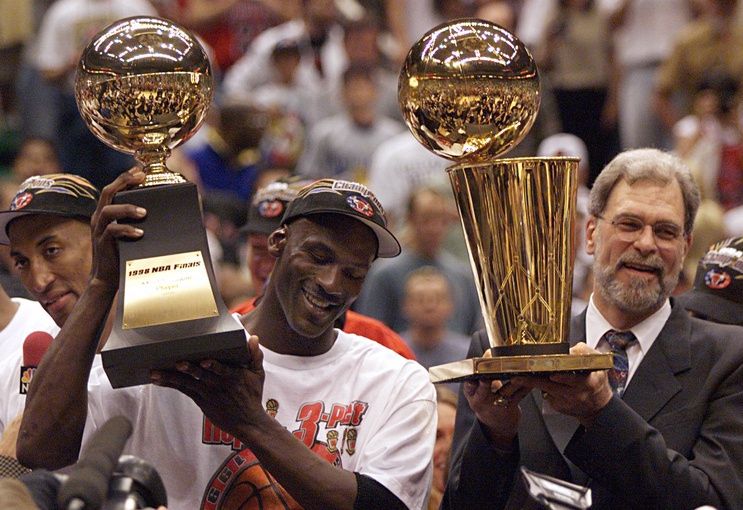
While Michael Jordan dominated the NBA court, his earnings did not always reflect his unparalleled stature. For a significant period, Jordan was not among the league’s highest-paid players. However, this dynamic shifted dramatically after his initial contract with the Chicago Bulls concluded, setting the stage for lucrative new agreements.
The New York Knicks, champions in 1970 and 1973, had long sought to reclaim their championship glory. A revival began under coach Pat Riley, whose arrival in 1991 ushered in a new era for the team. In the 1993-94 season, the Knicks posted a strong 57-25 regular season record before ultimately losing to the Houston Rockets in the NBA Finals.
With repeated defeats in the playoffs, New York recognized its urgent need for an iconic player, and few could match the impact of Jordan.
When Michael Jordan Almost Joined the New York Knicks
Jordan became a free agent in 1996, his first time on the open market since his return from his initial retirement in 1995. Desperate to overcome the Bulls’ dominance, the Knicks actively pursued Jordan. During Jordan’s era of supremacy, the Bulls eliminated the Knicks from the playoffs a total of five times. Before the critical 1996 free agency period, Jordan’s Bulls had defeated the Knicks in four prior playoff series.
Frustrated by consistent playoff losses to Chicago, Madison Square Garden President and CEO Dave Checketts sought to bring Jordan to New York. In 1996, after the Bulls won the NBA championship, Jordan famously embraced the ball on the court and wept. This profoundly emotional moment marked his first NBA title since his father’s tragic murder.
Michael Jordan dropped 45 PTS on the Magic to sweep the ECF series! (1996)
45 PTS
5 AST
1 STL
1 BLK
70% FG pic.twitter.com/QUNzkYjUNJ
As reported by ESPN, Sam Smith, the Chicago Tribune’s Bulls beat writer and author of “The Jordan Rules,” wrote, “The summer sort of dragged on, Jordan technically a free agent, but [no team other than Chicago] had money to pay him. There was nowhere he could go. Then, I had heard this thing about the Knicks.”
Mike Wise, a former Knicks beat writer for The New York Times, echoed this sentiment, emphasizing that defeating the Bulls was the Knicks’ paramount goal.
Ernie Grunfeld, then the Knicks General Manager, stated, “If we could have gotten it done financially, we would have dropped everything else. Believe me. In the media, Jordan’s camp let the word out that, if he didn’t get what he wanted from Chicago, he would look at other things.” Checketts added that the Knicks intentionally created significant salary cap space for a potential blockbuster acquisition of Jordan.
This day in #Bulls history: The Bulls signed Michael Jordan to a one-year contract in 1996. pic.twitter.com/u7a8lqQiaT
— Chicago Bulls (@chicagobulls) July 24, 2017
Twelve years prior, in 1984, Jordan signed a seven-year rookie deal with the Chicago Bulls worth approximately $6.3 million. Coincidentally, the NBA’s salary cap officially took effect for the first time in the 1984-85 season, set at $3.6 million. Following the 1996 season, the Knicks offered Jordan a $25 million deal. Their vision was to pair him with star players Patrick Ewing, John Starks, Charles Oakley, and Allan Houston.
However, Jordan leveraged these negotiations to re-sign with the Chicago Bulls for a remarkable $30.14 million for one year, which at the time was the richest single-season contract in sports history. He then secured an even larger contract for the subsequent season, receiving a $3 million increase that brought his salary to $33.14 million.
Jordan’s Continued Dominance After His New Contract
Despite the intense contract discussions, Jordan delivered another phenomenal performance in the following year, the 1996-97 season. He played all 82 regular-season games, leading the Bulls to an impressive 69-13 record, which was tied for the third-best of all time at that point.
For his efforts, Jordan was the NBA MVP runner-up, finishing second to Karl Malone. He was also named to the All-NBA First Team, the NBA All-Defensive First Team, and was the NBA scoring champion for the tenth time. Averaging 31.1 points, 7.9 rebounds, and 4.8 assists per game in the playoffs, Jordan once again cemented his legendary status.
Michael Jordan dropped 46 PTS on the Knicks in ECSF Game 3! (1996)
46 PTS
4 REB
2 STL
49% FG (17/35) pic.twitter.com/NAgpk0SkXH
Jordan famously scored 38 points against the Utah Jazz in Game 5 of the NBA Finals despite battling an illness, a performance that became known as the iconic “Flu Game.” The Bulls ultimately defeated the Utah Jazz 4-2 in the series, earning Jordan his fifth NBA championship, and the second title in his second consecutive three-peat.
