
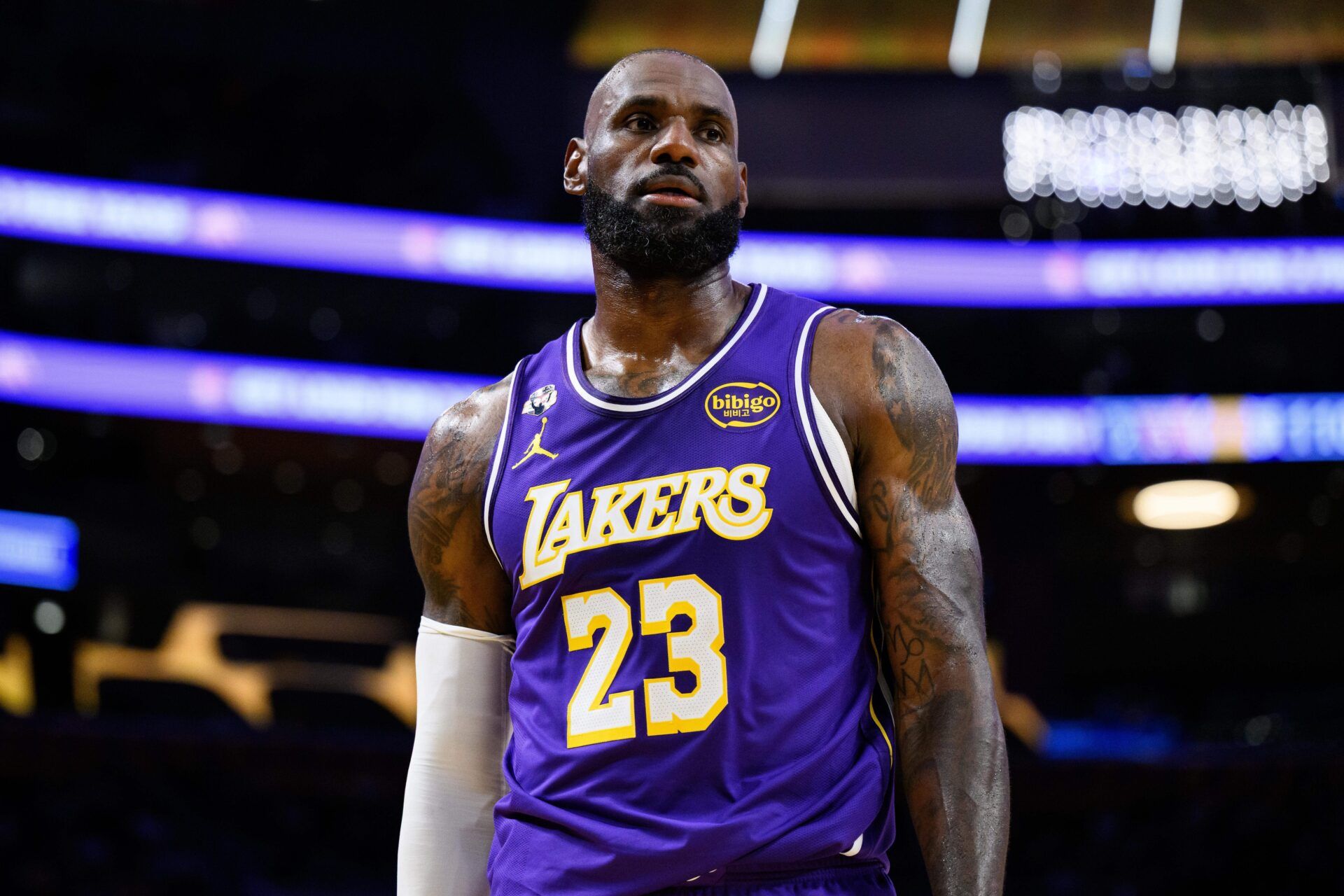
Moments of uncertainty around a generational player tend to reshape the league’s entire landscape. As LeBron James approaches a rare crossroads in his career, questions about his next move have begun to carry more weight than usual.
What comes next may not just define his future, but also reshape two franchises. The possibility of James leaving the Los Angeles Lakers has taken on a new dimension following insights from ESPN’s Dave McMenamin and Tim Bontemps.
For the first time in his two-decade career, James is set to enter unrestricted free agency, opening the door to scenarios that were previously unthinkable.
Could LeBron James Return to the Cleveland Cavaliers?
McMenamin outlined one such path, stating, “Yeah, a source in our story said that would be the cleanest fit. There could be a sign-and-trade scenario that the Cavs and Lakers would be able to pull off, which would get LeBron James more money potentially than, say, the mid-level exception if he stayed with the Lakers.”
“There could be a sign and trade scenario that the Cavs and Lakers would be able to pull off which would get LeBron James more money potentially than say the mid level exception if he stayed with the Lakers” – @mcten pic.twitter.com/hBoPLIoR5L
— Oh No He Didn’t (@ohnohedidnt24) March 31, 2026
This detail introduces a financial incentive that complicates the narrative around loyalty and legacy. The proposed framework centers on a sign-and-trade deal involving Cleveland Cavaliers center Jarrett Allen.
In this scenario, the Cavaliers would send Allen, who is owed $90.72 million through the 2028-29 season, to the Lakers in exchange for James. For the Lakers, this would address a clear roster concern by adding a reliable interior presence.
Jarrett Allen’s 2025-26 production, including 15.3 points, 8.5 rebounds, and 64% shooting, highlights his efficiency and consistency, traits the team has been seeking.
The Emotional and Competitive Impact of a James Reunion
From the Cavaliers’ perspective, the move carries both competitive and emotional significance. A third stint for James would reconnect the franchise with its most successful era. His previous tenure included two MVP awards, five Eastern Conference titles, and the franchise’s first championship in 2016.
That history adds a layer of narrative appeal that goes beyond basketball operations. McMenamin also pointed to organizational familiarity as a factor, noting that both front offices remain similar to those involved in the 2018 deal that created cap space for James to join the Lakers.
This continuity suggests that a complex transaction, such as a sign-and-trade, is not only possible but also realistic. Beyond finances and roster construction, the idea of a “retirement tour” in Cleveland introduces another dimension.
McMenamin emphasized the emotional pull of such a move, suggesting that no other destination could replicate the sense of full-circle closure that comes with James returning to his hometown team.
At the same time, uncertainty remains central to the situation. Retirement is still under consideration, and staying with the Lakers has not been ruled out. The Lakers’ current roster, including centers like Jaxson Hayes and Deandre Ayton, provides context for why adding a player like Allen could be appealing if James departs.
Ultimately, this scenario reflects more than a simple transaction. It represents a convergence of financial strategy, roster needs, and legacy considerations. Whether James prioritizes familiarity, financial upside, or continuity will determine how this pivotal chapter unfolds.
