
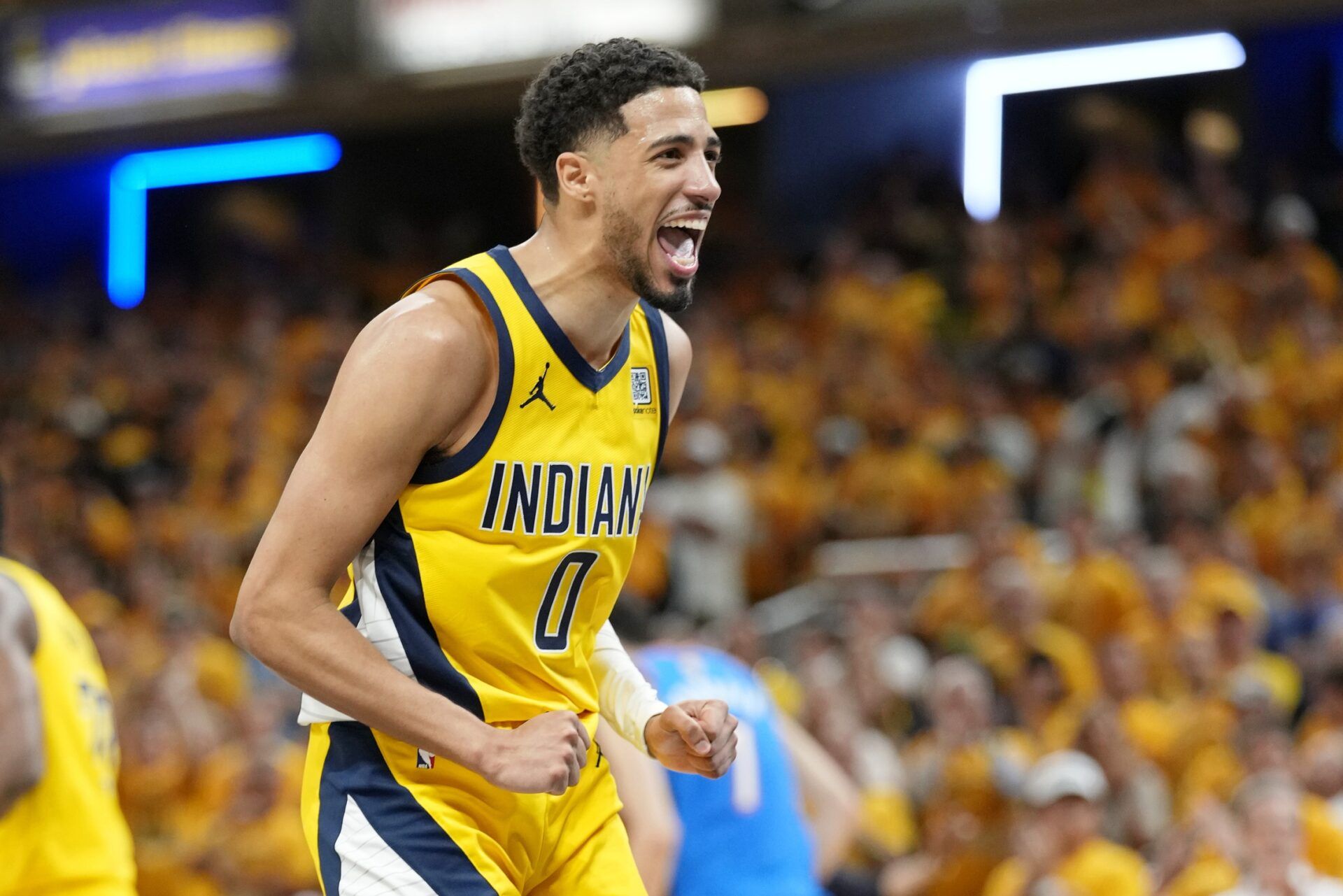
The Indiana Pacers have discovered a mathematical formula that could determine their NBA Finals fate against the Oklahoma City Thunder.
It’s not complicated analytics or advanced metrics. Rather, it’s a stark differential that separates victory from defeat: when the Pacers hit 50% of their pull-up three-pointers, they win. When that number plummets to 8.7%, they lose.
Sounds obvious, right? Maybe. Maybe not.

The Pacers-Thunder Numbers That Tell the Story
The disparity is jarring enough to make statisticians double-check their calculations. In Indiana’s two Finals victories, they’ve converted pull-up threes at an elite 50% clip. In their three losses? A dismal 8.7%, a percentage that would make even the worst shooting team in the league cringe.
Teams shooting at least 35% from three-point range have won 29 of 44 playoff games this postseason, but Indiana’s feast-or-famine approach takes this trend to an extreme.
Tyrese Haliburton follows up his three with a steal & slam 😤@GainbridgeFH is ROCKIN’ 🗣️ pic.twitter.com/IgQd6paUmK
— Indiana Pacers (@Pacers) May 26, 2025
The pull-up three has become basketball’s most valuable currency, particularly in high-stakes playoff moments. Unlike catch-and-shoot attempts that rely on ball movement and defensive breakdowns, pull-ups are self-created shots that showcase a player’s ability to generate offense independently.
For the Pacers, 27.3% of their three-point attempts in victories have come via pull-ups, a confidence indicator that drops to 21.7% in losses.
Why Pull-Up Shooting Defines Championship Basketball
Pull-up shooting creates something from nothing when defenses tighten and plays break down. Research from Sportico shows that defenses have relatively little influence on opponents’ outside shooting percentages, making pull-up proficiency a weapon that transcends defensive schemes.
The importance of this shot type becomes magnified in the Finals, where every possession carries championship weight. When the shot clock dwindles and set plays dissolve, teams need a player who can rise up and deliver. For Indiana, that burden falls squarely on Tyrese Haliburton’s shoulders, and the results have been binary.
During the regular season, Haliburton ranked second among qualified guards in pull-up effective field goal percentage at 53.9%, trailing only Zach LaVine and tied with Stephen Curry.
This elite company underscores his capability, yet the Finals have exposed a troubling pattern — when Haliburton’s pull-up game flourishes, the Pacers are nearly unbeatable. When it falters, they look ordinary.
Haliburton’s Jekyll and Hyde Performance
The stark reality is that Haliburton has accounted for 50.8% of Indiana’s pull-up points in victories, averaging an efficient 1.36 points per pull-up shot. He’s shooting an incredible 86.7% on game-tying or go-ahead shots in the final two minutes of the fourth quarter or overtime this season, cementing his clutch credentials.
However, in losses, those numbers crater dramatically. Haliburton’s share of pull-up points drops to just 30%, with his efficiency plummeting to 0.67 points per shot. The Thunder’s defensive approach — aggressive hedges and full-court pressure — has succeeded in disrupting his rhythm, forcing him into uncomfortable situations where his typically reliable pull-up becomes a prayer.
This volatility extends beyond mere shooting percentages. In Games 1-3, only 16.3% of Haliburton’s shots came in the final third of the shot clock. By Games 4-5, that number ballooned to 42.9%—a clear indicator that Oklahoma City’s defense is dictating terms and forcing Indiana into desperation heaves rather than quality looks.
The path forward for Indiana is clear but challenging. They must find ways to generate cleaner pull-up opportunities for Haliburton earlier in possessions, before the Thunder’s defense can fully load up. Home court has helped—the Pacers attempt shots on 45% of their drives at home compared to 40.4% on the road—but sustainable success requires more than environmental advantages.
As the series progresses, this 50% versus 8.7% divide looms as the ultimate barometer. For the Pacers to claim their first NBA title, they don’t need to reinvent basketball. They just need their pull-up threes to fall at a rate that transforms them from pretenders to champions.
