
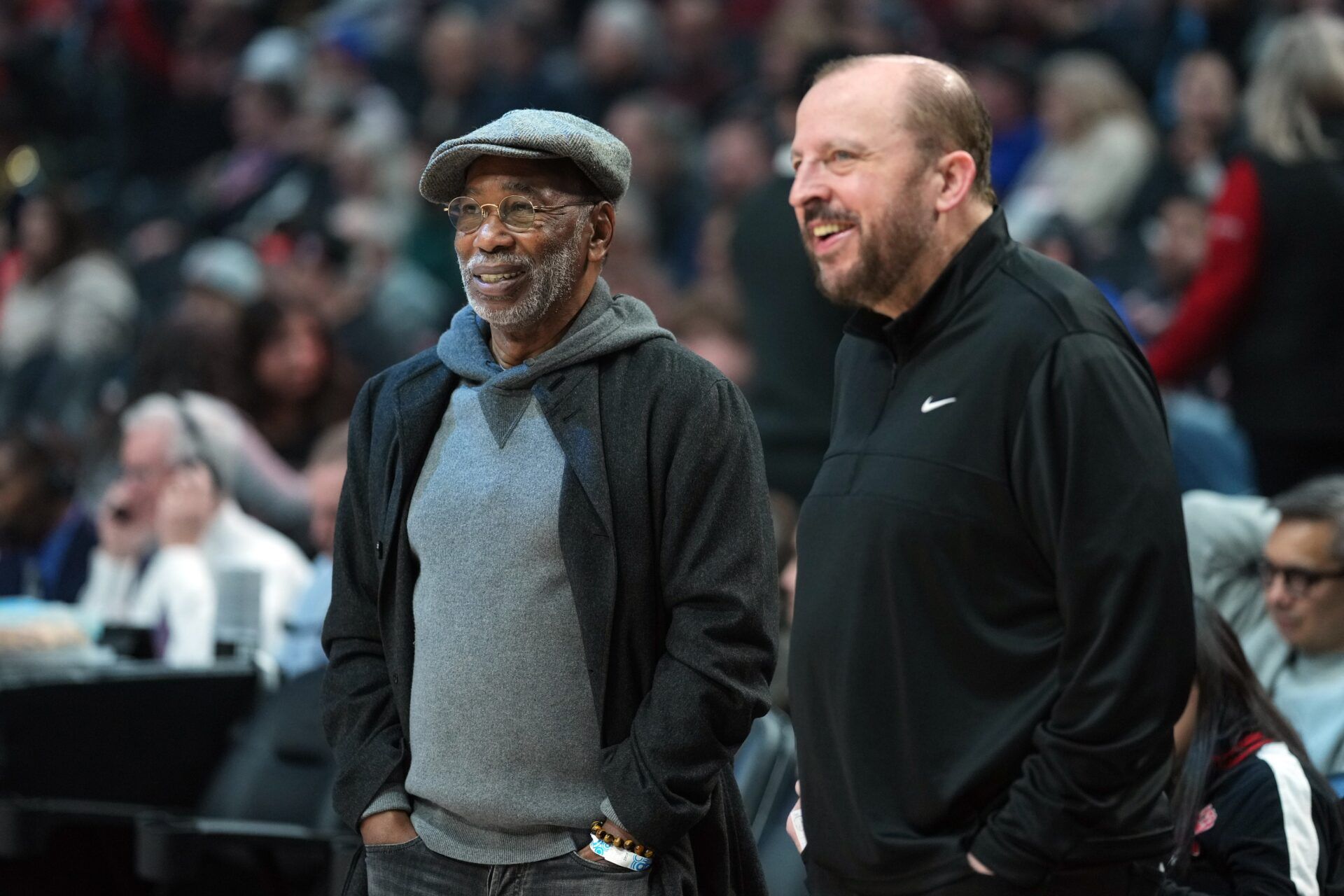
The former President of the Portland Trail Blazers, Larry Miller, has worked for years in the toughest parts of the sports world, building brands with steady effort and a fan’s passion. He helped turn Michael Jordan’s name from just a shoe into a worldwide business at Nike, a powerful force that connects different sports, countries, and age groups.
During most of that climb, he kept a piece of his story hidden.
Miller has led the Jordan Brand at Nike for many years, first as president and now as chairman of the Jordan Brand Advisory Board. When Nike made Jordan more than just a part of its business in the late 1990s, Miller helped turn it from just a product into a brand with its own identity.
Jordan Brand has become a worldwide symbol of hope, style, and competition. With Miller in charge, it grew worldwide, opened major stores like the one in Paris, and went from making hundreds of millions of dollars to billions in shoes, clothing, and culture. Miller constructed it while carrying a record.

The Secret Life of Larry Miller: How a Former Gang Member Rose to the Corporate Boardroom
He was incarcerated as a young man. According to jumpmysecretjourney.com, at 16, Miller joined a gang in West Philadelphia and committed an act of revenge by shooting and killing a man, a crime he kept hidden for decades.
Throughout his youth and early adulthood, he served time for murder and related offenses after being convicted and going in and out of prison and juvenile facilities.
After rebuilding his life through education and corporate success, he rose through roles that rarely offered opportunities to individuals with justice system histories. For years, even close colleagues were unaware of the complete story of his beginning.
Corporate America can celebrate redemption in speeches but still refuse to hire people who embody it. Miller grasped the contradiction and the power of storytelling. He decided to stop splitting his life in half.
Building a Multi-Billion Dollar Business: Miller’s Strategic Impact on Jordan Brand
Miller held finance and leadership roles at Jantzen, Kraft Foods, and Philadelphia Newspapers before joining Nike. Working with clothing taught him about products and understanding customers.
The food industry taught him how to operate at a large scale and manage operations. The media business showed him how stories spread and why getting people’s attention matters.
In 1997, he joined Nike as vice president and general manager of Nike Basketball, leading Jordan Brand, Nike Basketball, and Converse.
He was president of Jordan Brand from 1999 to 2006, returned to the role in 2012, and helped the brand grow into a business worth billions, working closely with Michael Jordan and Nike leaders.
Since 2019, Miller has been the chairman of the Jordan Brand Advisory Board, focusing on overall strategy rather than day-to-day tasks. An iconic brand is more than just a product. It encompasses community, ritual, and memory.
From Secret Journey to Real Infrastructure: Turning the Jump Memoir into a Movement
Miller tells the story of his move from the street to the boardroom in his book, “JUMP: My Secret Journey from the Streets to the Boardroom.” He discusses how incarceration was a part of his youth and how education ultimately changed his life’s trajectory.
A life can be altered by a single degree. One job can have a significant impact on a family.
Miller does not use slogans. They are personal math. The book introduced a new level of responsibility. If you have influence and survived, what do you owe the people still trapped where you started?
Miller chose to answer with infrastructure rather than speeches. This is where JUMP comes into play.
“It’s funny, because we do a lot of comparisons. Ken [Oliver, CEO & President of Jump] and I talk often about the parallels between what we were able to do building the Jordan Brand and how we can apply many of those same tactics and strategies as we build Jump,” said Miller.
“Over the years, I’ve learned a great deal about building a brand, managing an organization, and connecting with consumers, the people you want to build real relationships with. We’re focused on applying all of those skills and learnings to how we develop and grow Jump,” he added.
Miller concluded, “Ultimately, the goal is to have as much impact as possible, and we’re going to use whatever insights and skill sets we have and can tap into to make that happen.”
Miller and Oliver’s Vision: Building Career Pathways to Reduce Recidivism
Miller founded the Justice and Upward Mobility Project, along with Ken Oliver, who is the CEO & President, which supports people affected by the justice system.
The objective is to construct pathways to education, employment, and economic mobility for youth and adults affected by the justice system, using the cultural influence of sports, entertainment, and business as a catalyst.
“Having lived through the challenges of coming out of prison and trying to rebuild a life and a career, I understand firsthand how difficult that process can be. What’s needed to make success possible? For me, it felt natural to want to create opportunities that support people during that transition,” shared Miller.
READ MORE: Only 1 Person Has an Oscar and an Olympic Gold Medal, and It’s an NBA Legend
“We’re focused on figuring out how to help people not just come home and survive, but truly thrive. The lived experiences that both Ken and I bring have helped shape and form something we believe can genuinely accomplish that.”
JUMP exists to catalyze one million jobs and reduce recidivism by 50% by 2040. The numbers are intentionally measurable.
They are built to force partnerships to be real.
JUMP focuses on building gold-standard career pathway programs, convening local coalitions to create ecosystems that support First and Second Chance employment, developing media and narrative campaigns, and working with local, state, and federal policymakers on initiatives that remove barriers and support education and workforce development.
In sports terms, it is a system, not a single play.
From Muhammad Ali to Modern Athletes: A New Partnership for Social Justice
To celebrate Super Bowl 60 Weekend, JUMP and the Players Coalition will host a special event that brings together well-known figures from sports, entertainment, business, and philanthropy to honor the history and future of the 1967 Cleveland Summit.
“I’m old enough to remember when that summit took place, and I remember the excitement surrounding it. There were athletes, real heroes who stood up and said, ‘There are certain issues where we want to use our platform to make a difference,'” said Miller.
He added, “To me, they were the founding figures of this social movement, athletes engaging in social justice. Acknowledging and honoring that legacy matters, but so does building on it. That moment laid the foundation for athlete involvement in addressing the issues in our society that still need to be fixed.”
Muhammad Ali led that historic moment almost 60 years ago, proving that athletes can be leaders, advocates, and voices for social change.
“I was fortunate enough to spend time with Muhammad Ali on multiple occasions, and he was truly a special individual. What always stood out to me was that it was never about him; it was about what he could do for others,” Miller shared.
He added, “I think many athletes today are tapping into that same spirit. When you look at the two young guys, young to me, who brought the Players Coalition together, their goal was to create something that encouraged, and in many ways compelled, athletes to use their platforms to improve conditions in our communities.”
The event also marks the official start of a new partnership between JUMP and Players Coalition, joining together to use the power of sports to help young people and adults affected by the justice system find better opportunities in education, jobs, and moving up in life.
Miller said, “When we launched last year, we did so at NBA All-Star Weekend in front of a group of business leaders, philanthropists, athletes, and entertainers. That moment marked both our brand launch and our programmatic launch.”
“After what can only be described as an incredible first year, highlighted by partnerships with the NBA and others, we formed partnerships with the Players Coalition and Sport for Impact in November and December,” said Oliver, the CEO & President of JUMP.
Oliver added, “Given that momentum, it made sense to create a narrative-driven media campaign and event, what I call ‘edutainment,’ to engage the audiences in the Bay Area during Super Bowl week. The goal is to share the story of Jump, the work we’re doing, and the impact of our partnership with the Players Coalition.”
The event will be held on Saturday, February 7, 2026, at SFJAZZ. Kevin Frazier will be the host, and Bryan Stevenson will give the main speech. There will be a talk with Laila Ali, Jemele Hill, and Dr. Margo McClinton Stoglin.
Miller, Fat Joe, Malcolm Jenkins, and Anquan Boldin will join the panel discussion, which will also include Margo McClinton Stoglin. The night will also have a live show by Rapsody and music from D Nice and DJ Rashida.
Sports can shape stories, bring people together, create change, and inspire someone’s future, as JUMP and Players Coalition have said. The event is meant to start a partnership that breaks down barriers and turns understanding into action by sharing real-life experiences, telling stories, and bringing people together.
Champions of People: Malcolm Jenkins and Anquan Boldin on Athlete Advocacy
Players’ Coalition is a group of athletes advocating for social justice and racial equity at all levels of government.
Since its founding in 2017, Players Coalition has led advocacy, education, and awareness initiatives with over 1,500 athletes, coaches, and sports leaders to support community-based programs and partners.
“Athletes have a privilege and a platform that gives them the opportunity to not only be champions of a sport, but champions of people,” says Jenkins.
“This partnership with JUMP will help us make good on that responsibility by providing real opportunities for people to re-enter society and contribute to the workforce, and their communities, once again,” Jenkins added.
“First and Second chances shouldn’t be rare, they should be a normal function of society,” says Boldin.
“JUMP’s mission aligns deeply with our work at Players Coalition because it focuses on access, accountability, and opportunity. We will use our collective power to create life-changing outcomes for those who face systemic barriers,” Boldin added.
Players Coalition has helped pass 31 new laws in areas like criminal justice, education, police and community relations, and economic progress. By using culture, the trust people have in athletes, and proven ideas, the Players Coalition influences policy and creates lasting change.
JUMP and the pitch focus on using the trust people have in athletes and strong leadership to create job opportunities.
How Sports Culture Can Erase the Stigma of a Criminal Record
Sports have a unique ability to shape social norms. When leagues support a cause, they influence conversations at home. Celebrities can reach audiences who may not engage with policy discussions. When teams and sponsors hire individuals with justice system experience, they set a standard that extends to vendors, venues, and media partners.
Stigma has a long-lasting effect on culture. Many employers see past mistakes as something that never goes away, even after someone has finished their sentence.
JUMP wants to change this way of thinking by using Miller’s experience to create better ways for people to get jobs.
Proof That Access Pays Back: Miller as the Blueprint for Upward Mobility
Second-chance hiring is often seen as an act of mercy, but in today’s tight job market, it’s also a smart strategy.
Sports organizations and their partners depend on ticketing staff, production crews, warehouse teams, retail associates, facilities workers, cooks, drivers, security, customer service, and many others to make game day run smoothly. Those are careers, not filler.
“It was very intentional for us to lean into where influence and power already exist. Larry helped build the most iconic brand for the most iconic athlete in history, so we understand how deeply culture shapes narratives, how people think, and how society moves,” said Oliver.
This is how you build wealth in the corporate world…
I interviewed the former President of Nike’s “Jordan” in Saudi Arabia. I asked Larry Miller:
– The best advice he received throughout his career
And how can someone become wealthy working in the corporate world. pic.twitter.com/XQChXjeQHq
— The School of Hard Knocks (@hardknocksedu) June 25, 2025
He added, “The people with the biggest microphones often carry the greatest influence, especially when it comes to shifting perceptions. That’s why it’s important for us to partner with major brands, businesses, entertainers, entertainment companies, and athletes to elevate conversations around first and second chances.”
“When one-third of the American population has an arrest record, the barriers to accessing even the most basic opportunities in our economy are significant. Athlete-led influence helps bring visibility, urgency, and humanity to that reality in ways traditional approaches often can’t,” Oliver continued.
JUMP’s model encourages employers to help workers grow in their jobs.
This means offering training that helps people get promoted, mentors who support them, and certificates that help them get better jobs in the future. The goal is to help people move up, not just move from job to job.
For leaders, the question is simple. Will the industry look at how well people do their jobs, rather than their past, after they have finished their sentence and proven they can work?
Miller’s experience shows the answer. He isn’t an outsider who demands access. He is proof that access can pay back.
Jump and Reach Back: Miller’s Final Vision for True Upward Mobility
JUMP’s objectives call for more than just inspiration. Employers, schools, and policymakers must be willing to open doors, develop programs, and remove barriers that do not enhance safety but destroy opportunities.
Miller is not asking the sports community to overlook anything. He is demanding consistency.
If sport is going to market itself as the arena where dreams come true, it cannot ignore the people fighting for the most basic dream of all: A job that pays, a community that welcomes, and a future that is not defined by the worst day of their past.
Miller is not the cleanest version of this story. He built a ladder after turning around.
Jump and then reach back.
