
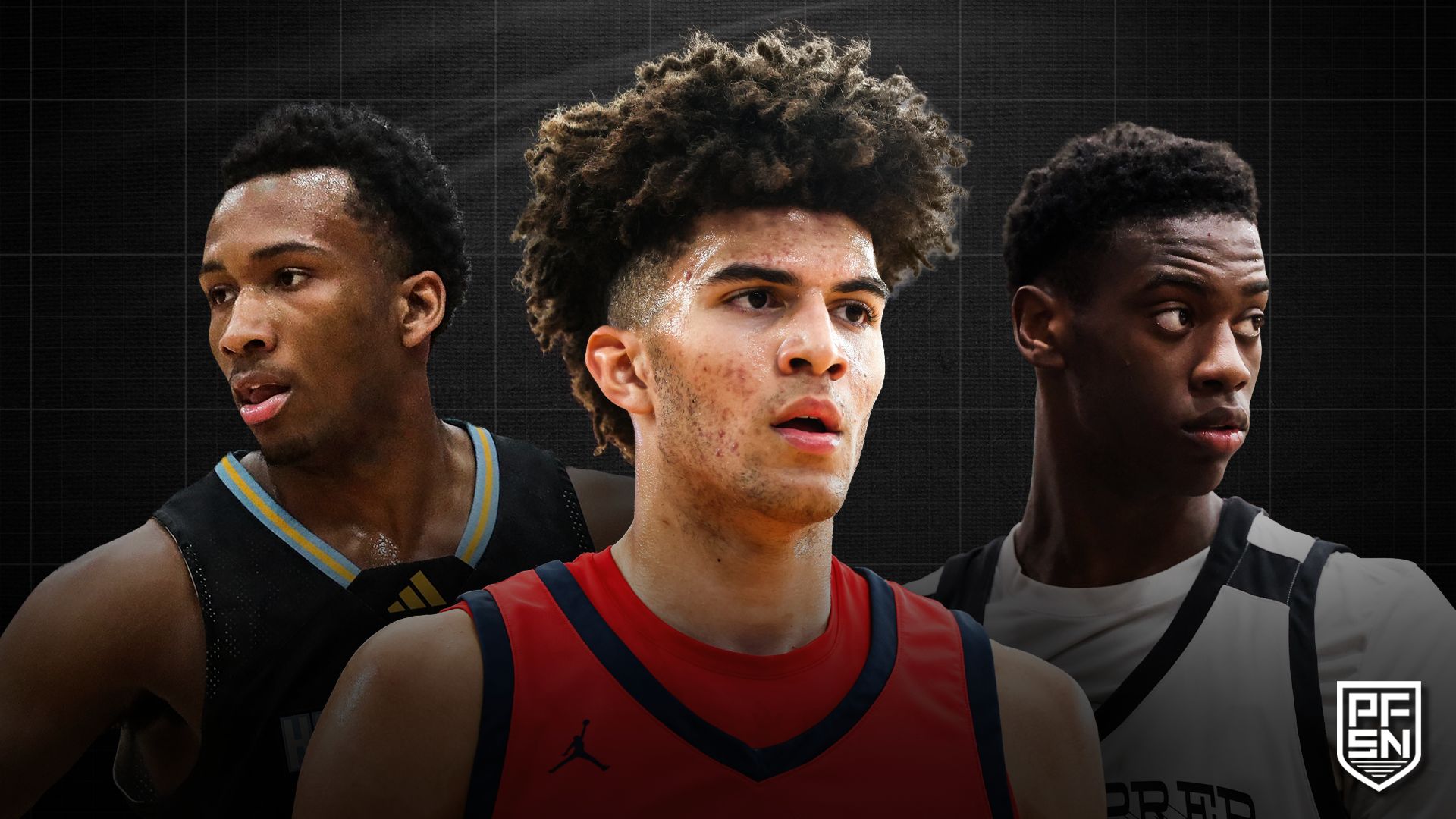
The NBA Draft is a year-round conversation, and while we have an entire season of basketball left to be played, it’s never too early to get a head start on the next wave of talent preparing to enter the league.
With the help of PFSN’s NBA Mock Draft Simulator, we’ve projected each selection in the first round of next year’s draft. This 2026 NBA Mock Draft reflects the current group of potential prospects and each team’s needs as they stand today.
[NOTE: Some of these picks may convey to another team ahead of the 2026 NBA Draft based on where teams finish in the standings for swaps and traded pick protections.]
1) Washington Wizards
Darryn Peterson, G, Kansas
After two straight seasons with less than 20 wins, the Washington Wizards desperately need a franchise cornerstone, especially after missing out on Cooper Flagg. Darryn Peterson can be that guy.
Peterson enters the 2026 NBA Draft as a prototypical jumbo guard with a mature on-court presence well beyond his years and the physical profile NBA teams covet in a versatile backcourt player.
The 2026 NBA Draft is already generating palpable buzz in league circles.
Darryn Peterson, standing 6’5” with a 6’10.5” wingspan, is an elite three-level scorer attending Kansas.
Some scouts view Peterson as the clear-cut best guard prospect this decade.pic.twitter.com/MY7cBoiWRM
— Evan Sidery (@esidery) July 5, 2025
Peterson is comfortable operating as a lead guard or off the ball, using his strong frame and advanced footwork to create scoring opportunities from anywhere on the floor. He thrives as a three-level scorer, displaying the ability to hit tough pull-up jumpers, finish creatively at the rim with either hand, and knock down shots from deep.
Peterson is instinctive and efficient, rarely forcing the issue despite his high usage. He excels in pick-and-roll situations and changes speeds effectively. His passing continues to improve, and he keeps turnovers low for a player with his scoring load. Defensively, Peterson’s length and competitiveness allow him to guard multiple positions.
Peterson’s high school career at Prolific Prep showcased his ability to dominate in transition and the half-court. He’s expected to take on a major role at Kansas, where his physical tools, basketball IQ, and two-way impact could solidify his status as the No. 1 overall pick.
2) New Orleans Pelicans
AJ Dybantsa, G/F, BYU
AJ Dybantsa is one of the most dynamic two-way wings we’ve seen recently, boasting a 6’9″ frame with a 6’11″ (sources vary: some list 7’1”) wingspan and 8’10″ standing reach. The BYU commit is an elite athlete with explosive leaping ability, fluid movement, and a quick first step that allows him to attack the rim or finish above the defense.
Dybantsa’s offensive game is versatile, as he scores efficiently in transition, creates his own shot in the half court, and is comfortable finishing with either hand. His improvement as a passer was on display at the USA Basketball U19 training camp, where he made advanced reads in the pick-and-roll and consistently found teammates for easy baskets.
Defensively, Dybantsa stands out for his intensity and versatility. He is able to guard positions one through four with physicality and quickness. He’s a disruptive force, often creating turnovers and turning defense into instant offense. His high motor, vocal leadership, and willingness to pick up full-court set him apart from other prospects his age.
While Dybantsa’s 3-point shot is inconsistent and still developing, his mechanics are sound, and he remains a threat from the perimeter. Dybantsa’s size, skill, and competitive fire give him a high floor and the upside to become a franchise cornerstone at the NBA level.
The New Orleans Pelicans are building a promising young core, and Dybantsa could elevate them to new heights.
3) Charlotte Hornets
Cameron Boozer, F, Duke
After moving on from Mark Williams, the Charlotte Hornets could use physicality and toughness in their frontcourt. Enter: Cameron Boozer, a 6’9″ power forward for Duke. The son of former NBA All-Star Carlos Boozer, he’s one of the most polished and productive prospects in his class.
Boozer’s game is defined by his elite rebounding, soft hands, and advanced footwork, making him a consistent force on both ends of the floor. He excels in the paint with various finishes and has developed a reliable range out to the 3-point line, making him a versatile pick-and-pop threat.
His basketball IQ is evident in his ability to read the floor, deliver accurate outlet passes, and create scoring opportunities for teammates.
Boozer is comfortable handling the ball in space, can attack off the dribble, and has shown steady improvement as a perimeter shooter. Defensively, he contests shots without fouling and uses his strong build to carve out space and seal opponents in the post.
While not an elite vertical athlete, Boozer compensates with physicality and feel for the game. He has a high floor thanks to his consistent production, winning pedigree, and unselfish play. Boozer’s combination of skill, feel, and competitiveness positions him as an immediate impact player at the next level and a potential franchise cornerstone.
4) Brooklyn Nets
Nate Ament, F, Tennessee
Nate Ament is a 6’10 forward entering Tennessee as one of this class’s most intriguing long-term prospects. He stands out for his perimeter skill set, which features a smooth pull-up jumper and an ability to create his own shot. He has flashed immense potential as a three-level scorer.
Ament’s offensive game is built on fluid ball handling, a high release on his jumper, and a soft touch around the rim. He’s shown flashes as a creative passer and is beginning to assert himself more as a playmaker.
Defensively, he has the tools to be versatile, using his length and athleticism to make plays off the ball. However, his wiry frame and upright playing style can make him susceptible to physical defenders, and he sometimes struggles to finish through contact.
Physically, Ament is still developing and needs to add strength to maximize his potential, especially against tougher competition in the SEC.
Ament’s tendency to become passive in physical games remains an area of concern, but as he grows more assertive, his upside as a scoring wing with defensive versatility is apparent. That would be an asset for a Brooklyn Nets team lacking legitimate two-way contributors.
5) Utah Jazz
Chris Cenac Jr., PF/C, Houston
Beyond Walker Kessler, the Utah Jazz lack proven big men. Chris Cenac Jr. is a 6’10″ center with a 7’4″ wingspan and a strong, athletic frame, making him one of the most intriguing big men in the 2026 NBA Draft class. He stands out for his mobility and fluidity, running the floor well and playing above the rim as a finisher, rebounder, and shot blocker.
Cenac is comfortable scoring in the post, using a soft touch and a developing jump hook, while also flashing a reliable face-up game and improving range out to the arc. He shows promise as an inside-out threat, with good hands, a smooth shooting release, and the ability to drive from the perimeter. He can push the ball in transition, make cross-court passes, and has solid court vision for his size.
Defensively, Cenac projects as a versatile anchor, able to protect the rim, switch onto smaller players, and rebound at a high level. His timing as a shot blocker and ability to rotate make him a valuable presence in multiple schemes.
While Cenac’s tools are elite, he is still developing his footwork and decision-making, particularly when handling the ball under pressure. With continued physical development and more experience, Cenac has the potential to become a high-impact, modern NBA big man.
6) Philadelphia 76ers
Caleb Wilson, F, North Carolina
Caleb Wilson, a 6’9, 195-pound forward committed to North Carolina, is one of the upcoming class’s most versatile and productive prospects. Wilson averaged 21.6 points, 11.1 rebounds, 5.0 assists, 3.5 blocks, and 2.1 steals per game as a senior and posted 15 double-doubles in 20 games.
Wilson’s game is built on fluid athleticism, length, and two-way impact. He covers ground quickly, finishes above the rim, and can guard multiple positions thanks to his 7’0″ wingspan and strong instincts.
Offensively, Wilson thrives as a secondary option, scoring efficiently around the basket, in transition, and with a developing midrange shot. He is an excellent passer for his size, showing vision in both transition and half-court sets. Defensively, he is a standout shot blocker and a disruptive help defender.
The Philadelphia 76ers’ frontcourt depth has taken a hit this offseason. While Wilson’s outside shooting is still inconsistent and his motor can waver, his ability to impact the game as a rebounder, passer, and defender gives him a high ceiling.
7) San Antonio Spurs
Bennett Stirtz, G, Iowa
Bennett Stirtz is a 6’4″ senior combo guard who’s transferring to Iowa after a standout season at Drake. Thanks to his elite shooting and high basketball IQ, he looks like a legitimate NBA prospect.
Stirtz averaged 19.2 points, 5.7 assists, 4.3 rebounds, and 2.1 steals per game at Drake, shooting a fraction under 50% from the field and 40% from 3. He was named Missouri Valley Player of the Year and played heavy minutes for his team, showcasing his endurance and value.
Stirtz is a creative playmaker. He excels in pick-and-rolls and consistently makes smart reads and passes. His off-ball movement, cutting, and finishing with either hand make him a versatile threat in modern offenses.
While Stirtz lacks elite athleticism and could be targeted defensively at the next level, his offensive efficiency, feel for the game, and ability to play on or off the ball give him real NBA upside.
With De’Aaron Fox’s future with the San Antonio Spurs uncertain beyond the 2025 season, it wouldn’t be surprising to see the front office bolster their backcourt alongside Dylan Harper and Stephon Castle.
8) Toronto Raptors
Mikel Brown Jr., G, Louisville
Mikel Brown Jr. is a 6’3″ point guard known for his lightning-quick first step, shifty handle, and ability to get to his spots at will. He is a dynamic creator who has showcased a smooth jumper and deep range.
Brown excels as a scorer and distributor, demonstrating advanced floor vision, precise passing off the dribble, and the ability to manipulate defenses in pick-and-roll situations.
While Brown’s slight frame and lack of strength are current limitations, his natural pace, basketball IQ, and improved two-way engagement make him one of this class’s top pure point guard prospects. He can be streaky as a shooter and sometimes settles for tough shots, but his clean release and confidence project well for the next level.
The Toronto Raptors need to add more primary ball-handling to their backcourt alongside Immanuel Quickley. If he continues to add strength and sharpens his decision-making, Brown has the upside to develop into a strong NBA starter or a high-impact spark off the bench.
9) Phoenix Suns
Tounde Yessoufou, G/F, Baylor
As the Phoenix Suns seemingly hit the reset button, post-Kevin Durant, they need to inject their roster with more young talent. A 6’5” Baylor commit, Tounde Yessoufou boasts a chiseled frame, elite athleticism, and a relentless motor. He brings a physical presence on both ends of the court.
Yessoufou is a force in transition and a nightmare for defenders when attacking downhill. He uses his strength to finish through contact and his quick-twitch athleticism to elevate in traffic. He’s most effective as a driver and finisher, consistently producing in the paint and punishing smaller defenders.
His offensive game is expanding, with a much-improved outside shot and better handles, making him a more complete wing. However, he is still learning to pick his spots and avoid forcing tough shots.
Defensively, Yessoufou’s versatility is a valuable asset. He can guard multiple positions, switch onto perimeter players and forwards, and use his anticipation and length to disrupt plays. While his handle and touch are still developing, his consistent production and willingness to compete set him apart.
If Yessoufou continues to improve his perimeter shooting and ball-handling, he projects as a high-level 3-and-D starter or an explosive energy player off the bench.
10) Portland Trail Blazers
Dash Daniels, G, Melbourne United
Dash Daniels, a 6’5″ guard from Melbourne United and the younger brother of Dyson Daniels, is emerging as a high-level NBA prospect with the potential to be a late-lottery pick. He performed well at the 2025 FIBA U19 World Cup, showing his ability to impact multiple areas of the game.
Daniels is a versatile two-way player who can operate on or off the ball. He’s a strong defender with excellent hands and instincts, capable of guarding multiple positions thanks to his solid frame and length. Offensively, he can score from all three levels and has shown progress as a shooter.
Daniels’ smooth release makes him effective against closeouts, and he is a creative playmaker. While he’s still working on being a more consistent shooter and ball-handler, his defensive versatility, competitive motor skills, and improved offensive skill set make him a strong candidate for developing into a reliable two-way contributor at the NBA level.
The Portland Trail Blazers are trending upward, led by a developing young core. Daniels’ two-way skill set would be a welcome addition for Chauncey Billups’ squad.
11) Dallas Mavericks
Isiah Harwell, G, Houston
Thanks to the new trio of Kyrie Irving, Anthony Davis, and Cooper Flagg, there’s a renewed excitement around the Dallas Mavericks. But you can never have too much talent.
Isiah Harwell, a 6’6″ 200-pound shooting guard and Houston commit, enters the 2026 NBA Draft as one of the class’s most polished two-way prospects. After starring for Wasatch Academy, he was named Utah’s Gatorade Player of the Year. There, he showcased a beautiful release and deep range.
Harwell thrives as a shooter, especially from midrange and beyond the arc, and is adept at scoring over smaller defenders with advanced footwork and a smooth pull-up. While not an elite athlete, he plays above the rim and uses his strong frame to finish through contact.
Harwell is a solid off-ball cutter who fits into structured offenses, rarely wasting dribbles and making smart decisions. Defensively, Harwell uses his size, strength, and competitiveness to guard multiple positions. He’s a physical and versatile defender, capable of switching up and down the lineup and contributing on the glass.
With his advanced shooting and two-way impact, Harwell projects as a high-floor NBA guard who can contribute immediately as a scorer and defender.
12) Chicago Bulls
Jayden Quaintance, F, Kentucky
At 6’9″, 225 pounds, Jayden Quaintance is among the most intriguing young big men in college basketball. Over his entire freshman season at Arizona State, Quaintance averaged 9.4 points, 7.9 rebounds, 1.5 assists, and 2.6 blocks per game while shooting 52.5% from the field.
6’10 PF Jayden Quaintance.
One of the best defensive prospects I’ve ever evaluated at just 17 years old (!) — 29.4% dFG on jumpshots + 42% dFG at the rim. Strong interior scoring (69.2% rim FG). Elite rebounding & leaping skill. Emerging mid-range/outside shot.
#4 on my board. https://t.co/34OKUVN4a1 pic.twitter.com/z8yrl5HMfG
— Mohamed (@mcfNBA) July 7, 2025
Quaintance was named to the Big 12 All-Defense and All-Freshman teams, and his shot-blocking numbers were among the best in the nation. He boasts a 7’3″ wingspan, elite vertical athleticism, and a strong, mobile frame. He’s a high-level lob threat, rim protector, and rebounder, capable of efficiently finishing above the rim and running the floor.
Offensively, Quaintance excels as a dunker and interior finisher, but his jump shot and overall skill set are still developing. He flashed some face-up ability and passing instincts, but his shooting range (18.8% from deep) and decision-making remain works in progress.
Defensively, Quaintance can guard the paint and switch onto the perimeter, using his quickness and length to disrupt plays. His technique and awareness are still raw, but his youth and athleticism give him significant upside.
Nikola Vucevic will be a free agent next offseason, and the Chicago Bulls could benefit from Quaintance’s two-way impact.
13) Sacramento Kings
Brayden Burries, G, Arizona
The Sacramento Kings are searching for direction after finishing below .500 last season. They traded De’Aaron Fox and head into next season with new head coach Doug Christie. With Zach LaVine prepared to hit free agency, it could be a good time to upgrade the backcourt.
Brayden Burries, a 6’4, 185-pound combo guard and Arizona commit, is one of the most productive and versatile scorers in the 2026 class. He was named California Gatorade Player of the Year and a McDonald’s All-American after averaging 29.7 points, 8.8 rebounds, 3.4 assists, and 2.9 steals per game, according to MaxPreps.
Burries is a three-level scoring threat with a strong frame, advanced feel, and the ability to play on or off the ball. He excels as a powerful driver who finishes through contact, has a polished midrange game, and can hit shots off the catch or dribble.
Burries isn’t a dynamic vertical athlete but uses his size, body control, and creativity to create space and score efficiently. Defensively, Burries is a physical and engaged presence, capable of guarding both guard spots and contributing as a rebounder and playmaker.
14) Atlanta Hawks
Darius Acuff Jr., G, Arkansas
Darius Acuff Jr. heads to Arkansas as one of the country’s most dynamic lead guard prospects. Standing 6’2” with a strong, compact frame, Acuff combines downhill speed, a powerful build, and advanced ball-handling to create offense at will. He was named the 2025 Allen Iverson National Player of the Year and McDonald’s All-American.
Acuff’s scoring profile is elite for his age. He’s a tough shot-maker with deep range and various scoring methods. He excels at creating space off the dribble, hitting contested pull-ups, and finishing creatively around the rim with both hands. His pick-and-roll game is advanced, and he thrives as a facilitator, making those around him better.
Defensively, Acuff leverages his length and physicality to disrupt ball-handlers and generate steals. He is a solid rebounder for his position and has the tools to become a reliable defender at the next level.
Trae Young has a player option next season and could hit free agency. If not, the Atlanta Hawks should still be looking to add a player like Acuff, who can run the second unit and provide a scoring punch off the bench.
15) Miami Heat
Dame Sarr, G, Duke
Dame Sarr is a 6’6″ wing from Italy who joins Duke after three seasons with FC Barcelona, where he gained valuable experience in both the EuroLeague and Spain’s ACB.
Sarr is a versatile defender with a reported 7-foot wingspan, giving him the size and length to guard multiple positions on the perimeter. He’s known for his defensive playmaking, athleticism, and ability to play above the rim. Offensively, Sarr flashes as a shooter, shot creator, and passer, especially in transition and attacking closeouts.
While Sarr’s decision-making and consistency as a shooter are still developing, his size, athleticism, and international experience make him a strong candidate to rise up draft boards if he can polish his game at Duke.
The Miami Heat’s backcourt features offensively gifted players like Tyler Herro, Norman Powell, and Kasparas Jakucionis. Sarr’s ability to impact the game on both ends of the floor brings balance, bolstering the group’s strength.
16) Phoenix Suns
Tahaad Pettiford, G, Auburn
Tahaad Pettiford returns to Auburn for his sophomore season after withdrawing from the 2025 NBA Draft. He is a dynamic scorer and explosive playmaker poised for a breakout year. As a freshman, Pettiford averaged 11.6 points, 3.0 assists, and 2.2 rebounds in 22.9 minutes per game.
Pettiford is known for his lightning-quick first step, ability to create separation, and versatile shooting. He’s also a crafty finisher with a reliable floater and shows flashes of advanced playmaking, though he’s still developing as a primary facilitator.
Defensively, Pettiford competes with a bulldog mentality despite his size, but his physical limitations can be exposed against bigger guards. With a larger role as Auburn’s lead guard, Pettiford’s scoring and confidence could make him an SEC Player of the Year candidate.
The Phoenix Suns acquired Jalen Green this offseason, but it remains to be seen if a backcourt of Green and Devin Booker can thrive on both ends of the floor. Pettiford’s skill set and fearlessness would boost this team and add toughness, which Phoenix lacked a season ago.
17) Detroit Pistons
Koa Peat, F, Arizona
The Detroit Pistons are on the rise, led by a strong young core of Cade Cunningham, Jaden Ivey, Ausar Thompson, and Jalen Duren.
Arizona commit Koa Peat is one of the most productive and physically mature prospects in this draft class. He could help Detroit climb the ranks in the Eastern Conference. He was named Arizona Gatorade Player of the Year for a third straight season and has been a double-double threat in every setting.
Peat’s game is built on a powerful frame, advanced footwork, and a polished mid-post arsenal. He excels at using his touch, high release, and strong left hand to score efficiently. He is a smart passer, capable of handling the ball in transition and making plays in short-roll or dribble hand-off actions.
While not an explosive athlete, Peat leverages his strength and instincts to rebound, defend, and generate steals and blocks. He’s also shown flashes of floor-spacing ability, though his three-point shot is still developing.
Defensively, Peat projects as a versatile four or small-ball five, using his length and anticipation to impact plays. However, he must continue improving his lateral quickness and rim protection to maximize his NBA upside.
18) Memphis Grizzlies
Magoon Gwath, C, San Diego State
Standing 7’0” and 205 pounds, Magoon Gwath emerged as one of the Mountain West’s top shot blockers in his first full collegiate season at San Diego State. Gwath averaged 8.5 points, 5.2 rebounds, and 2.6 blocks in 24.9 minutes per game, shooting 50.6% from the field and 37.8% from 3.
Gwath’s game is built on elite length, vertical explosiveness, and timing as a shot blocker, making him a constant presence around the rim defensively. Despite a slender frame, he uses his reach and instincts to alter shots and rebound effectively. On the offensive end, he thrives as a play-finisher, but he’s also flashed a promising face-up game.
While Gwath still needs to add strength, improve his rebounding in traffic, and improve his decision-making, his size, rim protection, and emerging shooting touch make him an intriguing long-term prospect as a modern stretch big.
The Memphis Grizzlies have a formidable young frontcourt duo in Jaren Jackson Jr. and Zach Edey, but Gwath’s physical tools and an improved offensive game would add valuable depth to the frontcourt.
19) Milwaukee Bucks
Isaiah Evans, G/F, Duke
Isaiah Evans returns to Duke for his sophomore season after making a strong impression as a freshman. The 6’6” wing averaged 6.8 points in just under 14 minutes per game, shooting 43.2% from the field and an impressive 41.6% from 3-point range.
Evans is a wiry, high-volume perimeter scorer with a quick, high release and deep NBA range. He can catch fire quickly, as seen in his 18-point performance against Auburn and multiple games with four or more made threes.
Evans thrives off movement and is comfortable shooting off the catch and the dribble. While most of his scoring comes from beyond the arc, he has shown flashes of scoring inside and is effective in transition.
Defensively, Evans uses his length and active hands to disrupt passing lanes, though his lean frame means he must continue adding strength to handle physical matchups. Still, Evans has the tools to develop into a go-to scorer and reliable two-way contributor at the NBA level.
Evans will have an opportunity to improve his draft stock with a larger role for the Blue Devils, and his perimeter shooting would solidify a strength for the Milwaukee Bucks.
20) Golden State Warriors
Flory Bidunga, C, Kansas
The Golden State Warriors already lacked overall size, and losing Kevon Looney to free agency made the hole even more glaring. With limited flexibility, they should look to upgrade in next year’s draft.
At 6’9” and 220 pounds, Kansas’ Flory Bidunga is one of the most athletic and physically imposing big men in the 2026 NBA Draft class. As a freshman, Bidunga averaged 5.9 points, 5.4 rebounds, and 1.6 blocks in just 16.3 minutes per game.
Bidunga consistently finished plays above the rim and was perfect from the field in 10 different outings. His game is built on elite leaping ability, quickness, and energy. He excels as a rim runner, lob threat, and rebounder, using his length and athleticism to protect the paint and finish through contact.
Offensively, he’s most comfortable near the basket, showing a soft lefty jump hook and flashes of a developing mid-range shot. He also demonstrated the ability to push the ball in transition and handle in the open court, though his ball skills remain a work in progress.
Defensively, Bidunga’s reaction speed and instincts make him a strong shot blocker, and he uses his physical tools to carve out space and control the glass. His aggressive style can lead to foul trouble, but his physical tools should translate well to the NBA.
21) Minnesota Timberwolves
Yaxel Lendeborg, F, Michigan
Yaxel Lendeborg is officially transferring to Michigan after withdrawing from the 2025 NBA Draft, The 6’9”, 230-pound forward is coming off a dominant season at UAB where he averaged 17.7 points, 11.4 rebounds, 4.2 assists, 1.8 blocks, and 1.7 steals per game while shooting 52.2% from the field and 35.7% from three.
Lendeborg had several standout performances, including 30 points, 20 rebounds, eight assists, five steals, and four blocks in a single game during the AAC Tournament.
Yaxel Lendeborg nearly had a 30-20, 5×5 and triple double in the same game vs ECU
30 Points (9/16 FG 1/3 3FG 11/13 FT)
20 Rebounds
8 Assists
5 Steals
4 Blocks
0 TO’s pic.twitter.com/e934iisZKV— Keandre Ashley (@HoopIntelllect) March 15, 2025
Lendeborg is a versatile, physical power forward who can stretch the floor, facilitate, and defend multiple positions. He thrives as a rebounder and shot blocker, using his length and timing to impact both ends.
Offensively, he can score inside, step out for threes, and create for others with his passing. Lendeborg’s all-around production, defensive playmaking, and ability to contribute in various roles make him a strong candidate to carve out a valuable role.
Lendeborg’s well-rounded skill set would be a positive addition to a Minnesota Timberwolves team that relied heavily on Anthony Edwards for stretches. He would give them another scorer and a switchable defender.
22) Cleveland Cavaliers
Alex Karaban, F, UConn
Alex Karaban is a 6’8″, 225-pound forward from UConn known for his high basketball IQ, elite shooting, and team-first mentality. As a junior, he averaged 14.3 points, 5.3 rebounds, 2.8 assists, and 1.5 blocks per game, earning Second-Team All-Big East honors.
Karaban thrives as a floor-spacing forward, excelling in catch-and-shoot situations, off-ball movement, and making timely cuts. He is a reliable spot-up shooter with a quick release and can attack closeouts or post up smaller defenders.
Karaban’s passing and decision-making add value as a complementary piece, and he consistently makes smart plays within the flow of the offense.
Karaban lacks elite athleticism and can struggle to defend quicker players, but he competes on the boards and positions himself well on defense. His long-term NBA role will depend on improving his defensive versatility and expanding his shot creation. Still, he projects as a valuable rotation piece and floor spacer at the next level.
The Cleveland Cavaliers were among the NBA’s top 3-point shooting teams last season, and Karaban would give them yet another player who can space the floor.
23) San Antonio Spurs
Henri Veesaar, C, North Carolina
At 7’0” and 225 pounds, Henri Veesaar is an agile and skilled center with intriguing two-way upside. Last season at Arizona, he averaged 9.4 points, 5.0 rebounds, and 1.1 blocks in 20.8 minutes per game, shooting 59.2% from the field.
Veesaar is known for his soft hands, quick leaping, and ability to finish lobs or putbacks with either hand, making him a reliable play-finisher around the rim. His shooting touch also stands out, hinting at future floor-spacing potential. He’s a skilled passer and rarely turns the ball over.
Defensively, Veesaar is a versatile rim protector with good timing. He can block shots as a primary defender and a help defender, occasionally switching onto the perimeter. While his lean frame and limited strength can make him vulnerable against physical bigs, he compensates with mobility, instincts, and a high motor.
The Spurs have one of the league’s most talented young cores, led by Victor Wembanyama, Stephon Castle, and Dylan Harper. Veesaar bolsters San Antonio’s depth at center and has the tools to impact both ends.
24) Houston Rockets
Meleek Thomas, G, Arkansas
Meleek Thomas, a 6’4, 180-pound guard signed with Arkansas, is one of the most dynamic and naturally talented scorers in the 2026 NBA Draft class. Thomas dominated with Overtime Elite and was a McDonald’s All-American who ranked as a top-15 national recruit in the 2025 class.
Thomas is an assertive, high-volume scorer who can create his own shot in isolation, score in bunches, and knock down threes with a quick release. He excels off the dribble, using a polished handle and an array of moves to generate space. He’s also a strong rebounding guard and an aggressive defender with good length and quick hands.
Thomas’ shot selection can be streaky, and he sometimes settles for tough looks, but he’s shown progress in attacking the rim and creating for others. He’s not an elite athlete but plays with confidence, physicality, and a competitive edge.
The Houston Rockets moved on from Jalen Green, but Thomas is another gifted scorer who would be an upgrade on the defensive end of the court, making him a better fit for what Ime Udoka wants to do.
25) Denver Nuggets
Boogie Fland, G, Florida
For the Denver Nuggets to get back to the top of the Western Conference, they must continue improving their backcourt depth. Boogie Fland offers the type of talent that could see him quickly climb draft boards.
Fland made an immediate impact as a freshman at Arkansas, averaging 13.5 points, 5.1 assists, and 3.2 rebounds in 21 games despite missing significant time due to thumb surgery. He’s a dynamic pick-and-roll operator with elite quickness, shifty handles, and strong playmaking instincts.
Fland’s offensive arsenal features a smooth, high-release jumper, and he excels at creating separation off the dribble. He’s particularly effective as a catch-and-shoot threat and uses floaters and runners to score over bigger defenders. His shot selection and efficiency can be streaky, but he’s a confident scorer who thrives in fast-paced systems.
Defensively, Fland is a pesky on-ball presence with quick hands, averaging 1.5 steals per game. His slight frame and below-the-rim finishing present challenges against bigger, more physical opponents, so he must add strength to maximize his NBA upside.
26) New York Knicks
Karim Lopez, F, NZ Breakers
Karim Lopez, a 6’8″ forward from Mexico, is emerging as one of the most intriguing international prospects in the upcoming class. Playing for the New Zealand Breakers in the NBL’s Next Stars program, Lopez showed notable improvement as a perimeter shooter and play-finisher against professional competition.
Lopez’s game features versatility and basketball instincts. He combines guard skills with the size and motor to defend multiple positions, often using his length and mobility to disrupt opposing offenses. Offensively, he’s a smooth operator who can handle the ball, initiate offense, and knock down shots from the outside.
Lopez’s ability to contribute as a shooter, ball-mover, and defender makes him a valuable role player. He has upside if he continues to develop his handle and consistency as a catch-and-shoot threat.
Not only can Lopez be a legitimate two-way contributor at the next level, but he’ll also do the little things. Those intangibles would mesh well with the New York Knicks’ current roster.
27) Oklahoma City Thunder
Alex Condon, C, Florida
Alex Condon was pivotal in the Florida Gators’ 2025 national championship run and earned All-SEC honors as a sophomore. His combination of size, mobility, and skill stands out, and he’s a high-motor big who runs the floor, rebounds aggressively, and offers valuable pick-and-pop potential.
Condon is comfortable operating on the perimeter, flashing soft hands, grab-and-go ability, and a willingness to do the dirty work inside. He’s a physical interior scorer who finishes through contact and makes himself available for lobs and putbacks, while also showing playmaking instincts (2.2 APG).
Defensively, Condon’s lateral mobility and effort allow him to switch onto wings and protect the rim, though he must continue to add strength and discipline to avoid foul trouble. His versatility, toughness, and championship pedigree make him a promising frontcourt prospect.
With Isaiah Hartenstein’s future in Oklahoma City up in the air beyond the 2025 season, the Thunder could add another center to join 2024 first-round pick Thomas Sorber.
28) Portland Trail Blazers
JT Toppin, F, Texas Tech
The Trail Blazers strengthened their backcourt earlier in the round, but adding depth to the frontcourt should also be a priority, especially with the loss of Deandre Ayton and Jerami Grant’s uncertain future.
JT Toppin is among the most productive and athletic big men in college basketball. As a sophomore at Texas Tech, he averaged 18.2 points, 9.4 rebounds, and 1.5 blocks per game while shooting 55.4% from the field. Toppin was named Big 12 Player of the Year, earning consensus All-American honors.
Toppin’s game is built on elite motor, a 7’2” wingspan, and impressive defensive instincts. He excels as a rim protector, shot-alterer, and rebounder, using his agility and timing to impact both ends.
Offensively, Toppin is a committed roll man, finishing strong around the rim while showing soft touch. His offensive game is still developing, but his relentless energy, defensive versatility, and rebounding prowess make him a high-upside prospect.
29) Los Angeles Lakers
Karter Knox, F, Arkansas
Karter Knox’s freshman season at Arkansas got off to a slow start. However, he eventually emerged as one of the Razorbacks’ best players in the second half of the year, including standout performances in the NCAA Tournament.
Arkansas guard Karter Knox showed off his explosiveness and scoring instincts to NBA execs at the LIFT Pro Day in Chicago. Closed his freshman year with nice momentum coming out of NCAA Tournament play. pic.twitter.com/h8xFoljmly
— Jacob Myers (@League_Him) May 17, 2025
Knox is a dynamic three-level scorer with a quick first step, straight-line explosiveness, and an improved jumper. He’s effective driving downhill, finishing at the rim, and can get hot from outside. His mid-range game and ability to create his own shot add to his scoring versatility.
Defensively, Knox uses his size and athleticism to guard multiple positions and contribute as a solid team defender. With continued development as a standstill shooter and improved ball-handling, he projects as a high-upside, plug-and-play scoring wing with the tools to become a versatile defender at the next level.
It’s unclear what the Los Angeles Lakers roster will look like in 2025 and beyond, especially regarding the superstar duo of LeBron James and Luka Doncic. Either way, Knox has the potential to be a difference-maker and a building block for the future.
30) Boston Celtics
Donnie Freeman, F, Syracuse
With Jayson Tatum just coming back from his injury and Anfernee Simons a free agent, the Celtics need to add some length to their rotation, something Donnie Freeman could offer them.
Freeman is a 6’9″, 205-pound forward who made an immediate impact as a freshman at Syracuse despite missing time with injury. He averaged 13.4 points and 7.9 rebounds in 25.4 minutes per game.
Freeman’s calling cards are his versatility, length, and mobility. He excels as a play-finisher, using his long strides and touch to finish at the rim, and has shown promise as a three-level scorer with a polished mid-range jumper and improving range beyond the arc.
Defensively, Freeman leverages his wingspan and agility to guard multiple positions and is an active rebounder. However, he’s still developing physically and can be pushed off his spots by stronger opponents. Freeman’s decision-making and 3-point consistency are areas for growth, but his size, skill, and two-way upside make him a highly intriguing NBA prospect.

no celtics?
Hey, thanks for reading and catching that omission. It has been fixed.