
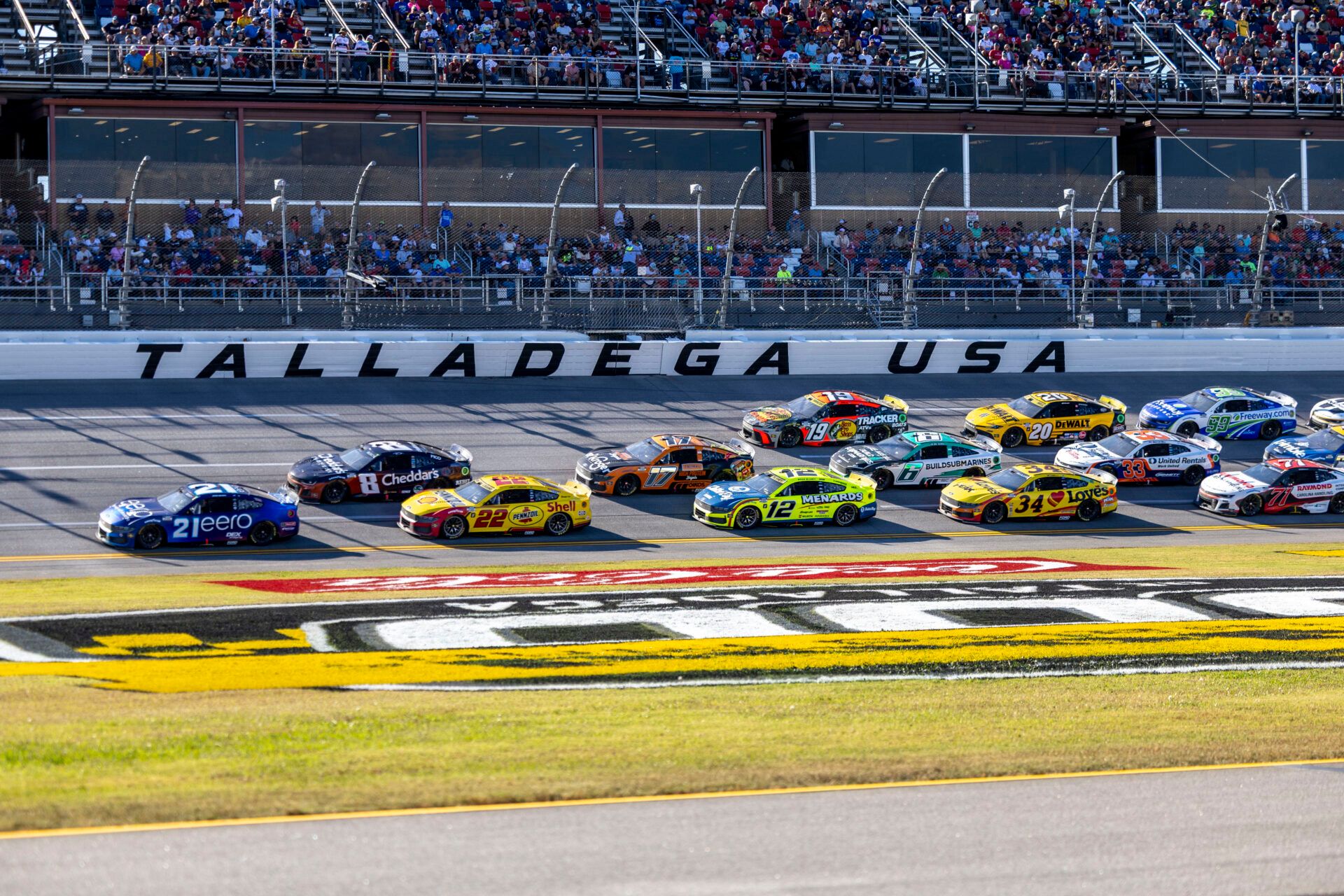
It started around 2022. Back then, a few drivers and teams realized the benefit of fuel saving during the race to reduce the time spent on pit road towards the end. It helped cycle them to the front of the field as the laps ticked on, and became a crucial strategy crew chiefs could rely on, especially on superspeedways.
Races became less about driving fast on the track and more like a chess game, where track position became paramount because driving through the field was so challenging.
But NASCAR wants to change that. After plenty of criticism following the Daytona 500, the sanctioning body is determined to eliminate fuel-saving games at superspeedways by coming up with a unique idea.
Will NASCAR’s Idea Work at Talladega Superspeedway?
In a surprising turn of events, NASCAR is flipping the stage lengths at Talladega to combat fuel-saving strategies. It’s a real problem because the pace slows down, the field is gridlocked, with cars two or three-wide, and crew chiefs are focused on either correcting their drivers running too fast or praising them for being perfect on the throttle.
But from an entertainment standpoint, fans have been pretty vocal about their dislike for such outcomes.
In an effort to switch things around, NASCAR EVP John Probst joined the ‘Hauler Talk’ podcast to discuss the changes planned at Talladega Superspeedway.
PREDICT THE CHASE: PFSN’s NASCAR Season Simulator
“If you look at generally how a lot of our speedways were laid out, it was a short stage, a short stage, and then a long stage to the end,” Probst said. “Going into Talladega, we’re going to flip that and adjust the lengths of the final two stages such that we’re confident that the last two stages are short enough to be made without a fuel stop.”
Last year, the race at Talladega Superspeedway featured 60 laps in the first stage, another 60 in the second, and 68 for the last. This time around, the first stage will likely be closer to 100 laps, with the last two being under 50 laps each. This means drivers and teams can go all out towards the end of the race, making it more compelling for fans.
While changing the stage lengths is one solution to the problem, NASCAR is also aiming to make changes in the car to tackle this issue. There will be a “Preseason Thunder” test next January at Daytona International Speedway, where technical changes to the cars will be assessed to reduce the impact of conservation strategies at such tracks.
“When it comes to car changes, we will likely right now plan to have a test in Daytona in January,” Probst said. “Kind of how we used to do it in the past, where we’ll go down there and try some different power levels and spoilers and maybe some other car type things to see what we can do there to mitigate it further.”
While it’s very unlikely that fuel saving will be eliminated, flipping the length of the stages could mean that such strategies might be more effective at the start of the race. However, with stage points and track positions still on the line, crew chiefs can still come up with innovative strategies to give their drivers all the advantage they can get.
STAY UPDATED: The Side Draft: PFSN’s NASCAR Newsletter
Ultimately, Probst is being realistic about the situation. He said, “I think that what we can do is just take steps to mitigate that. And I think that looking at the sporting stuff that we can do quickly and get a read on it this year, and then look at some car things next year, is our best chance for success there.”
Some of the long-term possibilities include increasing horsepower so that the field is spread. Theoretically, cars would burn more fuel, and drivers would be forced to make more pit stops. This would make races more unpredictable, and conservation strategies would be less effective. However, until NASCAR makes significant changes to its cars, such possibilities will remain speculation.
