
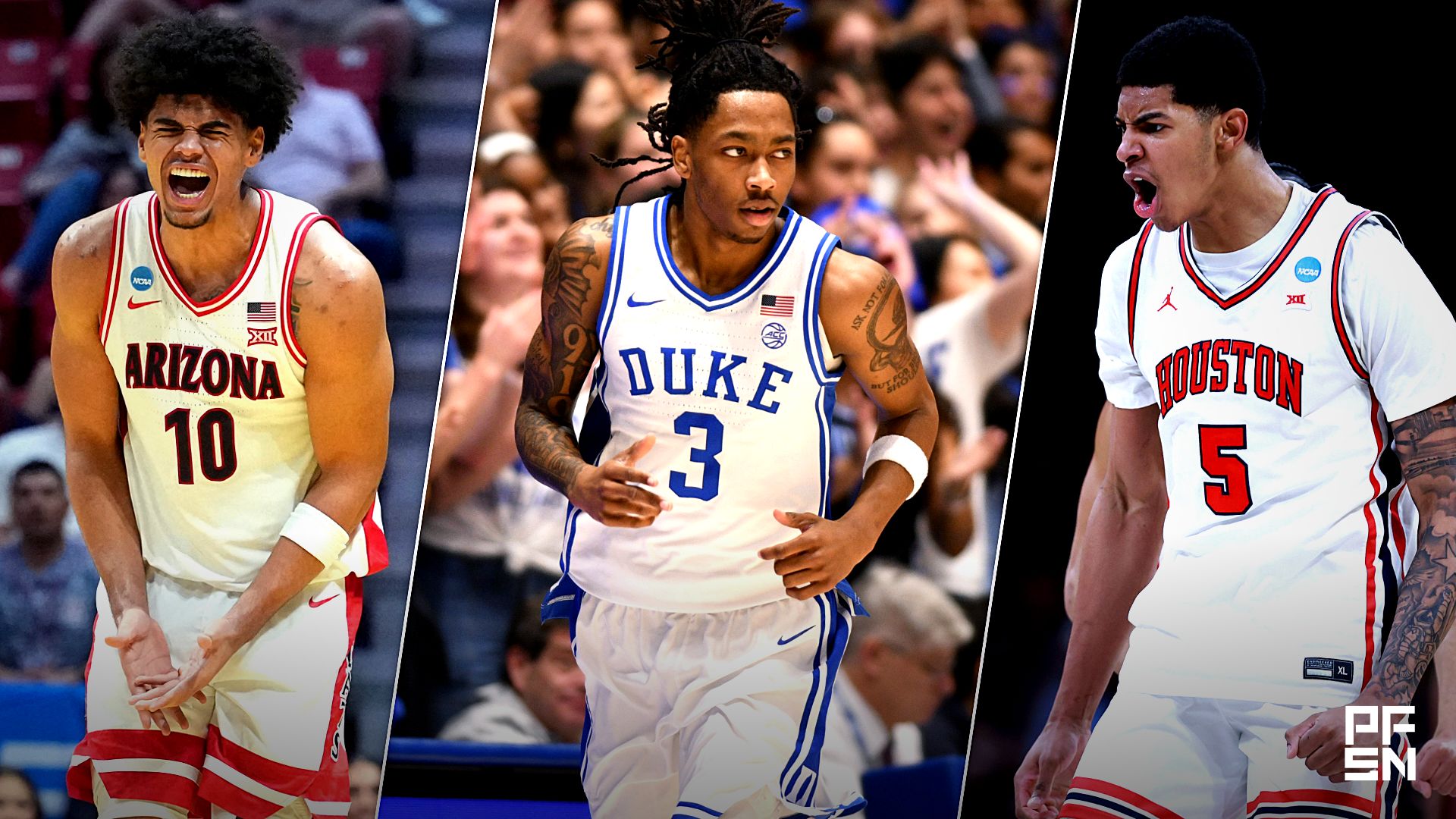
The Los Angeles Lakers have just one pick in the 2026 NBA Draft: the No. 25 overall selection in the first round. The Lakers previously traded their second-round pick.
This is a pivotal offseason for the Lakers, as LeBron James, Austin Reaves, Luke Kennard, and Rui Hachimura will be unrestricted free agents, while Deandre Ayton and Marcus Smart have player options so they could potentially join them.
While the big focus is on Los Angeles’ free-agency moves, they need to nail the draft first. With the No. 25 pick in the 2026 NBA Draft, who are some prospects the Lakers should target as they try to build around Luka Dončić going forward? Using PFN’s NBA Mock Draft Simulator, let’s identify six players who make sense for Los Angeles.
Koa Peat, SF, Arizona
Arizona’s Koa Peat was one of the most physically ready and skilled forwards in college basketball as a freshman. Standing 6’8″ and weighing 245 pounds, he uses his strength, coordination, and agility to make an impact on both offense and defense. Peat is a versatile player inside, able to finish through contact, rebound well, and defend several positions. He always plays with high energy and effort, making him a dependable option for the next level.
On offense, Peat is starting to show more skills beyond his physical tools. He handles the ball well, helps in transition, and can attack defenders, but he still needs to improve his outside shooting (he shot 35.0% from 3-point range, but only attempted 20 triples as a freshman). He reads plays quickly, defends different positions, and fits well into team systems, making him ready to contribute right away.
During his lone collegiate season, Peat averaged 14.1 points, 5.6 rebounds, 2.6 assists, 0.7 blocks, and 0.6 steals, while shooting 52.8% from the field, 35.0% from 3-point range, and 62.3% from the free-throw line (which is certainly a concern). Peat is still just 19 years old, so his best basketball is still ahead of him. If he keeps developing, Peat could become a tough, two-way forward with a long NBA career.
Chris Cenac Jr., F, Houston
Chris Cenac Jr. is a 6’11” forward-center whose size, mobility, and growing skills make him a promising long-term prospect. At Houston, he stood out for his smooth movement at his height, ability to run the floor, above-the-rim finishing, and perimeter skills that are rare for someone his size. Cenac can face up, handle the ball, and has a good shooting touch from midrange and beyond.
As a freshman, the 19-year-old averaged 9.5 points, 7.9 rebounds, 0.8 steals, and 0.5 blocks, while shooting 48.5% from the field, 33.3% from 3-point range, and 62.1% from the free-throw line.
On defense, Cenac uses his length and agility to rotate, protect the rim, and guard smaller players when needed. He rebounds well and has instincts that help on both offense and defense. As he gets stronger and refines his game, his potential becomes even more obvious. With his smooth athleticism, improving offensive skills, and ability to play both ends, Cenac could become a high-impact player at the next level.
Isaiah Evans, SG/SF, Duke
Isaiah Evans is a 6’6″ wing with a knack for catching fire and taking over games as a shooter. He brings confidence, microwave scoring, and NBA-caliber range. At Duke, he stood out with his ability to hit 3s from deep and in bunches. Evans has the tools of an elite floor-spacer, with a quick release, smooth shot, and a feel for scoring off movement or attacking closeouts. His length and agility give him the upside to grow into a multi-level creator as he rounds out his game.
While Evans still needs to get stronger and may take time to adjust to the NBA’s physicality, his energy, confidence, and willingness to defend will make him an immediate-impact player. He flashes disruptive hands and length on defense, with room to improve his consistency as he grows into his frame. If he continues to refine his shot selection, playmaking, and off-ball focus, Evans could quickly become a valuable scoring wing.
As a sophomore, he averaged 15.0 points, 3.2 rebounds, 2.7 3-pointers, 1.3 assists, 0.7 steals, and 0.7 blocks, while shooting 43.3% from the field, 36.1% from 3-point range, and 86.0% from the free-throw line.
Henri Veesaar, C, North Carolina
Henri Veesaar is a 7-footer known for his advanced footwork, rim protection, and improved offensive versatility. He combines a high motor with good hands and quick leaping ability, making him an effective lob threat and rim protector. Despite a lean frame, Veesaar’s footwork and fundamentals compensate for limited explosiveness, allowing him to create advantages in the post and show strong shot-blocking instincts. He also shows promising shooting touch and efficient finishing around the rim.
Veesaar has overcome injury setbacks, and his progress is notable from his time at Arizona to North Carolina. He displays intelligent decision-making, skillful passing, and defensive versatility, though he needs to improve his strength and foul discipline to reach his full potential. Projected as a developmental NBA prospect, Veesaar’s size, smarts, and touch make him a modern rim-protecting big with upside for an evolving frontcourt role.
Veesaar is 22 years old, so he’s older than the other players on this list. As a junior, he averaged 17.0 points, 8.7 rebounds, 2.1 assists, 1.3 3-pointers, 1.2 blocks, 0.6 steals, while shooting 60.8% from the field, 42.6% from 3-point range, and 61.5% from the free-throw line.
Dailyn Swain, SF, Texas
Dailyn Swain is a versatile two-way wing whose game should translate well to the next level. Standing at 6’8″ and 220 lbs., Swain is a versatile Swiss-army-knife forward whose presence is felt on both ends of the court. He has the size, athleticism, skill set, versatility, and high IQ that NBA executives covet.
As a junior at Texas, the 20-year-old averaged 17.3 points, 7.5 rebounds, 3.6 assists, 1.6 steals, and 0.9 3-pointers, while shooting 54.2% from the field, 34.4% from 3-point range (on 2.6 attempts), and 81.5% from the free-throw line.
There were some questions about whether Swain would stay in the 2026 NBA Draft or return to college, but he ultimately decided to stay in the class, indicating that he feels good about his draft stock and his chances of going in the first round.
Jayden Quaintance, PF, Kentucky
Jayden Quaintance’s sophomore season at Kentucky didn’t go according to plan. He played just four games (with one start) before tearing his ACL and meniscus. Prior to his injury, averaged 5.0 points, 5.0 rebounds, 0.8 blocks, and 0.5 steals on 57.1% shooting from the field prior to his injury. However, as a freshman, he averaged 9.4 points, 7.9 rebounds, 2.6 blocks, and 1.1 steals on 52.5% shooting from the field at Arizona State.
Quaintance was one of the youngest players in college basketball last season, so he’s still just 18 years old. His size and athleticism have stood out, as he brings a mix of strength, agility, and bounce that shows up on both ends. Defensively, he protects the rim, switches onto smaller players, and grabs rebounds. On offense, he finishes well around the basket, has a soft touch, and is getting more confident with his midrange shot.
Despite his youth, he makes a difference in games with his energy, athleticism, and instincts. Quaintance has worked to add more to his offensive game, with his footwork, ball-handling, and passing getting better, showing signs that he could become a modern, face-up big man. He needs to work on his outside shooting, as he shot 6-of-32 (18.8%) from 3-point range across his two collegiate seasons and didn’t attempt a single 3 in his four games as a sophomore. To reach his full potential, he will need to be more consistent and make good decisions, especially when playing away from the basket. Given his upside, Quaintance is one of the most interesting big men for the 2026 NBA Draft.