
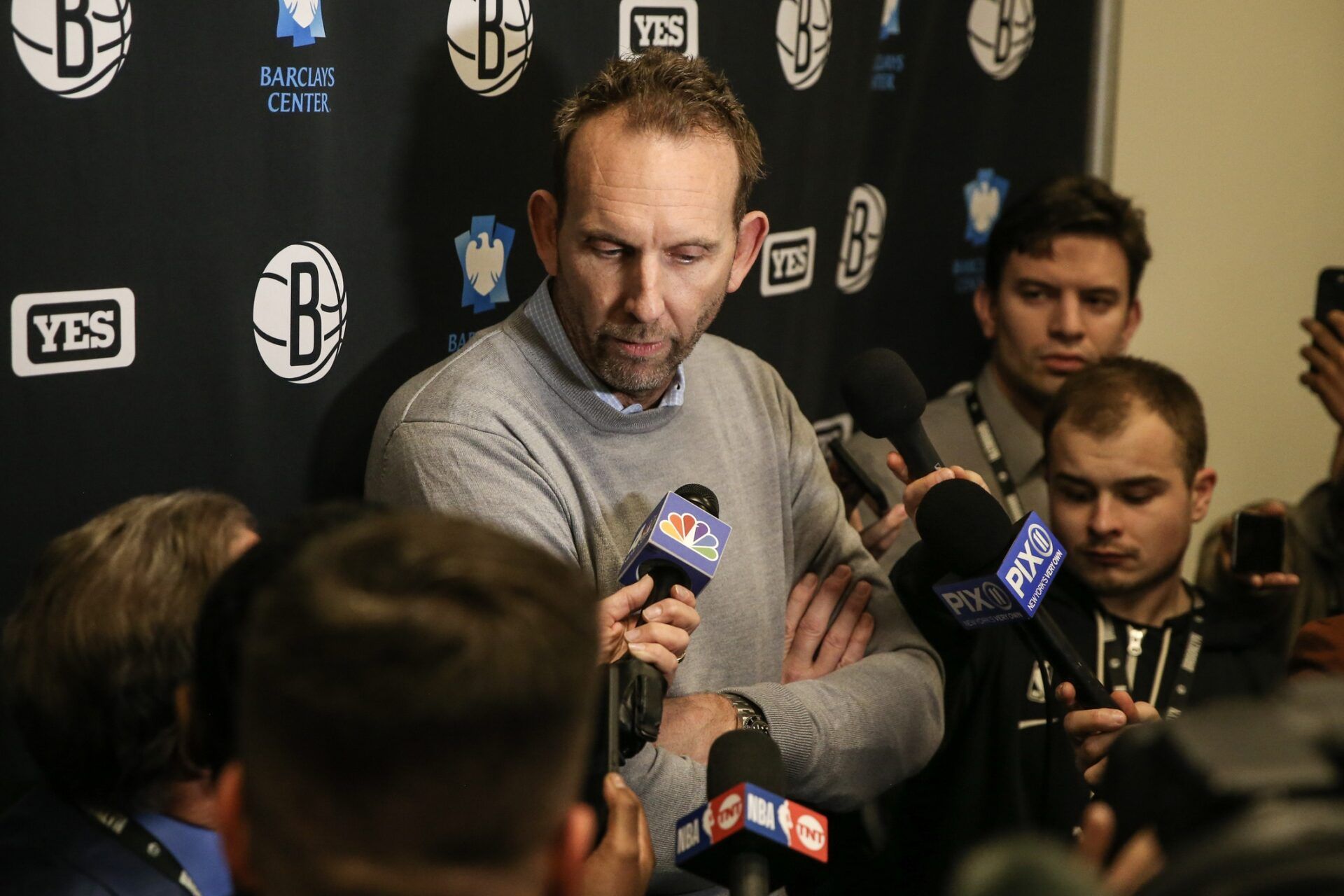
The Brooklyn Nets shocked the basketball world by keeping all five of their first-round picks in the 2025 NBA Draft, earning them a disappointing “C” grade from PFSN analysts.
After pivotal trades gave them the opportunity to select one-sixth of the first round’s talent, many expected the Nets to package picks for an established star.
Instead, the organization fully committed to rebuilding, selecting five young prospects with varying levels of potential and polish.

The Brooklyn Nets Have Been Awarded a C-Tier Draft Grade
According to PFSN’s Cam Mellor, the Nets deserve a “C” draft grade for their five selections in the 2025 NBA Draft.
“The Brooklyn Nets entered the 2025 NBA Draft with a blank canvas. With just one player (Nic Claxton) under contract beyond 2026 and $45 million in cap space, they’re clearly in teardown mode. That gave them room to swing on upside, and they took that route, stacking five first-round picks,” Mellor said.
“Their top pick, Egor Demin, fits the mold of a rebuilding franchise. At 6’8″, he’s a long, intelligent playmaker with good vision and instincts. The shot needs work, but his size allows him to get it off over defenders. In a system without pressure to win now, Demin should have time to grow alongside scorers like Cam Thomas,” Mellor remarked.
Demin arrives from Russia with the potential to become another international talent who dominates the league. The point guard attended high school at Real Madrid and brings significant global exposure to Brooklyn. In 33 games at BYU, he averaged 10.6 points, 3.9 rebounds, and 5.5 assists per game. While his court vision impressed scouts, his shooting struggled, connecting on just 41.2% from the field, 27.3% from 3-point range, and 69.5% from the free-throw line.
Brooklyn Doubles Down on Young Guards
With their second selection, the Nets continued building their backcourt of the future. “Brooklyn doubled down at guard with Nolan Traore, an 18-year-old French point guard with serious juice. He’s a confident creator with excellent speed, passing touch, and the kind of tools that often pop by year three. His game needs polishing, the shot selection and strength aren’t there yet, but the Nets can afford to be patient,” Mellor explained.
Traore brings professional experience from overseas, having competed in the Betclic Elite, France’s top basketball league. Playing for Saint-Quentin this season, the 6-foot-3 point guard averaged 11.7 points, 5.1 assists, and 1.7 rebounds across 30 games. His efficiency raises concerns for NBA scouts, as he shot just 39% from the field and 30% from beyond the arc. However, his youth and professional experience at 18 years old suggest significant room for growth.
The Nets then pivoted to address their wing depth. “They shifted to the wing with Drake Powell, a high-motor defender from North Carolina. Powell’s game wasn’t fully unlocked in Chapel Hill, but he brings toughness, defensive versatility, and a strong feel for off-ball movement. If he develops as a shooter, he could be a reliable 3-and-D piece,” Mellor commented on Brooklyn’s 22nd overall selection.
Powell’s college statistics reflect his two-way potential. Through 37 games with the Tar Heels, he averaged 7.4 points, 3.4 rebounds, and 1.1 assists while shooting an efficient 48.3% from the field and 37.9% from 3-point range. Those shooting percentages suggest he could develop into the floor-spacing defender every NBA team covets.
International Talent Rounds Out Brooklyn’s Haul
Brooklyn’s final two selections continued their theme of betting on upside over immediate production. “As part of the Mikal Bridges trade, the Nets added Ben Saraf. A lefty from Israel with a pro background, Saraf brings some craft and instincts, but he’ll need to bulk up and tighten the jumper. His role likely begins small, but he fits the theme: young, moldable backcourt talent,” Mellor noted about the 26th pick.
Saraf’s professional journey spans two international leagues despite his young age. During his 22-game stint with Ironi Kiryat Ata in the Israeli Basketball Premier League, he averaged 10.7 points, 3.7 assists, and 3.2 rebounds. After that season, he joined Ratiopharm Ulm in Germany’s competitive EuroCup, where he elevated his game to 12.8 points, 4.6 assists, and 2.2 rebounds per contest. His 1.3 steals per game demonstrate the defensive instincts that caught Brooklyn’s attention.
The Nets closed their historic draft night with perhaps their most intriguing selection. “Their final swing was on Danny Wolf, one of the most divisive players in this class. The 7-footer out of Michigan functioned as a point-center, showing real passing chops and stretch potential. He averaged 13.2 points, 9.7 rebounds, and nearly four assists, often running the offense. But concerns about his athleticism, defense, and turnovers kept him on the board until pick 27. He’s not a rim protector and isn’t dynamic laterally, but his unique offensive profile could make him an outlier win if things click,” Mellor concluded.
Wolf’s versatility sets him apart from traditional big men. The Michigan center’s ability to facilitate offense from the high post gives Brooklyn a unique weapon, though questions about his defensive mobility and turnover rate remain legitimate concerns for NBA evaluators.
The Nets now face the challenge of developing this diverse group of prospects. With a roster featuring Russian court vision, French speed, Carolina defense, Israeli craftiness, and Michigan’s unconventional big man skills, Brooklyn has assembled an international collection of basketball potential. The upcoming 2025-26 season will reveal whether this patient approach to team building can transform these five first-round talents into the foundation of a competitive NBA franchise.

Is it possible the Nets confused the first round with the second? Their last pick, Wolf, seems like the only one who may end up as a long-term consistent starter. Rather extraordinary they failed what should’ve been an easy layup.