
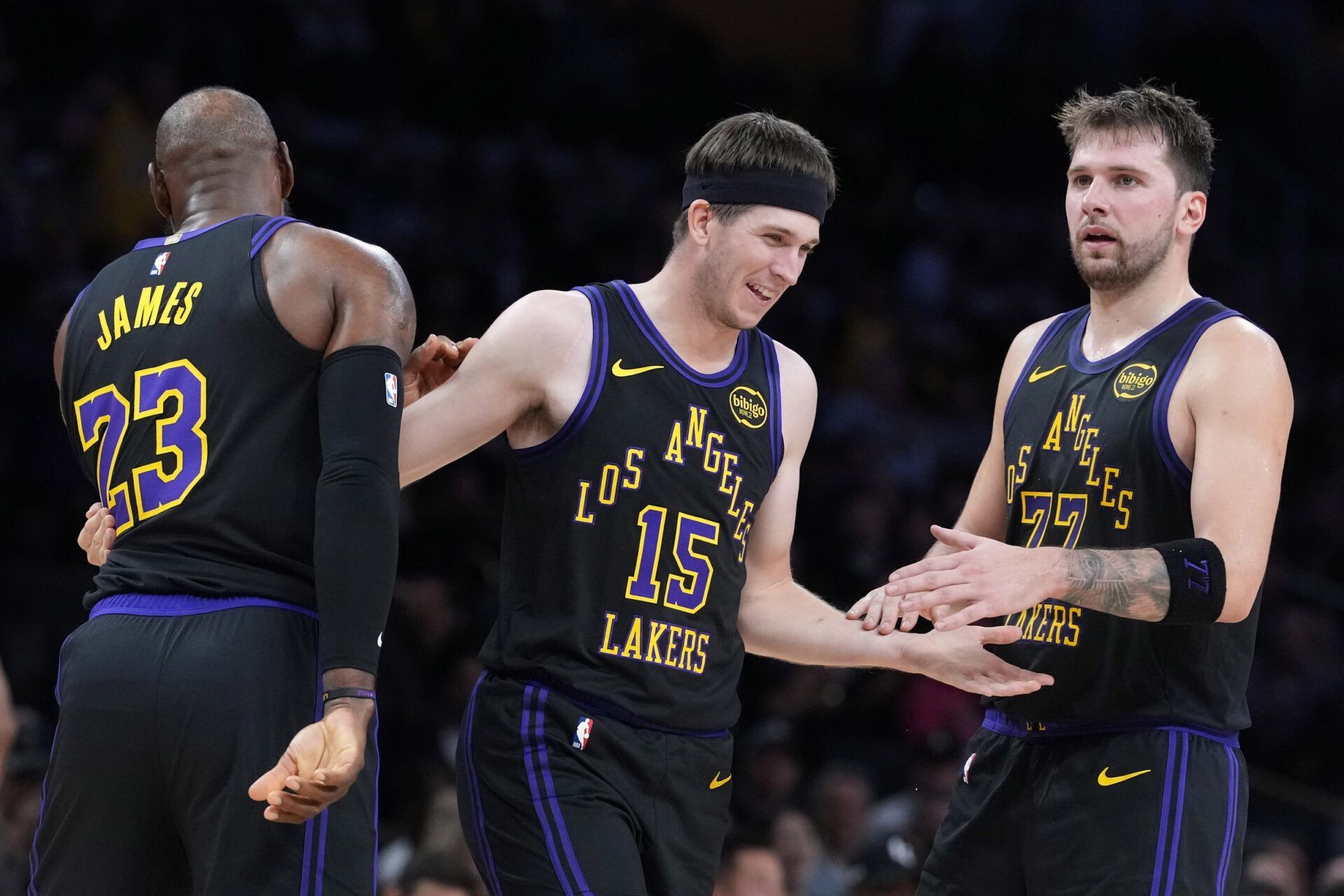
The Los Angeles Lakers’ recent surge has sparked a deeper conversation about roles, identity, and long-term sustainability. At the center of it all is LeBron James, whose evolving position within the team has drawn both praise and skepticism as the postseason approaches.

Kendrick Perkins Highlights LeBron James’ Shift into a Supporting Role
Former NBA player and analyst Kendrick Perkins offered a notable perspective on the Road Trippin’ Show, pointing to a significant adjustment in LeBron James’ approach this season. Rather than dominating possession, James appears to be embracing a more complementary role alongside Luka Dončić and Austin Reaves.
“He has fully accepted that I’m going to let Luka, Austin Reaves drive this car and I’m gonna benefit off of playing off the ball. He leads the entire NBA in transition buckets. The man is 41 years old. HE LEADS THE ENTIRE NBA in transition points. Think about that for a second.”
Kendrick Perkins says LeBron James has accepted being the third option on the Los Angeles Lakers:
“He has fully accepted that I’m going to let Luka, Austin Reaves drive this car and I’m gonna benefit off of playing off the ball. He leads the entire NBA in transition buckets. The… pic.twitter.com/A8ILJPKuxC
— NBA Courtside (@NBA__Courtside) March 17, 2026
Perkins’s remarks underline both the sacrifice and efficiency in James’s game. Even at 41, his ability to adapt athletically and mentally stands out. Transition scoring, typically reliant on speed and timing, reflects how James is finding new ways to impact winning without controlling every possession.
This shift comes amid a broader debate fueled by the Lakers’ performance without him. The team’s 14-7 record in games he missed has raised questions about whether the offense flows more naturally in his absence.
However, Rich Paul strongly pushed back on that narrative during an appearance on the Game Over podcast.
“I’ve never seen a team in my life that would be better without LeBron James. Not this one either.”
Paul instead framed the situation as an adjustment period rather than a limitation. He emphasized the complexity of repositioning a player who has historically been ball-dominant, explaining that integrating James off the ball requires both structural and psychological adaptation from the team.
That adjustment appears to be ongoing but productive. The Lakers sit at 43-25 and third in the Western Conference, having won 9 of their last 10 games, including a six-game streak capped by a victory over the Houston Rockets. The momentum suggests that the evolving hierarchy, with Dončić and Reaves initiating more offense, is beginning to stabilize.
James himself acknowledged the sacrifice involved, making it clear that team success outweighs individual output.
“If it benefits others, it benefits the team. The team is most important… I know what I’m capable of still doing as an individual, but what’s important for this team, I’m able to adapt to.”
That mindset could also influence lineup decisions. As noted by Lake Show Life’s Chris Lambert, staggering James with the second unit may maximize his playmaking while preserving the primary structure led by Dončić and Reaves. Such a move would allow him to remain aggressive in controlled stretches without disrupting the team’s balance.
Ultimately, the Lakers’ success may hinge on this very evolution. James’ willingness to adapt, combined with the team’s improving rhythm, positions them as a legitimate contender.
