
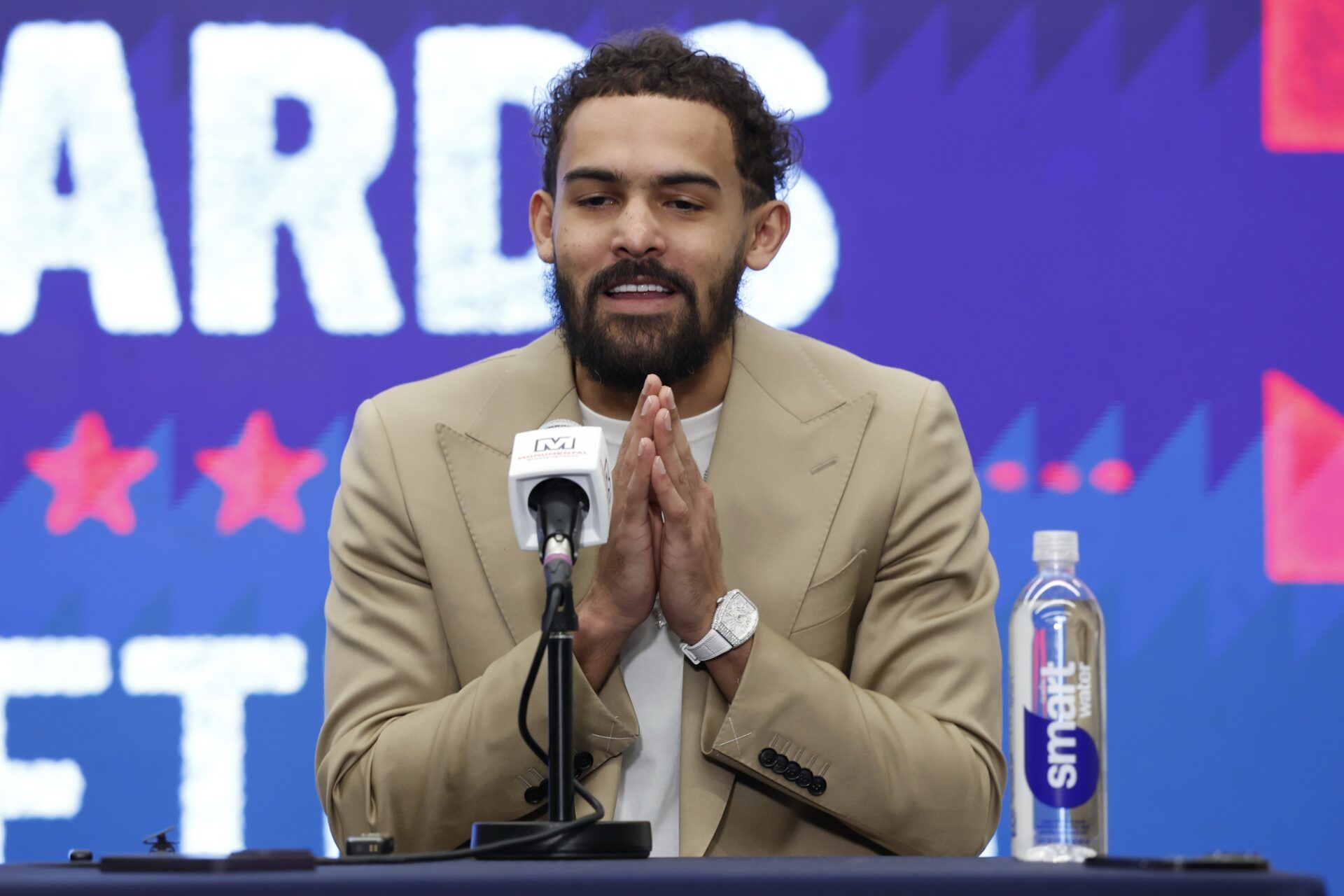
Brendan Haywood has seen enough front offices operate to know when a deal feels lopsided.
On Ryan Hollins’ Instagram Live Monday night, the former NBA champion and ex-Wizards center did not hedge when the topic turned to Washington acquiring Trae Young.
Hawks-Wizards Trade Sparks Debate Over Trae Young’s Value
“I’m telling you right now: that was a D trade for the Atlanta Hawks,” Haywood said. He called Young “a truly special playmaker” and said the Wizards “robbed the Hawks in broad daylight.”
The trade, as announced, sends Young to Washington in exchange for C.J. McCollum and Corey Kispert, with no draft picks included. Haywood’s point was simple: even if Young’s value has cooled, it should not fall that far.
View this post on Instagram
Haywood’s critique wasn’t about fit or vibes. It was about basic asset math.
He said Atlanta traded a multiple-time All-Star, a guard who has carried teams to the playoffs and put up near 30 points with near double-digit assists in some seasons, then took back a 34-year-old McCollum and added Kispert.
“And I love C.J. McCollum, but he’s 34,” Haywood said, using the age as the inflection point. “And then you add Corey Kispert?
Haywood acknowledged the league-wide reality that Young’s leverage is not what it was at his peak. But he kept coming back to the same line: Atlanta should have extracted more than two veterans.
Snap truth: stars usually bring picks.
What surprised Haywood most was what Atlanta did not receive.
“What surprised me most was they didn’t get a pick and they didn’t get a young player,” he said. In his view, a deal of this size should have required Washington to include one of its developing pieces along with draft compensation.
Haywood tossed out the type of name he would have demanded if he were negotiating for Atlanta.
“If I’m Atlanta, I got to get Buck Carrington, or I got to get one of these young players Trey Johnson,” he said, adding that he believed Washington could have offered “Trey Johnson.”
The larger idea was clear, even if the names were tossed out in conversation: Atlanta should have used Young’s stature to pull something forward-facing, not just salary and shooting.
Why Washington Could Justify the Swing for Young
The Wizards’ logic, as framed in reporting around the trade, is that Young gives them a recognizable engine and a real table-setter, a player who bends defenses and changes the geometry of half-court possessions.
DallasHoopsJournal reported that early interest has emerged on possible contract frameworks following the deal, including Washington exploring a multi-year framework for Young. The report also noted Washington’s broader context, including draft positioning and workload management as the season continues.
Haywood, for his part, sounded like someone who understands the Wizards’ motivation even while hammering Atlanta’s price.
“I knew we could score,” he said, then added that what’s made the move even more logical for Washington is the way minutes can be redistributed as the season progresses, including more opportunities for younger players.
That’s the blueprint: add the star, keep developing the kids, and let Young’s gravity do the heavy lifting.
Atlanta’s blueprint is the one Haywood questioned.
If the Hawks wanted a new direction, fine. If they wanted flexibility, fine. But in Haywood’s eyes, the return should have reflected what it means to move an All-Star level playmaker, even one with complications.
You can change the face of a franchise in one trade. You can also undersell it.
Haywood believes Atlanta did the latter. Washington gets the benefit of the doubt and the benefit of the doubt for the player.
