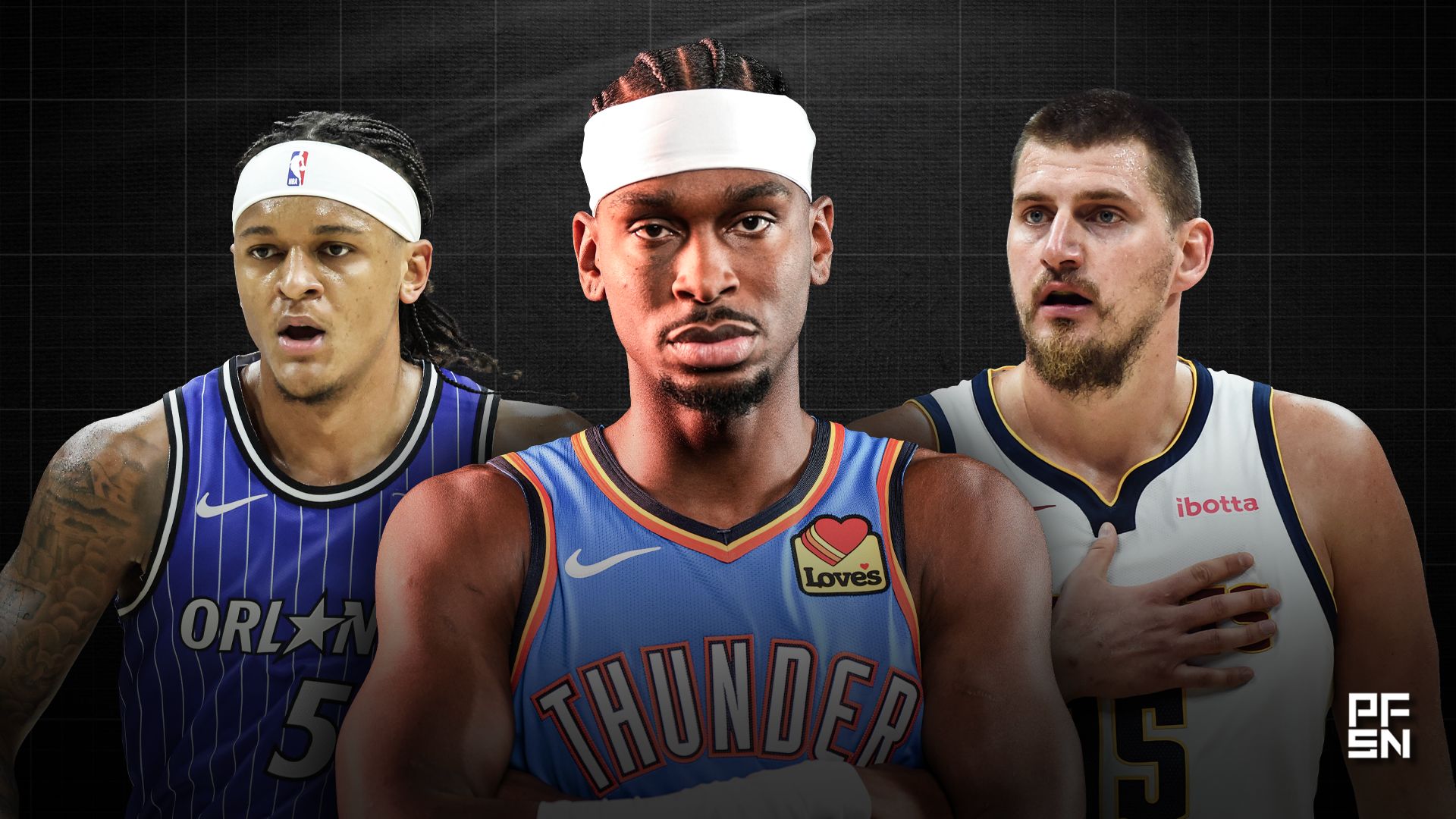
The wait is over: NBA Opening Night is finally here, and every team starts with a clean slate and dreams of winning a championship. Before the new season tips off, we’re ranking all 30 teams and taking stock of who’s poised to rise and fall. Dive into our NBA Power Rankings to see where each squad stands entering the 2025-26 campaign.

1) Oklahoma City Thunder
The Oklahoma City Thunder were the league’s most complete team last season, and they have a championship to prove it. What makes Oklahoma City’s rise even more remarkable is how sustainable it looks.
Shai Gilgeous-Alexander, the regular-season and Finals MVP, is only 26 and entering his prime years. Around him, Jalen Williams and Chet Holmgren already profile as All-NBA talents, while Nikola Topić adds another layer of upside. Oklahoma City began last season as the NBA’s youngest team and ended it rewriting what youth can accomplish at the highest level.
The Thunder lead the league in continuity, with nearly all their minutes returning. It’s been seven years since a team repeated as champion, but given their age, development, and proven chemistry, the Thunder could be poised to make history again.
2) Cleveland Cavaliers
The 2024-25 season marked a major step forward for the Cleveland Cavaliers, who went 64-18, their best record since 2008, and topped the NBA in offensive rating at 121.0, according to NBA Advanced Stats. First-year coach Kenny Atkinson earned Coach of the Year, while Evan Mobley claimed Defensive Player of the Year honors. With Mobley, Donovan Mitchell, and Darius Garland leading the way, the Cavs looked like true contenders until injuries derailed their postseason.
That abrupt exit reopened questions about the long-term fit of the Mitchell-Garland backcourt and the Mobley-Jarrett Allen frontcourt pairing. Still, Cleveland enters next season armed with talent, stability, and motivation.
The Eastern Conference may be wide open again, and after their breakthrough campaign, no team appears to have a clearer path than the Cavs. Cleveland returns its entire core, plus reinforcements in De’Andre Hunter, Lonzo Ball, and Larry Nance Jr. Their versatility and defensive instincts could be the key to finally pushing this roster over the top.
The Cavaliers don’t need to reinvent themselves. If they can’t take advantage now, they may not get a better chance.
3) Houston Rockets
The Houston Rockets surged back into contention last season, winning 52 games and finishing second in the West, their best mark since the James Harden years. Under Ime Udoka, one of the NBA’s youngest rosters became a balanced force, ranking 12th in offensive rating and fifth defensively. Though they bowed out in seven games to the Warriors, the playoff run proved their growth was real and sustainable.
This summer, Houston pushed even further, landing Kevin Durant in a blockbuster deal that signaled their transition from upstart to contender. Even after trading Jalen Green, the Rockets still boast a talented young core in Alperen Şengün, Amen Thompson, and Jabari Smith Jr., whose interior skill and defensive energy perfectly complement Durant’s scoring prowess. The potential fit is seamless, and the team’s championship window now feels wide open.
The one major setback comes with Fred VanVleet’s torn ACL, but Houston may be better equipped than most to weather it. Thompson and rookie Reed Sheppard will gain valuable on-ball experience, while Durant and Şengün take on more playmaking duties. Though spacing remains a concern, the Rockets’ collective versatility and defensive edge could keep them among the West’s elite.
4) Denver Nuggets
The Denver Nuggets endured a roller-coaster 2024 season, finishing 50-32, a dip from their 57-win campaign the year prior. Injuries to Jamal Murray and Aaron Gordon caused midseason turbulence, yet new head coach David Adelman kept the team steady for a strong postseason surge. Denver defeated the red-hot Clippers in the first round and then pushed the top-seeded Thunder to seven games, reestablishing themselves as an elite contender.
Nikola Jokić once again stood at the center of everything, averaging 29.6 points, 12.7 rebounds, and 10.2 assists, per Basketball Reference. He became just the third player ever to average a triple-double over a full season. With the three-time MVP leading the charge, Denver continues to present matchup nightmares for every opponent.
This summer’s moves only strengthen that outlook. Cameron Johnson replaces Michael Porter Jr. with more playmaking and defensive mobility, while Bruce Brown and Tim Hardaway Jr. bolster the wing rotation. Jonas Valančiūnas gives Denver its best backup center of the Jokić era, and Christian Braun continues to thrive as a versatile connector.
If healthy, this group may be one of the only rosters built to challenge Oklahoma City’s reign genuinely.
5) Minnesota Timberwolves
The Minnesota Timberwolves followed up their breakout 2023 season with another strong campaign, returning to the Western Conference Finals for the second straight year. Though they won fewer regular-season games, their playoff performance reaffirmed their staying power. Ultimately, a five-game loss to the eventual champion Thunder revealed the gap between contenders, but it also showed that Minnesota’s foundation is built to last.
At the center of everything is Anthony Edwards, who finished fourth in scoring and led the league in total three-pointers made. The 24-year-old star is a top-15 player and looks every bit like a future MVP. Surrounding him is a veteran core featuring Rudy Gobert, Julius Randle, and Naz Reid, who thrives as one of the league’s top reserves.
The Wolves’ main question entering the new season lies in backcourt depth. With Nickeil Alexander-Walker gone and Mike Conley turning 38, guards like Donte DiVincenzo and former No. 8 pick Rob Dillingham will need to shoulder more responsibility. If Minnesota finds that extra gear, they’ll remain one of the West’s toughest outs.
6) New York Knicks
The New York Knicks reached their first Eastern Conference Finals in 25 years and posted back-to-back 50-win seasons, but that still wasn’t enough to keep Tom Thibodeau in charge. His exit signals the franchise’s ambition to move beyond “good” toward true contention.
With All-Stars Jalen Brunson and Karl-Anthony Towns anchoring a starting five that also includes Mikal Bridges, OG Anunoby, and Josh Hart, the core remains one of the NBA’s most complete units.
Where the Knicks faltered was in offensive variety and second-unit production. Last postseason, too much of their attack relied on Brunson’s one-on-one scoring, making them predictable in key moments. New head coach Mike Brown is expected to bring more balance and movement to the offense.
The front office also addressed depth by adding Jordan Clarkson and Guerschon Yabusele, giving New York a more dynamic bench. Combined with the continuity of last year’s top six, the Knicks are positioned to take another leap if their offensive evolution matches their defensive consistency. After knocking on the door the past two seasons, they may finally be ready to break through.
7) Los Angeles Clippers
The Los Angeles Clippers entered last season with modest expectations after losing Paul George and Russell Westbrook, yet they defied the odds by winning 50 games and reaching the playoffs for the 12th time in 14 years.
Led by a top-three defense and a rejuvenated James Harden, who averaged 22.8 points, 8.7 assists, and 5.8 rebounds, they became one of the league’s most balanced teams. Ivica Zubac also emerged as a reliable two-way anchor inside.
Even as injuries limited Kawhi Leonard to just 37 games, the Clippers pushed the Nuggets to a seven-game series, highlighting their competitiveness when healthy. They played at a high level with Leonard on the floor and still maintained a positive differential without him. Their ceiling remains high as long as Leonard and Harden can share the court consistently, given their +14.1 net rating together last season.
This offseason added stability and depth around the stars. Bradley Beal, Brook Lopez, and Chris Paul join a veteran core, ensuring the Clippers can absorb injuries without collapsing. Paul should ease Harden’s playmaking load, while Lopez provides the interior defense and floor spacing the team lacked. Though older, this roster’s experience, shooting, and toughness make Los Angeles a legitimate dark horse in the West.
8) Los Angeles Lakers
The Los Angeles Lakers underwent a dramatic transformation last season after trading Anthony Davis to Dallas for Luka Dončić, a blockbuster move that completely altered the franchise’s direction.
Pairing Dončić with LeBron James created one of the league’s most dynamic duos. Under first-year coach JJ Redick, Los Angeles finished 50-32, securing the No. 3 seed in the West. Still, a first-round loss to Minnesota exposed their lack of frontcourt size and physical presence.
The Lakers addressed that weakness this offseason by replacing Jaxson Hayes with Deandre Ayton, whose rim protection and rebounding should stabilize their interior defense. With Ayton anchoring the paint and Dončić orchestrating the offense alongside James, Austin Reaves, and Rui Hachimura, the Lakers’ rotation looks deeper and more balanced than it has in years.
The roster has a better mix of creation, floor spacin,g and defensive coverage, which will be needed to compete in the postseason. LeBron’s age-41 season brings urgency, but also perspective. The window remains open, just narrower. Dončić’s elite playmaking and improved conditioning should keep him in the MVP conversation, and if he stays healthy, the Lakers have a legitimate shot to challenge for the title.
9) Orlando Magic
The Orlando Magic made it clear this offseason that their rebuild is officially over. After a second straight playoff appearance and a first-round loss to Boston, the front office accelerated the timeline by acquiring Desmond Bane in a blockbuster trade. The move cost them heavily in assets but landed one of the league’s most efficient shooters and secondary playmakers, signaling a full commitment to contention.
Even through injuries and inconsistency, the Magic finished last season at .500 while owning the NBA’s second-best defensive rating. Paolo Banchero and Franz Wagner both delivered career years, and Jalen Suggs emerged as a two-way force before his injury.
The addition of Bane, a career 41% shooter from deep, gives Orlando the offensive punch and spacing they lacked without sacrificing their defensive edge. Jase Richardson also brings needed perimeter skill and poise to an already dynamic young core.
If Banchero, Wagner, and Suggs stay healthy, Orlando has the talent and balance to climb into the East’s upper tier. With Bane stretching defenses and a deep rotation behind him, the Magic look ready to make a real run at a conference finals berth, and maybe more.
10) Detroit Pistons
The Detroit Pistons were one of the NBA’s most refreshing stories last season, flipping years of frustration into genuine progress. After five straight seasons with 23 or fewer wins, they surged to a 44-38 record, their best since 2016, and returned to the playoffs. First-year head coach J.B. Bickerstaff deserves credit for building an identity rooted in defense, balance, and accountability, helping the young roster find stability.
Cade Cunningham blossomed into a full-fledged star, averaging 26.1 points, 9.1 assists, and 6.1 rebounds while earning his first All-NBA nod and All-Star berth. Bickerstaff’s leadership brought cohesion to a group that included Jalen Duren, versatile Ausar Thompson, and rapidly improving Jaden Ivey before injury struck.
Even with a first-round exit, Detroit became a team on the rise. With Cunningham only 24 and still improving, the Pistons’ ceiling looks even higher heading into 2025. The return of Ivey and the continued growth of Thompson could be key. If Detroit’s young core maintains its upward trajectory, a 50-win season and deeper playoff run are well within reach.
11) Golden State Warriors
The Golden State Warriors’ 2024 season ended in the second round against Minnesota, but it was far from a disappointment considering the midseason turnaround that saved their year. The acquisition of Jimmy Butler III brought toughness, defense, and stability to a group that had struggled to find itself after Klay Thompson’s departure.
With Stephen Curry, Draymond Green, and Butler leading the way, the Warriors looked like a rejuvenated contender before depth issues caught up in the playoffs. Golden State held onto Jonathan Kuminga after his breakout postseason, retained Gary Payton II, and added Al Horford to reinforce their defense and paint presence.
Those moves should keep them among the league’s top defensive teams, but offensive consistency remains a concern. Butler’s free-throw generation helps, yet his shooting inefficiency and Curry’s heavy workload make balancing the attack challenging. Still, any team built around Stephen Curry can’t be counted out. Even at 38, he remains capable of All-NBA-caliber play, though the championship window grows narrower each season.
The Warriors’ quiet offseason and roster uncertainty signal the end of their dynasty era. Still, their experience, chemistry, and star power ensure they remain a threat in the West for as long as Curry, Green, and Butler are on the floor.
12) Dallas Mavericks
The Dallas Mavericks’ fortunes shifted dramatically when the lottery ball landed them the No. 1 pick, giving general manager Nico Harrison a lifeline after trading Luka Dončić to the Lakers for Anthony Davis. The gamble backfired early, as Davis played just nine games due to injury, and Kyrie Irving tore his ACL, leaving Dallas without its two stars for the rest of the year.
However, the arrival of Cooper Flagg has reignited optimism about the future.
Flagg gives Dallas a potential franchise cornerstone to rebuild around, and the roster still carries serious talent when healthy. Davis and Irving, alongside a supporting cast featuring Klay Thompson, Dereck Lively II, P.J. Washington, and Daniel Gafford, form a dangerous two-way foundation. Until Irving returns, the Mavericks will lean into a big-ball approach that few teams can match in size, rebounding, and rim protection.
The health of Davis and Irving will ultimately dictate Dallas’ ceiling, though expectations remain tempered after last season’s chaos. Still, the combination of elite interior presence and Flagg’s immense upside offers a clear roadmap forward. If the rookie lives up to the hype, even partially, the Mavericks could quickly return to relevance and become one of the West’s sleepers.
13) Atlanta Hawks
The Atlanta Hawks entered this season at a crossroads after another sub-.500 finish and a quick play-in exit. Trae Young’s offensive brilliance is undeniable, but his defensive shortcomings and the team’s playoff struggles have fueled debate about Atlanta’s next chapter.
However, there’s renewed optimism thanks to the growth of Dyson Daniels, who led the league in steals, and the emergence of Jalen Johnson before injury halted his breakout.
The front office made a significant statement by acquiring Kristaps Porziņģis in a bold offseason move. When healthy, Porziņģis adds elite rim protection, floor spacing, and two-way versatility. His presence, combined with Young’s creation and the athleticism of Johnson and Onyeka Okongwu, gives Atlanta one of the East’s more intriguing cores. The team’s improved balance could finally shift it from inconsistent to consistently competitive.
Beyond the stars, the supporting cast looks deeper and more dynamic than at any point in recent years. Zaccharie Risacher, Asa Newell, and Nickeil Alexander-Walker provide size, defense, and shooting that perfectly complement the core. For the first time in a while, the Hawks have both the length and lineup flexibility to compete on both ends of the floor.
If Young, Porziņģis, and Johnson stay healthy, Atlanta might be ready to rise out of the middle and back into the Eastern Conference mix.
14) San Antonio Spurs
The San Antonio Spurs are entering an exciting new era, led by Victor Wembanyama, who already looks like one of the NBA’s next great superstars. After years of patient rebuilding, San Antonio appears ready to accelerate its climb toward contention.
The midseason acquisition of De’Aaron Fox highlights that intent, giving the Spurs a dynamic backcourt partner for Wembanyama. Though their time together was brief due to injuries, the potential of that pairing is enormous.
New head coach Mitch Johnson takes over for Gregg Popovich, who transitions to a front-office role. The Spurs look to build on last year’s 12-win improvement.
The team’s young nucleus, including Rookie of the Year Stephon Castle, Devin Vassell, and Keldon Johnson, grows even stronger with first-rounders Dylan Harper and Carter Bryant joining the mix. Harper’s playmaking and versatility, in particular, fit perfectly alongside Fox and Wembanyama.
San Antonio’s defense still has room for growth after three straight seasons near the bottom of the league, but the foundation is clearly in place. With talent, flexibility, and a trove of trade assets, the Spurs are well-positioned to make another leap. If this group stays healthy and meshes well, the playoff drought may finally be nearing its end.
15) Memphis Grizzlies
The Memphis Grizzlies rebounded from an injury-marred 2023-24 season to post a 48-34 record, only to be swept by the Thunder in the first round. While the return to form was encouraging, inconsistency and health remained ongoing issues, with Ja Morant missing 32 games.
Despite their strong defense and improved offense, Memphis never fully clicked at full strength, prompting the front office to rethink its direction. That reset began with the dismissal of head coach Taylor Jenkins and a bold trade sending Desmond Bane to Orlando. The deal returned Kentavious Caldwell-Pope, Cole Anthony, four first-round picks, and a pick swap.
Rookie Cedric Coward could eventually fill some of Bane’s offensive void, while the added draft capital gives Memphis options to chase another star or strengthen its future core. Even after the shake-up, the Grizzlies remain competitive. Morant and Jaren Jackson Jr. are an elite inside-out duo, complemented by Caldwell-Pope’s shooting and veteran presence.
With Ty Jerome, Santi Aldama, and one of the NBA’s steadier defenses, Memphis should stay firmly in the Western Conference mix.
16) Milwaukee Bucks
The Milwaukee Bucks entered last season with title ambitions, but inconsistency and injuries kept them from reaching those heights. They managed a 48-34 record and won the NBA Cup, yet Milwaukee went winless in 10 regular-season games against Boston, New York, and Cleveland.
When Damian Lillard suffered a season-ending Achilles injury, Giannis Antetokounmpo carried the team heroically, but a first-round playoff exit to the Pacers marked another disappointing finish.
This summer brought sweeping change as the Bucks waived and stretched the remainder of Lillard’s contract to create flexibility for a Myles Turner deal. Turner’s floor spacing and interior defense should perfectly complement Antetokounmpo, giving Milwaukee one of the East’s better frontcourts. However, the supporting cast, featuring Kevin Porter Jr., Gary Trent Jr., Kyle Kuzma, and Bobby Portis, still lacks the two-way stability of a championship roster.
Trade rumors surrounding Antetokounmpo continue to swirl, and they’ll only intensify if the Bucks fail to rise back into the top tier of the conference. Giannis remains a perennial MVP candidate capable of keeping Milwaukee competitive on his own, but even his brilliance can’t fully mask the roster’s flaws.
17) Miami Heat
The Miami Heat endured another disappointing season, finishing 37-45 and making their third consecutive play-in appearance before being swept by Cleveland in the first round. The campaign was marked by the trade deadline deal that sent Jimmy Butler to Golden State, officially ending that era.
Despite Tyler Herro’s All-Star campaign and Bam Adebayo’s defensive consistency, the Heat struggled in clutch moments, going just 3-11 in one-possession games. Miami’s offseason took a hit when Herro underwent ankle surgery that could sideline him for the first couple of months of the new season.
For a team already lacking offensive firepower, replacing his scoring will be challenging. The addition of Norman Powell provides some relief, but the Heat will need significant contributions from young players like Jaime Jaquez Jr. and Nikola Jović to stay afloat until Herro returns.
The franchise’s future hinges on the development of its younger core, which also includes Kel’el Ware and first-round pick Kasparas Jakučionis, who addresses the team’s need for a playmaking point guard. If Adebayo can return to All-Star form and the young players take meaningful steps forward, Miami might be able to remain competitive in the interim.
18) Boston Celtics
The Boston Celtics entered last season as the championship favorite, winning over 60 games and finishing with the NBA’s second-best net rating. For most of the year, they looked every bit the part, until disaster struck in the playoffs. A second-round loss to the Knicks was compounded by Jayson Tatum’s devastating Achilles injury, which ended both his season and Boston’s title hopes.
Tatum’s injury came at the peak of his career form and now looms large over the franchise’s short-term future. With him expected to miss most, if not all, of the 2025-26 campaign, the Celtics pivoted by trading away Jrue Holiday and Kristaps Porziņģis while letting Al Horford walk in free agency. Anfernee Simons arrives as the key offseason addition, giving Boston a dynamic shot creator alongside Jaylen Brown and Derrick White.
Without their superstar, Boston faces a transitional year, one in which development and patience will likely replace championship contention. Brown, White, and Simons should put up big numbers, but the team’s overall ceiling is capped.
19) Indiana Pacers
The Indiana Pacers authored one of the most inspiring stories of last season, making a stunning run to the NBA Finals and pushing the Thunder to seven games. Powered by Tyrese Haliburton and Pascal Siakam, they combined elite playmaking, strong chemistry, and key performances from Myles Turner, Aaron Nesmith, T.J. McConnell, and Andrew Nembhard to reach their first Finals appearance in 25 years.
But the dream ended painfully when Haliburton, already nursing a calf strain, tore his Achilles in Game 7. His injury casts a long shadow over the 2025 season, likely sidelining him for the year and halting Indiana’s upward trajectory.
The loss of Turner in free agency further complicates their outlook, even as rookie guard Kam Jones joins the rotation to help fill the backcourt void. Without Haliburton, the Pacers are poised to take a step back after two deep playoff runs, potentially treating this as a transitional year.
Rick Carlisle remains one of the league’s best coaches, and Siakam is still a star capable of keeping the team competitive. Players like Nembhard and Bennedict Mathurin will have larger roles, but without their floor general, Indiana’s ceiling is clearly limited.
20) Sacramento Kings
The Sacramento Kings enter this season with more uncertainty than optimism after another disappointing year capped by a quick play-in tournament exit. Big-name acquisitions DeMar DeRozan and Zach LaVine failed to deliver the expected spark, and a midseason coaching switch from Mike Brown to Doug Christie offered little improvement.
The deadline trade of De’Aaron Fox further contributed to the instability, leaving Sacramento with no clear direction or identity. Finishing just below .500 with a bottom-half defense, the Kings now have serious questions about their long-term core.
The future of All-Star Domantas Sabonis is increasingly unclear, and recent draft picks Nique Clifford and Maxime Raynaud may help, but join a roster short on chemistry. Free-agent signings Dennis Schröder and Russell Westbrook bring experience but not long-term answers at point guard.
For Sacramento to shake its cycle of mediocrity, the team needs a massive leap from Keegan Murray, whose productivity has declined each season. The current group projects as a play-in hopeful at best.
21) Portland Trail Blazers
The Portland Trail Blazers enter the new season with renewed optimism after one of the NBA’s most surprising turnarounds. Expected to remain in rebuild mode, Chauncey Billups’ team instead won 36 games, 15 more than the year before, and posted a strong 23-18 record after the All-Star break.
The progress earned contract extensions for both Billups and general manager Joe Cronin, confirming confidence in the team’s leadership. Much of that late-season surge was powered by the growth of Portland’s young core.
Deni Avdija emerged as a legitimate two-way contributor, averaging 22.5 points, 9.3 rebounds, and 5.1 assists over his final 22 games. Scoot Henderson, Shaedon Sharpe, and Toumani Camara also flashed significant promise, giving the franchise a versatile and active foundation on the defensive end, something it had lacked in recent seasons.
The offseason addition of Jrue Holiday should further strengthen that identity. His veteran leadership and elite defense complement the young group, while the departures of Anfernee Simons and Deandre Ayton on that end of the floor could prove to be addition by subtraction.
If Portland’s young stars continue their upward trajectory, the Blazers could soon reemerge as a serious play-in contender in the loaded Western Conference, especially with Damian Lillard recovering from injury.
22) Chicago Bulls
The Chicago Bulls enter this season with quiet optimism after a promising close to their 2024 campaign. Despite another early play-in exit, a 14-6 stretch to end the year hinted at progress following Zach LaVine’s departure.
Under coach Billy Donovan, a reworked lineup featuring Josh Giddey, Coby White, Kevin Huerter, rookie Matas Buzelis, and Nikola Vučević provided balance, cohesion, and a clearer long-term vision.
Matas Buzelis’ breakout was one of the season’s biggest positives. The rookie doubled his minutes after the All-Star break and averaged 13.0 points per game on 58.5% true shooting, showcasing poise and versatility beyond his years. Meanwhile, Giddey and White gave Chicago a young, dynamic backcourt that’s still developing but increasingly capable of driving winning play.
The Bulls remain several steps away from contention but are finally trending in the right direction. With continued growth from Giddey and White and another leap from Buzelis, Chicago could graduate from play-in status to a solid playoff team.
23) Philadelphia 76ers
The 2024 season was a disaster for the Philadelphia 76ers, derailed almost entirely by injuries and unmet expectations.
Joel Embiid appeared in only 19 games, Paul George managed 41, and even rising star Tyrese Maxey missed 30 contests despite an All-Star-level campaign. Promising rookie Jared McCain joined the list of injured players, leaving the Sixers depleted and out of contention before the All-Star break.
Unsurprisingly, Philadelphia stumbled to a 24-win season, its worst in nearly a decade, but managed to find a silver lining in the draft lottery. Landing the No. 3 pick allowed the Sixers to select Baylor’s VJ Edgecombe, an athletic, defensive-minded wing who brings much-needed youth and intensity to the perimeter. They also added big man Johni Broome to fortify the frontcourt rotation behind Embiid.
Looking ahead, the Sixers’ potential depends almost entirely on health. When Embiid, George, and Maxey share the floor, Philadelphia still has the framework of a top-tier team. But history suggests sustaining that trio’s availability will be difficult. If they can finally stay healthy, the Sixers have the talent to rejoin the Eastern Conference mix. If not, it could be another long year.
24) New Orleans Pelicans
The New Orleans Pelicans’ 2024 season unraveled amid injuries and roster turnover, with nearly every key player missing significant time. The core barely shared the court before more change arrived.
Brandon Ingram was traded to Toronto, and Dejounte Murray is set to miss a large portion of the upcoming season recovering from a torn Achilles. Trey Murphy III’s breakout year was cut short, and Zion Williamson’s recurring injuries remain a lingering concern that clouds the franchise’s outlook.
When healthy, Williamson is as dominant as any player in the league. New Orleans went 49-33 the last time he played 70 games, but that durability has proven fleeting. The front office is wrestling with whether to continue building around him as the franchise’s centerpiece.
Even so, the Pelicans’ 2025 draft injected new optimism. Point guard Jeremiah Fears offers promise as a floor leader, while big man Derik Queen brings polish and scoring touch around the rim. A healthy blend of Williamson, Murphy, Herb Jones, Murray, and Jordan Poole could put New Orleans back in the playoff mix, but their success will hinge, once again, on staying on the floor together.
25) Toronto Raptors
The Toronto Raptors enter the new season with greater clarity about their young core but continued uncertainty about their long-term trajectory. Injuries and inconsistency defined their 2024 campaign, leaving them outside the play-in picture despite stretches of promise. A 22-21 finish over their final 43 games hinted at progress, yet the team still struggled to find cohesion around Scottie Barnes, RJ Barrett, and Immanuel Quickley.
Newcomer Brandon Ingram has yet to play a game for Toronto. Fit remains the biggest concern. The Barnes-Barrett-Quickley trio posted a troubling -12.7 net rating last season, and Ingram, while a gifted scorer, has a track record of mixed team success.
The Raptors’ offense remains heavily paint-focused, as they led the league in shots near the rim but ranked near the bottom in 3-point rate and percentage. Even so, there are encouraging signs. Rookie Collin Murray-Boyles adds strength, rebounding, and defensive instincts that fit well with Toronto’s identity.
If Barnes continues to evolve into a true two-way star and either Barrett or Ingram finds consistency, the Raptors could take a small step forward. Still, unless their spacing dramatically improves, they’re likely headed for another year on the Eastern Conference bubble.
26) Phoenix Suns
The Phoenix Suns have hit the reset button after a disastrous season that exposed the cracks in their star-heavy experiment. Despite carrying the NBA’s most expensive roster, the trio of Devin Booker, Kevin Durant, and Bradley Beal never found chemistry, stumbling to just 36 wins. Defensive lapses, a thin bench, and a lack of offensive cohesion left Phoenix miles from contention and forced the front office to rethink its direction.
Durant was shipped to Houston in a deal that landed Jalen Green, Dillon Brooks, and the No. 10 pick, while Bradley Beal was also moved as part of a full-scale reset. New head coach Jordan Ott now takes over a younger, more balanced roster featuring additions like Mark Williams, Khaman Maluach, and Rasheer Fleming, all aimed at improving the team’s interior presence and defensive identity.
Even so, Phoenix’s outlook for 2025 remains uncertain. Booker should deliver another elite individual season, and Green’s athleticism and scoring instincts make him a compelling No. 2 option. Beyond that, the supporting cast still lacks top-end talent, leaving the Suns stuck somewhere between a retool and a rebuild. The pieces are intriguing, but their path back to Western Conference relevance is far from clear.
27) Charlotte Hornets
The Charlotte Hornets once again fell short of expectations, turning what was supposed to be a breakout year into a 19-63 disappointment, their worst record since 2011. Injuries and inconsistency plagued the season, as LaMelo Ball, Brandon Miller, and Mark Williams shared the floor for just 211 possessions.
Ball’s continued health issues remain troubling, marking his third season in four with fewer than 50 games played, while Miller’s promising campaign was cut short by injury after 27 games.
The front office made more changes in the offseason, sending Williams to Phoenix and drafting Creighton big man Ryan Kalkbrenner, a defensive anchor who should immediately bolster the paint. Despite the setbacks, there were flashes of progress under head coach Charles Lee, including noticeable defensive improvement and encouraging offensive numbers when Ball and Miller were both healthy. Still, they’ve been unable to sustain success.
Charlotte’s roster remains intriguing on paper, featuring young talent like Ball, Miller, and Miles Bridges, along with sharpshooting rookies Kon Knueppel and Liam McNeeley. If they can stay healthy and finally establish continuity, there’s enough upside to climb out of the East’s basement. But it’s fair to ask: When will all that potential finally translate to results?
28) Washington Wizards
The Washington Wizards endured another brutal campaign, finishing 18-64, the worst mark in the East and their second straight season under 20 wins. While few expected an immediate turnaround, the team’s tumble to sixth in the draft lottery was a painful setback for a franchise still searching for a true franchise cornerstone. The lack of progress showed just how steep the climb remains under general manager Will Dawkins’ slow, Thunder-style rebuild.
Still, Washington managed to add meaningful talent in the draft, selecting Tre Johnson, one of the class’s most polished scorers, alongside athletic wing Will Riley and two-way player Jamir Watkins.
They join rising prospects Alex Sarr and Bub Carrington, with the latter earning All-Rookie Second Team honors. Behind those two, the Wizards have a young nucleus with legitimate upside. Sarr, in particular, showed flashes late in the year as a big man capable of spacing the floor and protecting the rim.
Veterans like Khris Middleton and newly acquired C.J. McCollum provide leadership and potential trade value for a team still years away from contention. The Wizards are almost certain to remain in the league’s bottom third on both ends, but this new core offers some optimism. It may be another long season in D.C., yet for the first time in a while, there’s a sense that an actual foundation is beginning to take shape.
29) Brooklyn Nets
The Brooklyn Nets entered 2024 with modest expectations, fully embracing a rebuild centered on youth and development. They finished well below .500 but landed their first lottery pick since 2010, selecting eighth overall. Under first-year head coach Jordi Fernández, Brooklyn stayed competitive despite frequent lineup changes and the extended absence of lead scorer Cam Thomas, who averaged 24.0 points in just 25 games.
The Nets’ offseason brought a flood of young talent through the draft, adding Egor Demin, Nolan Traoré, Drake Powell, and Danny Wolf. Brooklyn’s rotation will feature heavy minutes for unproven players, giving Fernández room to experiment and identify future cornerstone pieces. The organization’s patience signals a commitment to long-term growth even without immediate playoff hopes.
Veterans will help steady the transition. Michael Porter Jr. brings elite outside shooting to a roster short on spacing, while Nicolas Claxton remains a reliable defensive anchor despite a quieter offensive year. Terance Mann adds versatility and leadership. Still, wins may be scarce again in 2025.
30) Utah Jazz
The Utah Jazz endured a nightmare 2024 season, finishing 17-65, the worst record in franchise history, and their first 60-loss campaign. After two years of overachieving under Will Hardy, the team completely fell apart, posting a -9.2 net rating that ranked among the league’s worst. Injuries, lack of direction, and roster imbalance left the Jazz searching for answers and forced a serious reassessment of their rebuild.
There’s renewed optimism, however, with the arrival of rookies Ace Bailey and Walter Clayton Jr. Bailey’s elite athleticism and upside on both ends make him a strong complement to Lauri Markkanen, while Clayton’s instant scoring ability adds spark to the backcourt. Both are viewed as long-term pieces in Utah’s next chapter, giving fans reason to hope after a season devoid of positives.
Still, the path forward remains uncertain. Markkanen, limited to 47 games last year, signed a five-year, $238 million extension, but his future in Utah is far from guaranteed. New president of basketball operations Austin Ainge has emphasized building competitiveness, yet the Jazz appear destined for another year near the bottom of the standings.