
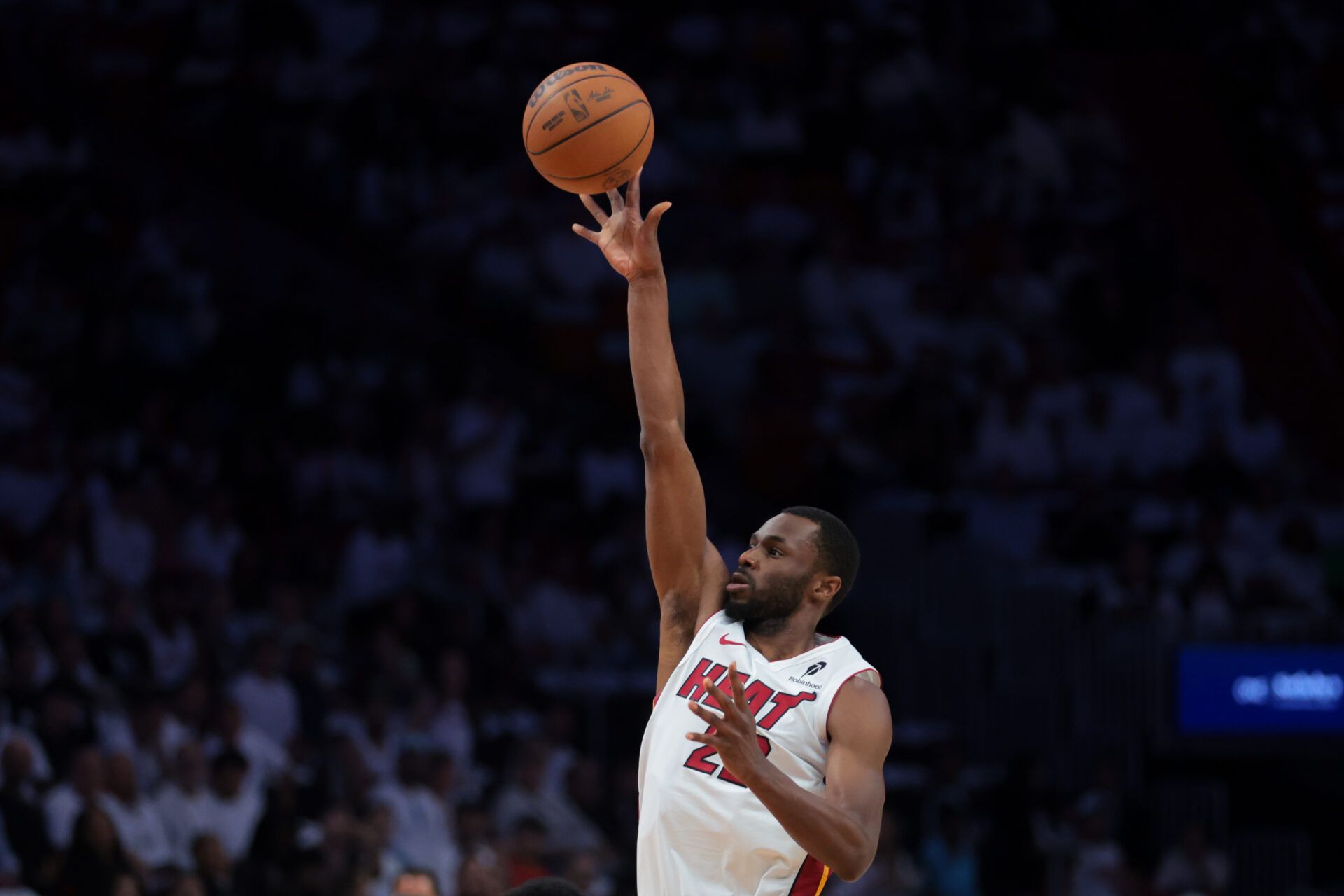
The Los Angeles Lakers have been no strangers to blockbuster moves, and once again, the franchise finds itself at the center of another major one. Well, at least rumored to be! With training camp fast approaching, reports suggest that the Lakers could be eyeing a trade for Andrew Wiggins, a two-way forward with a championship pedigree and the kind of playoff-tested versatility that could elevate their title hopes.
The proposed framework involves moving on from a crucial $51,000,000 piece of their roster puzzle. While still hypothetical, this scenario is generating quite a buzz across the league.

How Is Andrew Wiggins to The Lakers Possible?
Among the different scenarios floated, one of the most detailed comes from Fadeaway World, where the Lakers receive Wiggins and young forward Jaime Jaquez Jr. in exchange for the team’s $51 million star, Rui Hachimura. Along with Hachimura, Dalton Knecht, Maxi Kleber, and a future first-round pick are also going to be involved.
For LA, the deal would address their most glaring need, i.e., adding another reliable two-way wing to support LeBron James and Luka Doncic.
Wiggins, 30, comes with proven playoff experience and a track record of shining under pressure. He was pivotal in the Golden State Warriors’ 2022 championship run, and last season with the Miami Heat showed that he has more to offer in terms of his offensive responsibility. In 17 games for Miami, Wiggins averaged 19 points, 4.2 rebounds, 3.3 assists, and 1.2 steals per game, while shooting an efficient 45.8% from the field and 36% from deep.
Andrew Wiggins is on the board for the Heat!
He scores his first PTS for Miami from beyond the arc 🎯 pic.twitter.com/aW7FnlZ5wu
— NBA (@NBA) February 11, 2025
His ability to score in isolation, hit catch-and-shoot threes, and guard multiple positions makes him the kind of player the Lakers have been searching for.
Now, acquiring Jaquez Jr. in the same deal would add even more depth. Although the 24-year-old regressed slightly in the recent past, his rookie year showed flashes of multi-level scoring potential. His 8.6 points and 4.4 rebound average last season suggest he can thrive in a reduced-pressure role off the Lakers’ bench.
However, the price of this package is pretty steep. Hachimura has emerged as a solid fit alongside Doncic, posting 13.1 points and 5 rebounds per game while shooting 41% from beyond the arc last season.
Many fans see him as an underappreciated asset. The front office, on the other hand, may value Wiggins’ superior defense and playoff resume more highly.
How Will The Proposed Wiggins-Hachimura Trade Pan Out For the Lakers?
A closer look at the numbers can help illustrate why the Lakers might be tempted. Wiggins’ career averages stand at 18.5 points, 4.5 rebounds, and 2.3 assists per game across 11 seasons. Hachimura, on the other hand, sits at 12.8 points, 4.9 rebounds, and 1.3 assists per contest.
In playoff settings, Wiggins again holds the edge, averaging 16 points and 6.3 rebounds compared to Hachimura’s 12.3 and 4.4.
Importantly, Wiggins has already proven he can be a second or third option on a championship team, while Hachimura’s role has remained more complementary.
Still, there are reasonable doubts about the fit. Hachimura’s off-ball efficiency makes him a seamless partner for Doncic, while Wiggins, at times, thrives best when he has the ball in his hands. Balancing touches between James, Doncic, and Wiggins could pose challenges for the Lakers’ rotation.
For Miami, the incentive is financial as much as it is basketball-related. Hachimura’s contract expires in 2026, providing cap flexibility, while Wiggins has a $30.2 million player option that could complicate long-term planning. Adding Knecht, a promising young shooter who is averaging 9.1 points on 37.6% from deep as a rookie, also sweetens the package.
As things stand, the proposed trade is still just speculation, but the logic is clear. For the Lakers, landing Wiggins could serve as the final piece that transforms them from a contender into a legitimate favorite. As for the Heat, it offers future flexibility and younger assets in return.
