
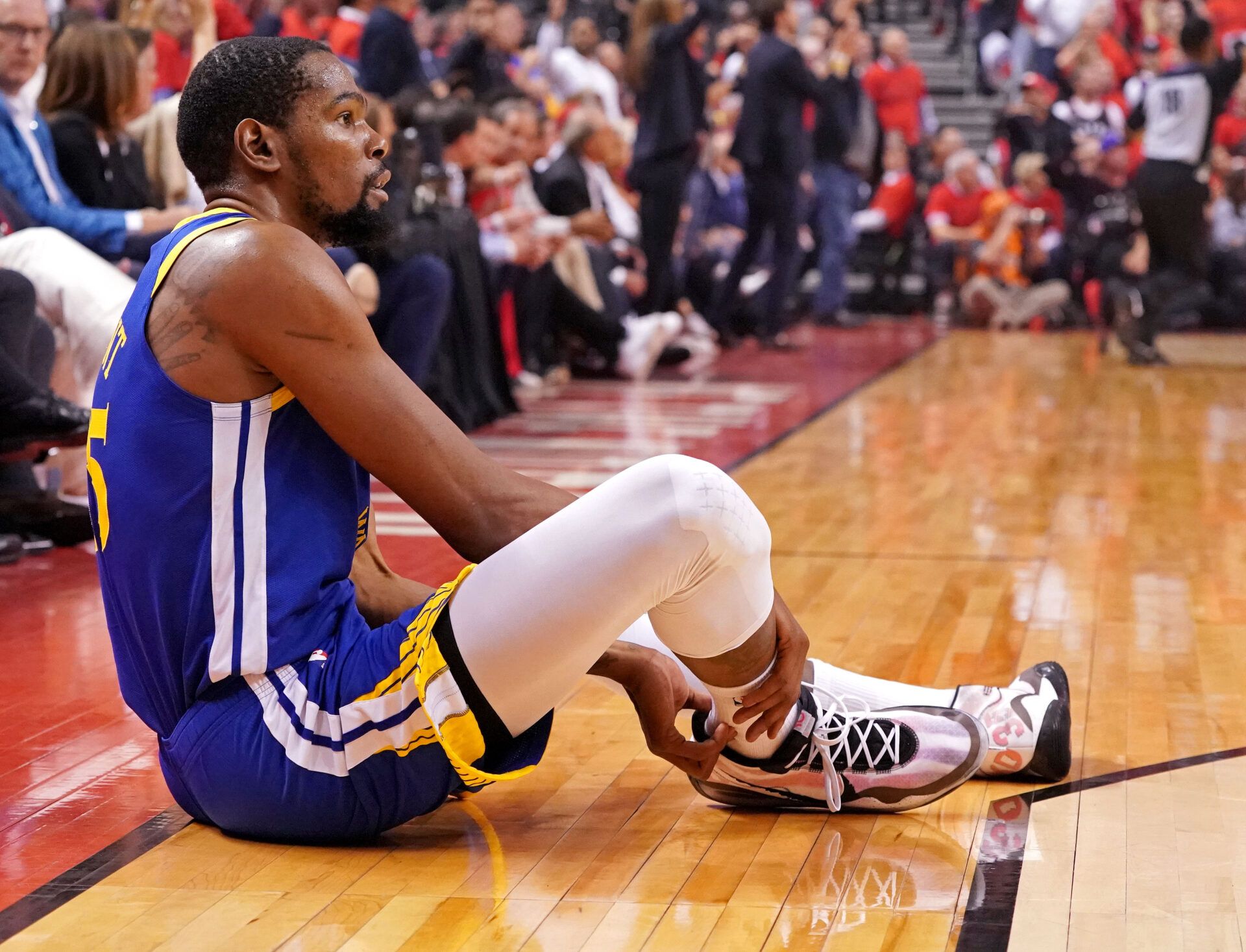
When Jayson Tatum and Damian Lillard went down with Achilles tears during the 2024-25 postseason, they knew exactly who to call. Kevin Durant has become the unofficial mentor for NBA stars facing basketball’s most devastating injury, and his phone has been ringing more than ever.
The Achilles tear used to be rare in the NBA, with only 45 players suffering the injury between 1990 and 2023. But the 2024-25 campaign saw eight such tears, including those of Tatum and Lillard. While both stars face a long road back, they have Durant’s experience to lean on.
How Did Kevin Durant Overcome His Achilles Injury?
Durant tore his Achilles in 2019 and recently discussed the injury’s impact on his body and game during the latest episode of the “Mind The Game” podcast. Unlike many stars who never fully recovered, Durant stands as the rare exception to the Achilles curse.
The injury has historically ended careers or severely diminished performance. Kobe Bryant’s physical decline began after his 2013 tear, while DeMarcus Cousins saw his promising career derailed by the same injury in 2018. Even Klay Thompson, who recovered to win a championship with the Warriors, wasn’t as efficient as he was during his first three rings.
Durant’s case tells a different story. Since his Achilles tear, he has not only maintained his efficiency but also improved in certain areas. His points and assist numbers have increased, and his overall efficiency has risen across the board.
This success has made Durant the go-to resource for injured stars. Both Tatum and Lillard reached out to the 15-time All-Star after their injuries. Durant believes acceptance of the lengthy absence is crucial for recovery.
“I’m starting to feel like the Achilles guy”
KD says Tatum & Dame reached out after their Achilles injuries 🙏
(via @mindthegamepod) pic.twitter.com/OvBAGRMy4p
— Bleacher Report (@BleacherReport) July 8, 2025
“I think it’ll be easy for them to lock in on once they truly grasp that like I’m going to be out for a year. And I think that takes initially that takes a few weeks for you to truly understand,” said the Houston Rockets forward. “It’s just probably their first time in their whole lives they got to sit down and not play sport. They can’t physically play.”
What Physical Changes Does an Achilles Tear Cause?
Durant didn’t sugarcoat the physical reality of Achilles recovery. The injury fundamentally changes a player’s body, requiring significant adjustments to their game.
“When you tear your Achilles, your calf muscle goes to nothing. You sit around for three months and you can’t move your calf,” he explained. “My right is smaller than my left. But that’s just from not using it for those four or five months. It completely shut down. So that’s most of the work.”
These physical changes forced Durant to modify his playing style. The adjustments weren’t just temporary, they became permanent parts of his approach to the game.
“I think that’s gonna be the adjustment for them, and those deep threes that both of those guys shoot. They shoot a lot of tough step-back threes. I was shooting those before, you know, I got injured and I fine-tuned my game to take some of that stuff out, [like] the side step, just not because it’s a bad shot. It’s because I didn’t truly have enough power in my right leg yet in order for me to do those moves. So, it’s going to be that type of adjustment for guys coming back from Achilles, just building that power up.”
For Lillard and Tatum, a year of recovery lies ahead. However, they have the wisdom of veterans like Durant and Thompson to guide them through this challenging journey. Durant’s success story proves that while the road back is difficult, it’s not impossible to return at an elite level.
