
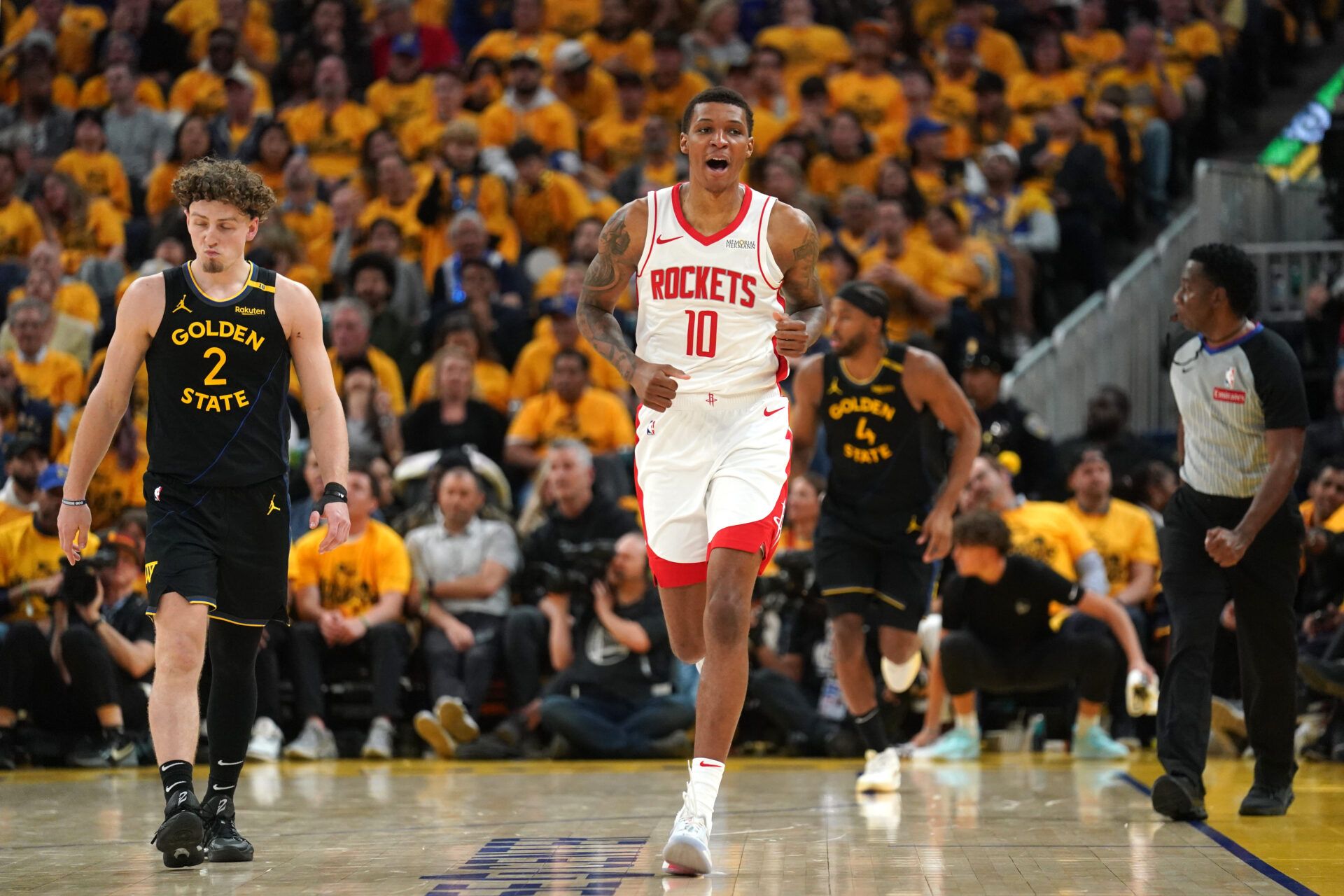
The NBA offseason is always a whirlwind, but the opening weeks have dramatically reshuffled the league’s power structure. Blockbuster trades and signings have already shifted championship odds.
Some franchises have seized the moment, while others watched key players walk out the door, missed on top targets, or doubled down on questionable strategies, leaving their futures in doubt.
With the dust beginning to settle and rosters taking shape, it’s time to break down the biggest winners and losers of NBA free agency so far, and what these moves mean for the season ahead, starting with the teams who strengthened their outlook.
Houston Rockets
Acquiring Kevin Durant, a future Hall of Famer and one of the most efficient scorers in NBA history, addressed the Houston Rockets’ most pressing need for a reliable offensive star capable of breaking down defenses and scoring under pressure.
This trade, which cost them Jalen Green, Dillon Brooks, and a first-round pick (plus multiple second-rounders), transformed the Rockets from a strong 52-win team into a legitimate title contender without sacrificing their core young talents, Amen Thompson and Alperen Sengun.
Beyond Durant, Houston’s free agency moves further solidified their roster. The signing of Dorian Finney-Smith to a four-year, $53 million contract was a key addition. His ability to fit seamlessly into head coach Ime Udoka’s defensive schemes as a true three-and-D wing player adds crucial depth and stability on the perimeter.
The Rockets also secured Clint Capela, who provides valuable insurance at center alongside Sengun and Steven Adams. Capela’s presence offers a vertical lob threat and enables flexible double-big lineups, enhancing Houston’s frontcourt versatility.
Additionally, re-signing veteran point guard Fred VanVleet to a more manageable two-year, $50 million extension was instrumental in maintaining leadership and stability at the point guard position.
Houston also extended Jabari Smith Jr. on a reasonable deal and re-signed role players Jae’Sean Tate, Aaron Holiday, and Jeff Green, rounding out a deep and versatile roster. While the Rockets face some risks, their offseason strategy has yielded a roster capable of competing at the highest level in the Western Conference.
Atlanta Hawks
The Atlanta Hawks quickly established themselves as one of the biggest winners of NBA free agency, thanks to a series of bold, creative moves under new general manager Onsi Saleh. The front office made a statement by acquiring Kristaps Porziņģis, who directly addresses the team’s need for a floor-spacing big who can defend alongside Trae Young.
.@TimBontemps says the Hawks are better than the Celtics and Bucks after yesterday’s free agent moves 👀 pic.twitter.com/Cu1G8gOQG3
— Get Up (@GetUpESPN) July 1, 2025
The Hawks also signed Nickeil Alexander-Walker to a four-year contract, adding a versatile defender to pair with Dyson Daniels. Atlanta further bolstered its shooting by signing Luke Kennard, who holds a career mark of 43.8% from deep, per Basketball Reference. These additions give the Hawks improved perimeter defense and elite shooting to help Young with spacing.
Perhaps the most shrewd move came on draft night, when Atlanta traded back from the 13th to the 23rd pick and secured an unprotected 2026 first-round pick from New Orleans. With the uncertain futures of both the Pelicans and Bucks, this pick could become a highly valuable lottery asset.
Despite losing Clint Capela, Caris LeVert, and Larry Nance Jr. in free agency, the Hawks have constructed a rotation surrounding Young with defensive stoppers, athletic wings, and two-way versatility. Jalen Johnson, Zaccharie Risacher, and Onyeka Okongwu provide further upside and versatility.
With these moves, the Hawks have seemingly climbed the ranks in the Eastern Conference.
Denver Nuggets
After pushing the eventual champion Oklahoma City Thunder to seven games in the playoffs, the Denver Nuggets identified the need for more consistent shooting, better defense, and improved bench depth to support Nikola Jokić and Jamal Murray.
The team’s most significant move was trading Michael Porter Jr. and a future first-round pick to Brooklyn for Cameron Johnson. Johnson, who averaged 18.8 points, 4.3 rebounds, and 3.4 assists while shooting 39.0% from deep last season, brings similar offensive production to Porter Jr. but with greater consistency and defensive reliability.
Johnson’s steadier shooting and high-IQ play make him an ideal fit in Denver’s system. His contract is significantly more team-friendly, freeing up financial flexibility for the Nuggets. Denver also re-signed Bruce Brown Jr., a proven contributor during their 2023 title run, on a team-friendly deal. Brown’s versatility and defensive prowess are an upgrade over an aging Russell Westbrook.
The Nuggets further bolstered their rotation, adding Tim Hardaway Jr. His shooting will help space the floor for Jokić and Murray, making Denver’s offense even more potent.
The acquisition of Jonas Valanciunas from Sacramento is another key upgrade. He gives Denver a capable backup, ensuring the team can maintain a high level of play when Jokić rests. The Nuggets now boast a deeper, more balanced roster that can comfortably go nine or ten players deep, positioning themselves as serious contenders for another championship run.
New York Knicks
The New York Knicks are coming off their deepest playoff run in 25 years. Last season, they reached the Eastern Conference Finals for the first time since 2000, but their lack of depth forced their core players into heavy minutes, exposing the need for a stronger supporting cast.
Hard-capped at the second apron with little flexibility, New York made the most of its situation by adding Jordan Clarkson and Guerschon Yabusele.
Clarkson, who averaged 16.2 points, 3.7 assists, and 3.2 rebounds last season, instantly boosts the Knicks’ bench scoring and playmaking. Yabusele is a versatile forward who has developed into a reliable contributor after playing overseas. He brings size, energy, and shooting to the frontcourt rotation.
These additions come alongside the hiring of new head coach Mike Brown, who takes over for Tom Thibodeau. Brown’s arrival should bring a fresh perspective and a more balanced approach. With Jalen Brunson and Karl-Anthony Towns anchoring the core, the Knicks have improved depth to better manage the grind of an 82-game season and another deep playoff run.
New York has maximized its assets and improved its chances in an Eastern Conference that remains wide open.
Orlando Magic
The Desmond Bane blockbuster trade instantly elevated the Orlando Magic into the conversation as a top-four team in the Eastern Conference. The move cost them a lot, sending Cole Anthony, Kentavious Caldwell-Pope, four unprotected first-round picks, and a pick swap to the Memphis Grizzlies in exchange for Bane. However, Bane is a dynamic guard who addresses Orlando’s need for perimeter shooting and shot creation.
Bane is one of the league’s most consistent and efficient perimeter threats. His ability to create his own shot and stretch defenses perfectly complements the Magic’s core of Paolo Banchero, Franz Wagner, and Jalen Suggs, which already anchors one of the NBA’s elite defenses.
Orlando further strengthened its backcourt by signing Tyus Jones to a one-year, $7 million contract. Jones, who previously played alongside Bane in Memphis, brings steady playmaking, elite ball security, and reliable three-point shooting (41.4% 3PT last season) as a backup point guard. His presence will help organize the offense, reduce turnovers, and make life easier for the stars.
The front office has made it clear the franchise is shifting to a win-now approach, and these moves reflect that vision. By adding Bane and Jones without sacrificing their young core, the Magic have transformed from a promising up-and-comer to a legitimate contender in the East, with the depth and offensive firepower to make a deep playoff run.
NBA Free Agency Losers
Milwaukee Bucks
Damian Lillard suffered a season-ending Achilles injury, and the Milwaukee Bucks waived him this offseason. The move results in $22.5 million in dead money on their books for each of the next five seasons. This financial burden severely limits Milwaukee’s flexibility to improve the roster.
According to ESPN’s Sham Charania, the Bucks did manage to sign Myles Turner to a four-year, $107 million deal to replace the aging Brook Lopez. Turner is a younger and more athletic rim protector, but his addition alone does not solve Milwaukee’s key issues. The team still lacks another guard or wing who can reliably create shots.
Even with Giannis Antetokounmpo under contract through at least 2027, his future in Milwaukee is now uncertain for the first time in his career. He appears to be weighing his options, and the situation is likely fluid. The Bucks have no control over their own first-round picks until 2031, have limited young talent on the roster, and are now stuck with significant dead cap space.
While Milwaukee’s front office deserves credit for being bold, a roster not built to contend for a title surely won’t make Antetokounmpo happy.
Los Angeles Lakers
Despite having Luka Dončić and LeBron James, the Los Angeles Lakers were eliminated in the first round of the playoffs, exposing major flaws in rebounding, defense, and overall roster balance.
The Lakers’ most notable move this offseason was signing Deandre Ayton to a two-year, $16.6 million deal after missing out on other center targets. Ayton, a former No. 1 pick, has posted solid box score stats but hasn’t quite lived up to the hype. He also doesn’t fit the ideal mold as a lob threat for Dončić or as a defensive anchor.
Ayton’s addition is more a stopgap than a solution, especially after the failed trade for Mark Williams left the Lakers scrambling at the position. Beyond Ayton, the Lakers signed Jake LaRavia, but made no significant trades or signings to address their lack of shooting, perimeter defense, or playmaking depth.
The uncertainty around LeBron James’ future further clouds the offseason. James picked up his $52.6 million player option but did not engage in contract extension talks with the Lakers. That move fueled speculation about a possible trade or departure if the team does not improve.
Instead of moving closer to championship contention, the Lakers appear in limbo, with their two generational stars facing an uncertain future together.
Indiana Pacers
The Indiana Pacers suffered a devastating blow with Tyrese Haliburton’s Achilles tear in Game 7 of the NBA Finals. He was the catalyst for Indiana’s run to the Finals, but he will miss at least most of the 2025-26 season as he recovers from surgery.
#Pacers president of basketball operations Kevin Pritchard on Myles Turner signing with the Bucks:
“Herb Simon and Steven Rales and the Simon family were fully prepared to go deep into the tax to keep him, and we really wanted to do that.” pic.twitter.com/Et8zTQUcHN
— WISH-TV News (@WISHNews8) July 7, 2025
Haliburton’s absence removes the Pacers’ engine for their high-powered offense and leaves a massive void in playmaking and leadership. Compounding this setback, the Pacers failed to retain Myles Turner, their starting center and a key defensive anchor.
After reportedly offering Turner a significantly lesser contract than the deal he received from Milwaukee, Indiana lost him for nothing in free agency. His departure leaves the Pacers without a reliable interior presence on either end.
Instead of leveraging their Finals momentum to keep the core together, Pacers ownership opted to avoid the luxury tax in what now looks like a lost season. The team has yet to make significant moves to replace Turner or offset Haliburton’s absence, signaling a likely step back after their surprise Finals run.
With their All-Star point guard sidelined for the year and no meaningful additions to the roster, Indiana’s bright future has become much cloudier.
Golden State Warriors
The Golden State Warriors finished last season 48-34 and lost in the Western Conference semifinals. Now, they’re poised to return nearly the same roster without making any clear upgrades to their needs. Unsurprisingly, this has been a quiet offseason for Golden State, as the front office made its big swing before last year’s trade deadline, when it acquired Jimmy Butler III.
The unresolved situation with Jonathan Kuminga, a restricted free agent, casts a shadow. Kuminga has not secured a new deal or been moved in a sign-and-trade, leaving his future and the team’s flexibility in limbo.
The Warriors’ center position is weaker after Kevon Looney departed for New Orleans, and the front office has not yet filled that void, missing out on top veteran targets.
Financially, the Warriors are handicapped by massive commitments to Stephen Curry, Draymond Green, and Butler. Their contracts limit the team’s ability to pursue meaningful upgrades.
The only notable additions so far are second-round draft picks Alex Toohey and Will Richard, neither of whom is expected to make an immediate impact. The Warriors seemingly risk running back an aging group while their Western Conference rivals get stronger.
Sacramento Kings
The Sacramento Kings’ decision to sign 31-year-old Dennis Schröder to a three-year, $45 million contract was quite puzzling. Schröder, who played for three teams last season, is no longer a starting-caliber point guard and has struggled with efficiency. Naturally, there are concerns about his fit as Sacramento’s primary ballhandler.
The Kings, who finished 40-42 and missed the playoffs, have replaced De’Aaron Fox with a journeyman whose best years are behind him. The front office’s inability to build a sustainable core is concerning. The roster, already thin at point guard, now relies on Schröder or hopes for a leap from unproven young players like Devin Carter.
Sacramento’s offseason is further marred by the trade of Jonas Valanciunas, which leaves the team with Dario Saric as its backup center. This move could also negatively impact the team’s defensive efforts.
With no significant upgrades elsewhere, Kings fans are left wondering how the team went from a promising young backcourt of Fox and Tyrese Haliburton to its current state. This offseason offers little hope for meaningful improvement in a competitive Western Conference.